
Lieferung heute & morgen

Qualitätsgarantie

Willkommens-Angebote freischalten: KOSTENLOSE Lieferung | Bis zu 80 % RABATT | Kostenlose 30-Tage-JoyPlus-Testphase
App herunterladen
Bean-to-cup coffee machines and espresso machines need more than the occasional rinsing of the drip tray. Coffee oils, milk residue and limescale build up in different areas. Confusing cleaning with descaling, or using an unsuitable product, can lead to unnecessary costs and avoidable maintenance work.
This shopping guide from the Joybuy Product Recommendation Officer explains the differences between cleaning tablets, descaling tablets, liquid descalers and milk-system cleaners in a clear, practical way.
A coffee-oil remover mainly dissolves fats and coffee residue in the brewing system. A descaler, on the other hand, is designed for mineral deposits in the water circuit. One product therefore does not automatically replace the other.
When caring for a bean-to-cup coffee machine, three separate processes are usually relevant:
Many products are described as universal. However, your machine’s instruction manual remains the deciding factor. Some machines require specific tablet sizes, liquid quantities or a dedicated cleaning mode.
For machines from Siemens, De’Longhi, Gaggia, Saeco, Jura, Melitta, Nivona or Sage, check the following first:
An eco-friendly coffee machine descaler can be a sensible option, but terms such as “plant-based”, “biodegradable” or “chlorine-free” alone say nothing about whether the product is suitable for your machine. Even a natural acid ingredient can irritate the skin and eyes.
You should therefore check:
| Care task | Suitable product type | Typical use | |---|---|---| | Coffee oils and brewing residue | Cleaning tablets for bean-to-cup machines or coffee-oil remover | Machine cleaning programme | | Limescale in the water circuit | Coffee machine descaling tablets or liquid descaler | Descaling programme | | Milk fats and proteins | Milk-system cleaner | Milk-system programme | | Limescale prevention | Water filter or anti-limescale system | Water tank, depending on the machine |
The term “cleaning tablet” should therefore not automatically be interpreted as meaning descaler. A multipack may contain both types of product, but the tablets are normally not interchangeable.
Original care products for bean-to-cup coffee machines are often matched to the programmes of a particular machine series. One example is the Siemens EQ cleaning tablets TZ80001A. According to the product details, they are intended for EQ300, EQ500, EQ6 plus, EQ700, EQ9 plus, EQ900, EQ900 plus and Siemens built-in bean-to-cup machines.
Other brands have their own requirements. A Gaggia liquid solution, Sage powder or Jura milk-system cleaner should only be used in accordance with the relevant instructions. If a product’s compatibility is not clearly stated, consulting the model manual is more important than relying on a general marketing claim.
A larger pack is not automatically better value. What matters is how often your machine needs servicing and how many applications the pack actually provides.
Examples from the selection:
Also check whether the dosage is pre-portioned. Pre-filled bottles can make application easier, while larger containers may mean less packaging per application for frequently used office machines.
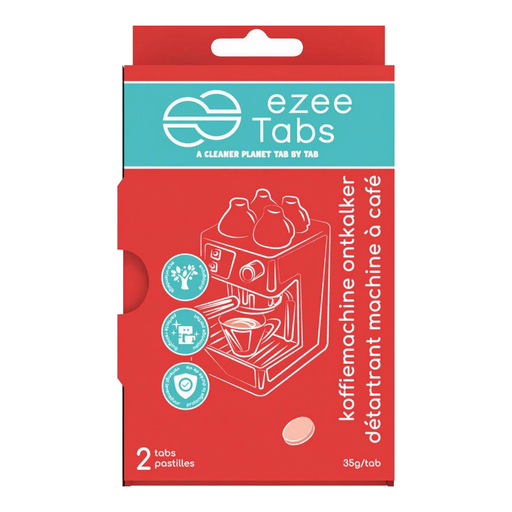
Why this product suits this profile: The pack contains two soluble tablets weighing 35 g each. It is suitable for users who prefer a compact format and want to determine their machine’s descaling requirements themselves based on water hardness and usage.
The dosage is clearly defined as one tablet. Nevertheless, check whether your machine requires tablet or liquid descaler before use.
Vegan according to the product details, free from microplastics and biodegradable according to the manufacturer’s description.
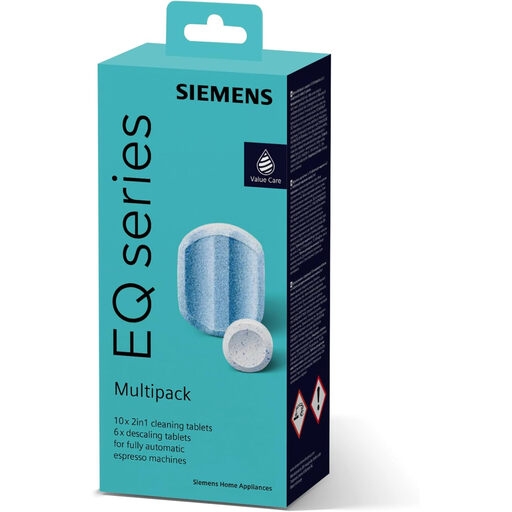
Why this product suits this profile: Owners of compatible Siemens EQ or built-in bean-to-cup machines get cleaning and descaling in one pack, without having to combine two different product ranges.
The two care tasks are clearly distinguished by separate types of tablet. Compatibility with the specific EQ model must still be checked.
Contains 10 cleaning tablets and 6 descaling tablets; fragrance-free according to the product details.
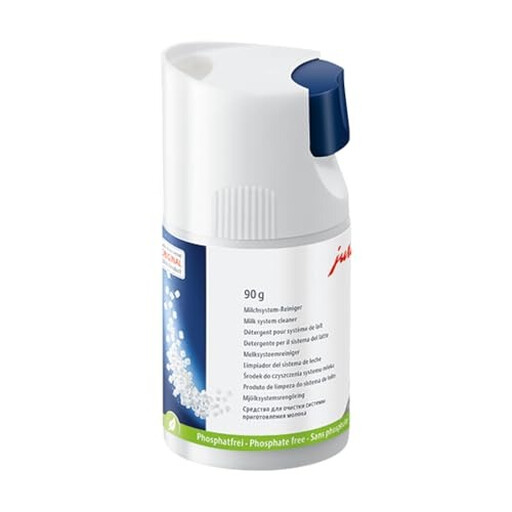
Why this product suits this profile: Users who enjoy milk-based drinks and office machines benefit from a product designed specifically for the milk circuit and supplied with a dosing system.
It is not used as a general descaler, but specifically for milk systems. This keeps its use clearly separate from limescale care.
90 g contents, dosing bottle and approximately 30 cleaning cycles according to the product description; phosphate-free formula according to the supplier’s details.
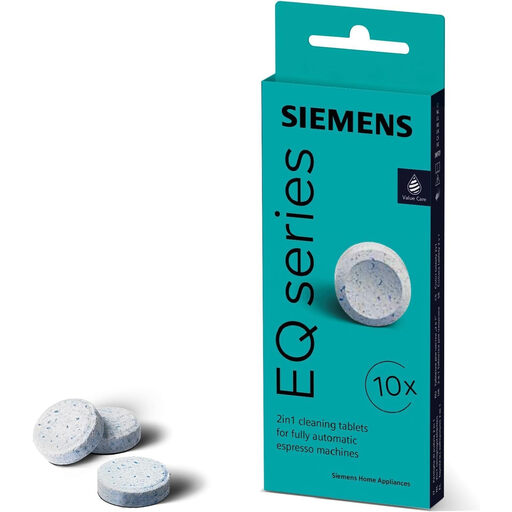
Why this product suits this profile: For owners of a compatible Siemens EQ machine who prefer an original accessory for the automatic cleaning cycle.
The stated EQ compatibility reduces the risk of choosing an unsuitable product. These are cleaning tablets, not a standalone descaling product.
10 tablets, fragrance-free and chlorine-free according to the product details; for specified Siemens EQ models and built-in machines.
We have put together a complete, regularly updated list of products that fully meet these strict selection criteria and the safety regulations applicable in the EU.
Before using a care product, switch off the machine unless the instructions state otherwise, and allow the relevant programmes to run to completion. Cleaning or descaling should not be interrupted. Once the process is complete, rinse the water tank, drip tray and any components specified by the manufacturer thoroughly with clean water.
Also bear the following in mind:
This depends on water hardness, usage levels and the machine model. Many machines indicate automatically when descaling is required. If there is no indicator, follow the recommendation in the instruction manual and take account of any water filter and the local water hardness. Frequent use or hard water may mean that descaling is needed more often.
Generally, no. Cleaning tablets mainly dissolve coffee oils and organic residue, while descalers are used to remove limescale deposits. Only use a product whose purpose and dosage are explicitly suitable for your machine.
In addition to regular brewing-unit and coffee-oil cleaning, the milk system needs its own care routine. Dose a suitable milk-system cleaner according to the designated programme. Hoses, milk containers and outlets should also be dismantled regularly and cleaned with water, provided the instructions allow this.