
Lieferung heute & morgen

Qualitätsgarantie

Willkommens-Angebote freischalten: KOSTENLOSE Lieferung | Bis zu 80 % RABATT | Kostenlose 30-Tage-JoyPlus-Testphase
App herunterladen
Bean-to-cup coffee machines, portafilter machines, capsule machines and pod machines all require different types of care. If you choose coffee machine descalers and cleaning tablets based solely on price or pack size, you risk making the wrong purchase: a descaler dissolves limescale, but does not automatically remove coffee oils. Cleaning tablets for bean-to-cup machines generally perform the other task.
Your choice should therefore suit your appliance, its cleaning programme and the water hardness in your area. Our recommendation as Joybuy Product Recommendation Officer: before buying, first check the operating instructions and the exact model designation, then compare the active ingredient, dosage and application format.
Limescale is caused by minerals in the water and builds up mainly in the water circuit and on heating elements. Coffee oils and coffee residue, on the other hand, collect in the brewing unit, pipes, filter or spout. A coffee oil remover or cleaning tablet is designed for this purpose.
A product described solely as a coffee machine descaler therefore cannot replace a cleaning tablet. Conversely, a coffee oil remover does not reliably remove limescale. Multipacks such as the Siemens TZ80003A can cover both care steps, but the individual tablets are still intended for different programmes.
Liquid descalers for espresso machines are often marketed as suitable for multiple brands. This can be practical, but the decisive factors are the dosage and approval for the specific appliance. Some bean-to-cup machines require a particular tablet format, a defined amount of active ingredient or a dedicated integrated cleaning programme.
For Siemens, De’Longhi, Philips, Jura, Gaggia, Nivona, Saeco and Sage appliances, the model instructions should therefore take precedence over general advertising claims. Original products such as Siemens TZ80001A or Jura descaling tablets are designed for specific appliance series. Compatible alternatives may be a sensible choice if the dosage and application method match.
A large bottle or multipack reveals little about the actual cost per application. Compare:
A 100-ml bottle may be portioned for one complete cycle, while a 500-ml container may provide several applications. The manufacturer’s dosage remains the key factor.
The product description should explicitly name your appliance series or provide a clear indication of general suitability. According to the product description, Siemens TZ80001A is intended for Siemens EQ bean-to-cup machines and built-in appliances. Siemens TZ80003A combines ten cleaning tablets with six descaling tablets and is also designed for various EQ series.
For a portafilter or capsule machine, however, you should check whether the product is suitable for manual or semi-automatic systems. For example, Gaggia appliances have a liquid Gaggia descaler based on citric acid. Philips CA6700 and Philips CA6700/22 are described as liquid descalers for Philips espresso machines.
Tablets are compact, pre-portioned and convenient for automatic programmes. Depending on the instructions, liquid descalers can be dosed flexibly, but they require careful measuring. Powdered products such as the Sage descaler for Sage coffee machines and kettles must be dissolved completely.
Look for details such as citric- or lactic-acid-based active ingredient, phosphate-free, chlorine-free or biodegradable. These properties describe the formulation, but do not generally prove that a product will deliver better appliance performance. For sensitive surfaces and seals, approval from the machine manufacturer is what matters.
Descalers and cleaning tablets are household chemicals and are not intended for consumption. Before use, read the label, keep the product away from children and pets, and follow the recommended protective equipment instructions. Depending on the formulation, skin or eye irritation may occur.
The following points are also important:
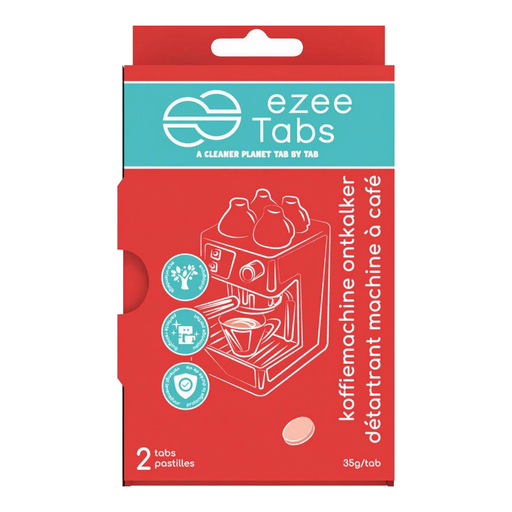
Why this product suits this profile: Two soluble 35-g tablets provide a manageable supply and are intended for bean-to-cup and espresso machines.
The pack states the dosage per tablet. The instructions specify either adding the tablet directly or dissolving it in 500 ml of water; the machine instructions remain the decisive guide.
Tablet format, 2 x 35 g and, according to the product details, vegan, microplastic-free and biodegradable.
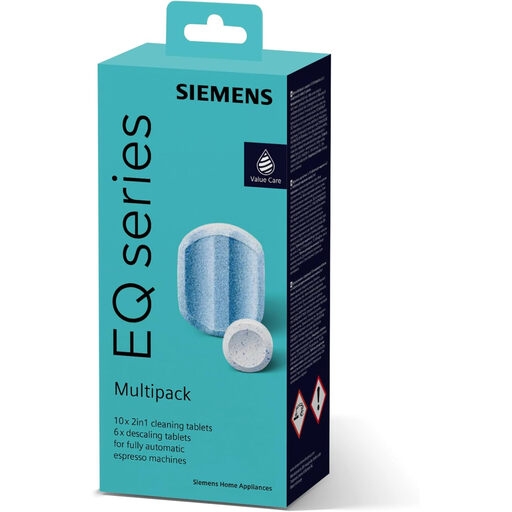
Why this product suits this profile: For owners of compatible Siemens EQ bean-to-cup machines who want to buy cleaning and descaling products separately, but in one multipack.
The ten cleaning tablets and six descaling tablets are clearly separated and intended for automatic programmes on the specified EQ series.
Original accessories, 16 individual pieces and, according to the product details, a fragrance-free formulation.
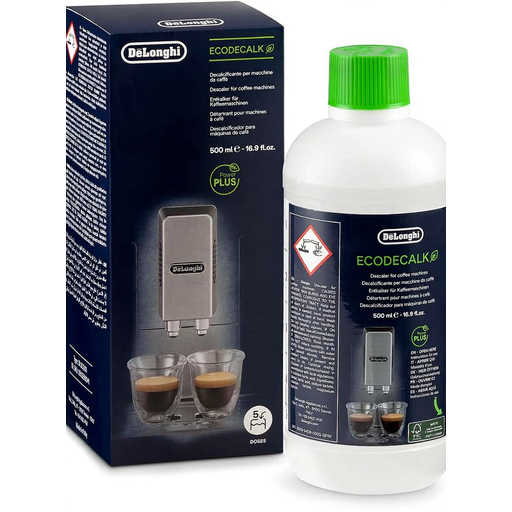
Why this product suits this profile: The 500-ml container is aimed at households that descale regularly and, according to the instructions, can be measured out in 100-ml portions.
The dosage marking reduces the risk of using too much or too little liquid descaler over several applications.
500 ml capacity, 100-ml portions and, according to the product description, a plant-based acid formulation.
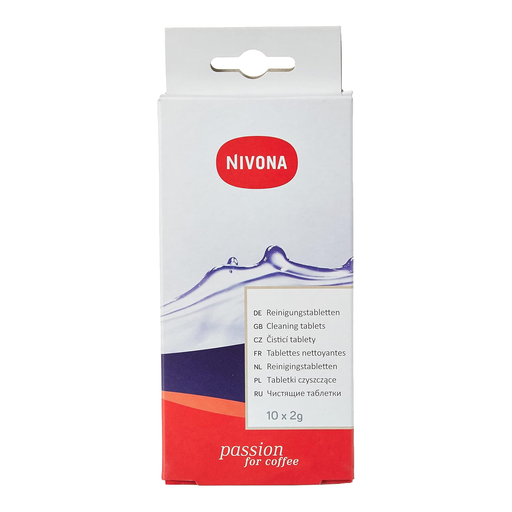
Why this product suits this profile: The tablet is specifically described for Nivona bean-to-cup machines and is suitable for users looking for a brand-specific cleaning product.
Its focus on Nivona appliances makes compatibility easier to check. The cleaning tablet is not described as a descaler and should not be used for that purpose.
Tablet format, designed for coffee and oil residue, and, according to the product details, free from silicone and GMOs.
The exact frequency depends on water hardness, the number of coffees made and the appliance model. In areas with hard water, more frequent descaling may be necessary. Many bean-to-cup machines display care requirements automatically. This notification should not be ignored, but neither should it be replaced with unnecessary additional cycles.
For everyday use:
Products available for coffee oil residue include Saeco CA6704/99, De’Longhi La Specialista DLSC552 and the cleaning tablets for bean-to-cup machines mentioned above. For limescale care alone, options include Philips CA6700, Gaggia descaler, Jura descaling tablets and the Sage descaler.
We have put together a complete, regularly updated list of products that fully meet these strict selection criteria and the safety regulations applicable in the EU.
This depends on water hardness, usage and the manufacturer’s specifications. Wherever possible, follow the care interval shown on the display or stated in the operating instructions. A water filter can reduce limescale deposits, but does not automatically replace the descaling programme.
No. The two products have different purposes and are normally used in separate programmes. Use only the product requested by the appliance and never mix cleaning chemicals.
This can only be assessed per application. Divide the purchase price by the number of complete descaling cycles specified by the manufacturer. Liquid descalers often come in larger containers, while tablets can provide a fixed individual portion.