Collectors who enter lots of numbers
If you often enter years, catalogue numbers or purchase dates, a number pad can make things easier. OpenNumismat includes fields for recording coin details.


If you regularly enter years, prices or catalogue numbers, a number pad is an obvious choice. Programmable keys can also help with repetitive tasks, provided your catalogue software supports the shortcuts. You set up custom catalogue fields in the software – a keyboard can’t create them. If you enter numbers less often and need room for coins, notes or photos, a compact keyboard could be a better fit for your workspace. Before buying, check that it has a German layout and that the key functions you want work with your computer and catalogue software.
If you often enter years, catalogue numbers or purchase dates, a number pad can make things easier. OpenNumismat includes fields for recording coin details.
If you often switch between catalogue views or data-entry steps, check whether you can assign recurring commands to keys. Logitech says its MX Keys S Smart Actions use Logi Options+ software.
If you want to leave room for coins, labels or photos beside your computer and enter fewer numbers, a keyboard without a number pad could work well. CHERRY describes the STREAM KEYBOARD TKL as a shorter version without a number pad.
A good fit if: you enter number sequences frequently and have plenty of desk space.
Consider: The integrated number pad takes up space; custom commands may require additional software.
A good fit if: you rarely enter long number sequences and want to keep space free for your collection.
Consider: If you enter numbers frequently, you’ll need to use the number row or add a separate number pad.
A good fit if: you’d like to try a different key layout while keeping a number pad.
Consider: A split layout may take some getting used to and require extra desk space.
A good fit if: you want to keep your current keyboard and position an additional number pad wherever you like.
Consider: The number pad is an addition to your keyboard. According to Keychron, the barebone version of the Keychron Q0 Max doesn’t include switches or keycaps.
| Priority | What to check when buying | Who is this important to? |
|---|---|---|
| Entering numbers | Check whether the specific German-layout version has an integrated number pad and whether its position suits your workspace. | If I often enter years, prices or catalogue numbers, a dedicated number pad matters to me. Around 36% of consumers prioritise frequent number entry. |
| Recurring commands | Test the task you want to perform in your catalogue software, and check the operating system, any configuration software required and the features of the specific keyboard. | If I repeatedly carry out the same data-entry steps, I want to be able to use suitable key commands. Around 28% of consumers prioritise repeatable commands. |
| Desk space | Measure the space available for your keyboard, mouse and collection items; then decide whether you’re happy to do without a number pad. | If I want to leave room for coins, notes or photos beside my keyboard and mouse, width is important. Around 18% of consumers prioritise free workspace. |
| Hand position | Check the key layout, footprint and connection on the specific model. An ergonomic product description can’t predict how the keyboard will feel to you. | If I’m planning longer cataloguing sessions, I want to find a key layout that suits me without jumping to conclusions about its health benefits. Around 18% of consumers prioritise hand position. |
Fields are set up in your catalogue software. A macro key can’t add field functions that the software doesn’t have.
First check the field and shortcut functions in your catalogue application, then look at the keyboard’s configuration options.
Unlike the larger STREAM model, the CHERRY STREAM KEYBOARD TKL doesn’t have a number pad.
Weigh up how often you enter numbers against the space you have available. A separate number pad is another option, but you’ll need to make room for it.
Perixx lists Windows as a requirement for the downloadable configuration software for the PERIBOARD-335. The manufacturer also describes how to set it up directly on the keyboard.
Before buying, check that the function you want will work with your operating system and catalogue software.
Perixx notes that the split PERIBOARD-512 B may take some getting used to. The Keychron Q0 Max is a number pad, not a replacement for a main keyboard; the barebone version doesn’t include switches or keycaps.
Check the space you have available and what’s included with the version you choose. Also consider whether you’re happy to adapt to a different key layout.
The MX Keys S offers customisable commands, while the ERGO K860 is a full-size split keyboard with a number pad.
The STREAM KEYBOARD is a wired office keyboard, while the STREAM KEYBOARD TKL is the shorter version without a number pad.
The K10 Max ISO is a configurable full-size keyboard, while the Q0 Max is a separate, configurable number pad.
The PERIBOARD-512 B is a wired split keyboard with a number pad; the PERIBOARD-335 is more compact and offers macro functions.
The following Joybuy models are suited to typing in German and a range of workspace needs. Depending on how you catalogue your coins, check whether you need a number pad or configurable keys.
 No image available
A compact keyboard for typing in German, ideal if you want to save desk space.
65% layout; German QWERTZ layout; connects via 2.4 GHz, Bluetooth or USB-C; MX Speed Low Profile switches.
 No image available
An option if you’re looking for an ISO-DE layout and a keyboard that’s compatible with VIA.
75% layout; ISO-DE layout; tri-mode connectivity; VIA-compatible; hot-swappable design.
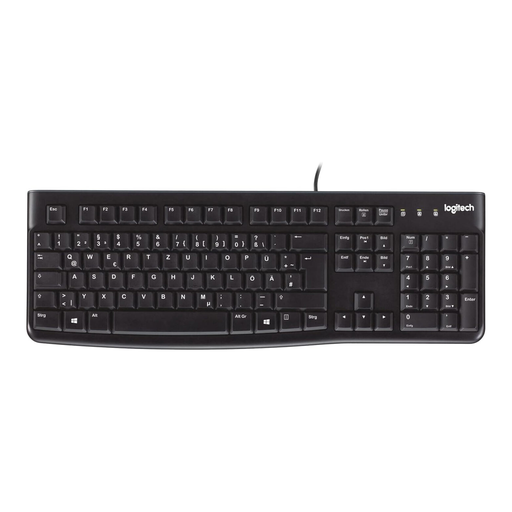 No image available
A wired keyboard for typing on a PC or laptop if you don’t need a wireless connection.
Full-size; USB plug and play; German QWERTZ layout; listed as compatible with Windows in the product name.
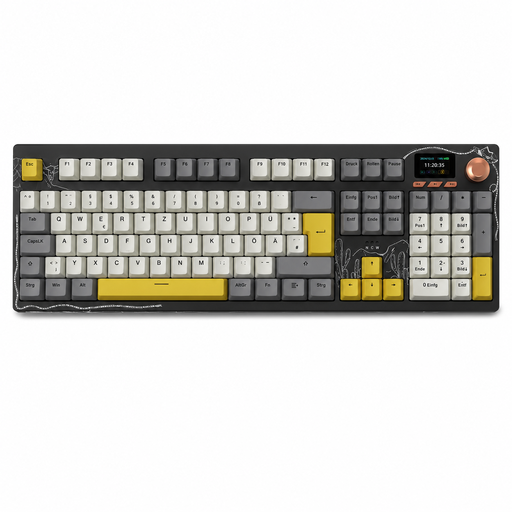 No image available
A mechanical keyboard for typing in German, with a choice of wireless or USB-C connections.
German QWERTZ layout; tri-mode connectivity via Bluetooth, 2.4 GHz or USB-C.
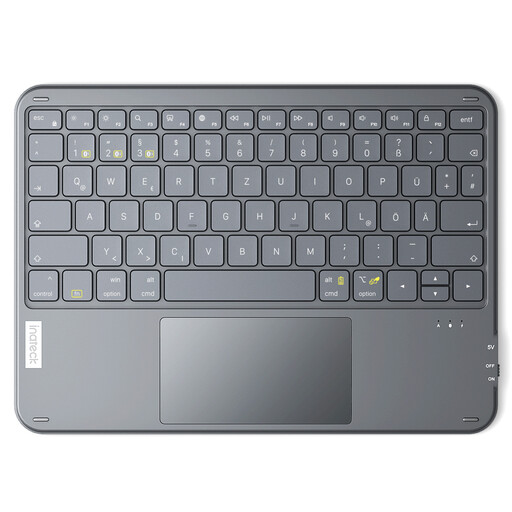 No image available
A slim keyboard with an integrated touchpad, ideal if you want to use a compatible tablet or computer with a combined input solution.
German QWERTZ layout; Bluetooth; integrated touchpad; listed as compatible with iPad, Android tablets, Windows laptops and PCs in the product name.
No. You set up fields in your catalogue software, not through the keyboard. OpenNumismat describes selectable fields and configurable lists; key assignments can only support relevant tasks. Check the features of the software you actually use.
Test a task you repeat and its shortcuts directly in your catalogue software. Logitech says the MX Keys S Smart Actions use Logi Options+; Perixx states that the downloadable software for the PERIBOARD-335 is only available for Windows, and also describes setting it up directly on the keyboard.