What should you look for when buying?
Camera or smartphone you already own
Suitable if: You want to record the condition or progress of your work and aren’t planning a high-quality reproduction.
The trade-off: Even for simple documentation, the camera position and lighting need to suit the collage.
Interchangeable-lens camera with a suitable lens
Suitable if: Straight edges, consistent colours and enough detail for a high-quality file or print are important to you.
The trade-off: As well as the camera body, you’ll need a suitable lens, a stable set-up and possibly additional lighting.
The Association of Artists’ Estates and Museums in Brandenburg highlight the intended use, lens, camera position and lighting as separate points to consider.
| What matters |
What to check before buying |
Who is this important to? |
| Consistent colours |
Check RAW support for the specific model; factor in a colour chart and your planned artificial light sources when setting up the shot. |
If I need to compare colours under artificial light, I factor in the lighting and a colour chart. Around 36% of consumers put consistent colours first for this task. |
| Reflections, shadows and edges |
Position the camera parallel to the collage; check the lighting set-up and distortion of the specific lens. |
With shiny or raised elements, I want to assess reflections and shadows using the actual set-up. Around 29% of consumers prioritise controlling reflections and shadows. |
| Detail for the intended use |
Consider your planned print or viewing size alongside the resolution, framing and lens. |
If the shot is for a catalogue or a larger print, I check the level of detail and framing together. Around 21% of consumers put detail for the intended use first. |
| A simple process |
Check whether you’re buying a camera body or a lens kit; make sure your existing lighting, tripod and lens mount work with the planned set-up. |
For occasional condition shots, I want to keep setting up to a minimum and check whether my existing equipment will do. Around 14% of consumers prioritise a simple process. |
Camera brands to consider
These examples refer to the product lines mentioned and don’t replace checking the specific lens or photography set-up.
Canon
The EOS R50 is an APS-C camera body with an RF mount for RF and RF-S lenses.
- Canon lists 24.2 effective megapixels.
- Canon says the camera body has no sensor-shift stabilisation and is not compatible with EF-M lenses. The lens and lighting also affect how the collage looks in the image.
Nikon
The Z50II kit with a Z DX 16–50 mm standard zoom is a set designed for a range of framing options.
- Nikon specifies that this kit has lens stabilisation.
- The kit specifications don’t prove that the lens will provide low distortion or accurate colour reproduction for every collage.
Fujifilm
The X-S20 is an X-mount camera body with RAW support and in-body stabilisation.
- Fujifilm lists 26.1 effective megapixels and a five-axis sensor stabiliser.
- According to Fujifilm, the stated stabilisation performance applies under specific CIPA test conditions with a particular lens. It doesn’t guarantee reproduction quality or replace a stable set-up.
Sony
The ILCE-6700 is an APS-C E-mount camera body with RAW support and a choice of lenses.
- Sony lists around 26.0 effective megapixels for photos and RAW support.
- These camera body specifications alone tell you nothing about distortion, freedom from reflections or whether a particular lens kit is suitable.
Joybuy products
The Joybuy products below include digital cameras and an APS-C mirrorless camera with a zoom lens. For reproduction photography, you’ll also need a lens, lighting and camera angle that suit your collage panel.
 No image available
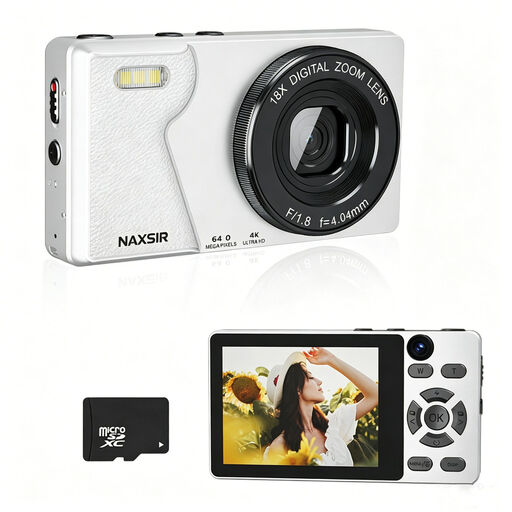
NAXSIR 4K Ultra HD digital camera, 64 MP
A digital camera may be suitable for simple documentation shots. If you’re planning to print your work, check that the framing and lens are up to the job.
Specifications include 64 MP photo resolution, 18x digital zoom, autofocus and a 32 GB memory card.
View at Joybuy
 No image available
Sony Alpha 6100 APS-C with 16–50 mm power zoom lens
The zoom lens offers different framing options. For reproduction photography, also check its distortion and the available shooting distance.
This product is described as an APS-C mirrorless camera with a 16–50 mm power zoom lens.
View at Joybuy
 No image available
KOMERY G7-A 4K digital camera, white
This digital camera may be suitable for simple documentation shots. Take a test shot to see how well it captures your collage.
The product name lists 4K, 80 MP and 18x zoom.
View at Joybuy
 No image available
KOMERY W6 4K digital camera
The stated optical zoom may be useful if you want to change the framing. Still, check whether the lens is suitable for flat artwork reproduction.
Specifications include 12x optical zoom, 4K, Wi-Fi and 64 MP.
View at Joybuy
 No image available
KOMERY G7 5K digital camera, white
A digital camera may be suitable for simple documentation shots. If you’re planning to print your work, check the framing and image quality beforehand.
The product name lists 5K, 80 MP and 18x zoom.
View at Joybuy
Frequently asked questions
How should I position the camera and lights to photograph the whole collage?
Position the camera as parallel as possible to the artwork and check the edges in the image. Museums in Brandenburg recommends two light sources placed to the sides for even reproduction. Test the set-up on your panel to see whether it creates reflections or changes the material textures you want to show.
Do I need a macro lens for small material details?
Not for every overall shot. First, consider how large the details need to appear in the finished image and how close the specific lens can focus. Museums in Brandenburg recommends having a macro function if possible, but doesn’t make it a requirement for every shot.
Who is responsible if something goes wrong after I buy online?
When you buy from a business seller in the EU, you’re generally entitled to a minimum two-year legal guarantee from the date you receive the goods. This is a claim against the seller and is separate from any additional manufacturer’s warranty. These EU rules don’t apply in the same way to private sales. This information is based on guidance from Your Europe, the European Union’s consumer portal.
Can I return a camera bought online?
For a distance contract with a business seller, you generally have 14 days from delivery to cancel. Exceptions and any conditions about return costs that were provided in advance should be taken into account. Purchases from private individuals aren’t covered by this right to cancel. The European Union explains these rules on its Your Europe consumer portal.
Can I publish photos of a collage that includes images created by others?
Taking a photograph doesn’t automatically remove the rights to other people’s works used in the collage. Under section 23 of the German Copyright Act (UrhG), permission may be needed to publish or exploit an adaptation of a protected work. Whether copyright, usage rights or an exception applies depends on the individual case. Before publishing, check the rights under the applicable rules set out by the Federal Ministry of Justice and the Federal Office of Justice.


