
Lieferung heute & morgen

Qualitätsgarantie

Willkommens-Angebote freischalten: KOSTENLOSE Lieferung | Bis zu 80 % RABATT | Kostenlose 30-Tage-JoyPlus-Testphase
App herunterladen
By Joybuy Product Recommendation Officer, July 29, 2026
A colorful gel pen set can make organizing notes, keeping a bullet journal, or studying significantly easier and more enjoyable. Yet, the search for the perfect set often ends in frustration: the ink smears, the colors aren't as vibrant as hoped, or the pens give up after a short time. Many marketing claims don't hold up to practical use. This guide will help you identify the crucial features and find a set that truly meets your needs.
Before you make a decision, you should be aware of the three most common problems that occur with low-quality gel pen sets:
To avoid these problems, focus on three objective criteria. These will help you realistically assess a gel pen's performance.
This is the most critical criterion for clean handwriting. Quick-drying pens are not only essential for left-handers but for anyone who wants to work efficiently without waiting for the ink to dry. A good gel ink should be smudge-proof on standard paper within a few seconds. Products explicitly labeled as no-smear often use special ink formulations that absorb into the paper fibers more quickly.
The tip determines the precision and writing feel. The most common line weight for detailed notes is 0.5mm, which produces a fine, clear script and is a good alternative to a 0.5mm colored fineliner set. For more creative applications or headlines, a 0.7mm weight can be advantageous.
A good gel pen set is distinguished not just by its number of colors, but by their quality. The pigment density determines the vibrancy and opacity. Look for consistent color delivery without skipping. At the same time, aesthetic pens are often also ergonomically designed. A rubberized or triangular grip can significantly increase comfort during long sessions and is an important feature for good bullet journal accessories.
Here are some recommendations tailored to specific user profiles and the quality criteria mentioned above.
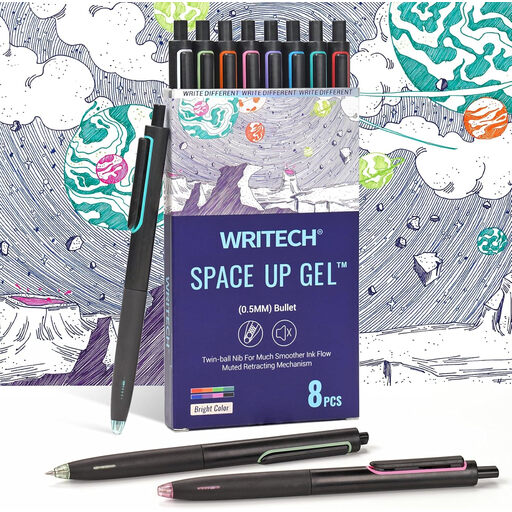
Why It's a Match: Ideal for structured notes, color-coding in a planner, or for university. The silent click mechanism is a practical advantage in quiet environments like libraries or offices. The 0.5mm tip ensures precision.
The quick-drying ink counteracts smearing, while the twin-ball tip technology ensures a consistent ink flow without skipping.
The ergonomic, triangular barrel promotes a relaxed grip during long writing sessions. The patented, silent click mechanism is a unique selling point.
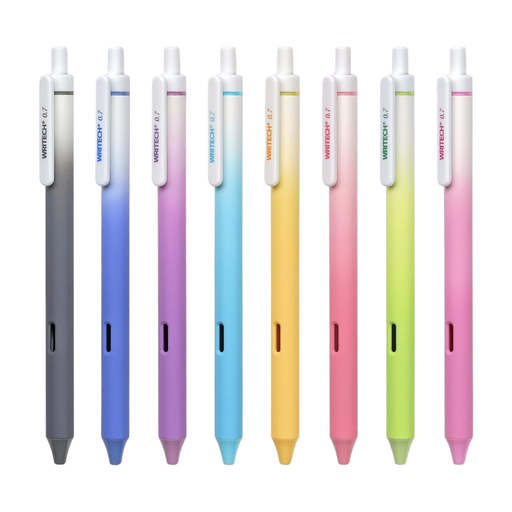
Why It's a Match: The medium 0.7mm line weight is well-suited for headlines and filling in trackers in a bullet journal. The aesthetic barrel with a matte color gradient appeals to creative users who value the design of their tools.
Despite the wider line, the quick-drying ink formula prevents smudging, a common problem with thicker-tipped pens that lay down a lot of ink.
The combination of a visually appealing design and a smooth, rich ink flow at a 0.7mm line weight offers a great balance between aesthetics and function.
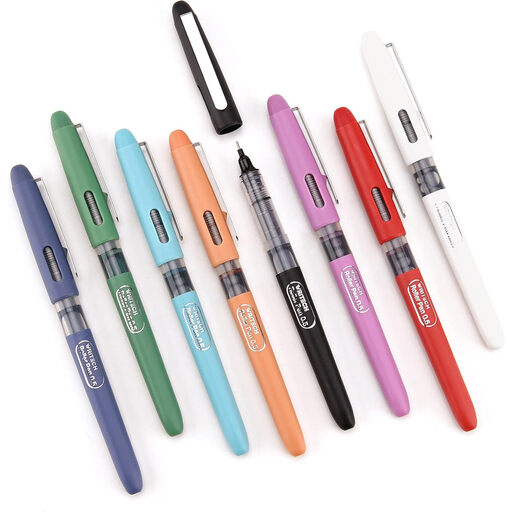
Why It's a Match: This set is designed for users for whom smudge resistance is the top priority. The product description explicitly highlights its suitability for left-handers, indicating a reliable, quick-drying ink.
The liquid ink system with a precise regulator, combined with the quick-drying formula, directly addresses the core problem of smudging for left-handers.
The combination of an extra-fine 0.5mm tip for precision and an ink that minimizes smudging is highly functional. The transparent barrel also allows you to monitor the ink level.
We have compiled a complete, up-to-date list of products that fully meet these strict selection criteria and current regulations.
Most gel pens should be stored horizontally or with the tip facing down. For pens with caps, it is crucial to always close them tightly after use. For retractable pens, the tip should always be retracted. Store the pens in a cool, dry place away from direct sunlight.
The performance of gel ink can vary depending on the paper quality. On very smooth, coated paper, drying takes longer, which increases the risk of smudging. On very thin paper (under 80 gsm), heavy ink flow can lead to bleed-through. For optimal results, standard notebook paper or special journaling paper is recommended.
The main difference lies in the ink and the tip. Gel pens use a pigmented, water-based gel ink that provides vibrant colors and a very smooth writing feel. Fineliners typically use a dye-based ink and have a hard, fiber or plastic-encased tip that allows for a very consistent, fine line and often dries faster.