
Lieferung heute & morgen

Qualitätsgarantie

Willkommens-Angebote freischalten: KOSTENLOSE Lieferung | Bis zu 80 % RABATT | Kostenlose 30-Tage-JoyPlus-Testphase
App herunterladen
A clutter-free home creates a sense of clarity and calm. Yet, the path to achieving it is often paved with poor furniture choices. A shelf that sags after just a few months, or a TV stand that looks modern but offers no practical storage—such experiences are frustrating and expensive. As your Joybuy Product Recommendation Officer, I'm here to help you navigate the common pitfalls and identify the right shelving and storage solutions for your needs.
Before you decide on a model, you should be aware of the most common problems that often only become apparent after assembly.
To avoid a bad purchase, focus on objective, measurable features. These three parameters are essential for making an informed decision.
The stability of a shelf depends directly on its material and construction.
Always check the specified maximum load capacity per shelf. For books, it should be at least 10-15 kg; for lighter decorative objects, 5 kg is sufficient.
Good storage furniture makes optimal use of the available space.
We have selected products tailored to specific needs and spatial situations, taking the above criteria into account.
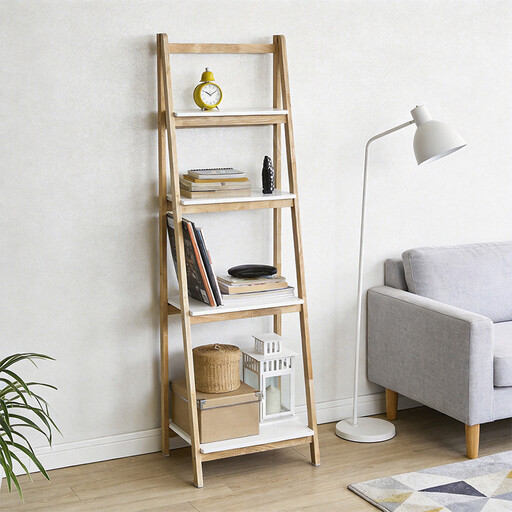
Why it's a great match: Ideal for a first apartment or for anyone seeking a flexible solution. It's quick to set up, requires no permanent installation, and can be easily folded and stored when moving or not in use.
Instead of a wobbly construction made purely of particle board, the rubberwood frame provides a solid base. The folding mechanism is designed for durability, avoiding the typical weak points of simple slot-in systems.
High Flexibility: Ready to use immediately without assembly and can be stored to save space. Solid Materials: A combination of MDF shelves and a rubberwood frame with a load capacity of up to 15 kg per shelf.
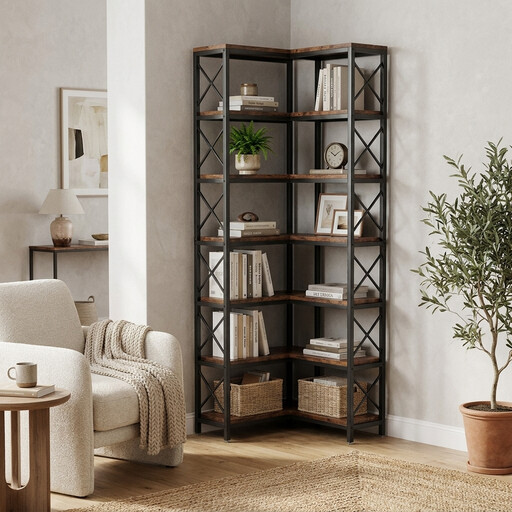
Why it's a great match: Perfect for those who appreciate the urban industrial style and want to transform an unused corner in their living room or home office into a functional design statement. It combines aesthetics with maximum space utilization.
This shelf uses the corner as a structural element, which increases stability. The robust metal frame with X-bracing prevents side-to-side swaying—a common problem with tall, freestanding shelves.
Optimal Space Utilization: The 90-degree design fits perfectly into corners. High Stability: Adjustable feet for uneven floors and a load capacity of up to 20 kg per shelf provide secure support for books and heavy objects.
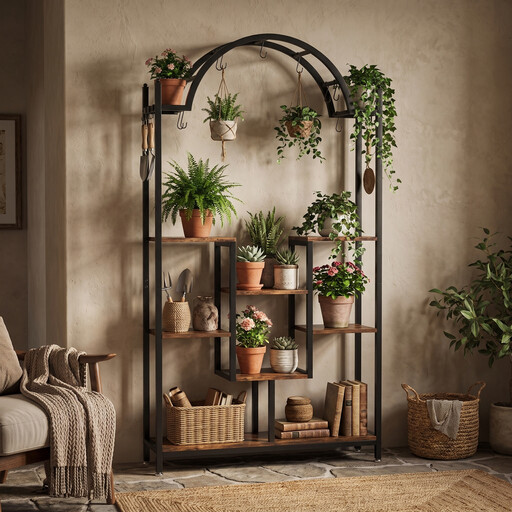
Why it's a great match: For plant lovers who want to display their collection in style while ensuring every plant gets enough light. The design is not only decorative but also extremely functional for plant care.
Unlike simple, flat shelves where plants can shade each other, the tiered arch design ensures optimal light distribution. The high total load capacity of over 100 kg prevents the shelves from sagging under the weight of wet soil.
Large Capacity: Provides space for at least 8 potted plants and additional hanging plants. Sturdy Construction: The metal frame and high-quality E1-grade particle boards ensure high load-bearing capacity and durability.
We have compiled a complete, up-to-date list of products that fully meet these strict selection criteria and UK safety regulations.
1. Do I need to secure tall shelves to the wall? Yes, it is strongly recommended. Tall and narrow standing shelves or bookshelves, in particular, should always be anchored to the wall with an anti-tip kit for safety. This is especially important in households with children or pets. Most manufacturers include the necessary mounting hardware.
2. How much weight can an average bookshelf hold? This varies greatly depending on the material and construction. There is no one-size-fits-all answer. Therefore, always check the manufacturer's specification for the load capacity per shelf. As a rule of thumb: simple particle board shelves often hold 5-10 kg per shelf, while models made of MDF, solid wood, or with a metal frame can support 15 kg, 20 kg, or more.
3. What is the difference between MDF and particle board?MDF (Medium-Density Fibreboard) is made from very finely shredded wood fibres that are glued together under high pressure. This makes it denser, more uniform, and more resistant to bending than particle board. Particle boards are made from coarser wood chips. They are lighter and less expensive, but also less stable and more prone to swelling when exposed to moisture. For durable and heavily used furniture, MDF is often the better choice.