Photographers in narrow courtyards
If you can’t step back far enough to capture the whole façade, compare the camera’s angle of view with the space available at your shooting position.


When photographing façades in a narrow Berlin courtyard, the angle of view you can actually achieve from an authorised position is usually more important than having a long telephoto range. In changing daylight, also consider how much control you have over exposure and whether the files can be edited as you’d like. A travel zoom is most worthwhile if you regularly photograph distant details rather than just wide views. You should also check access to the courtyard and how you plan to use photos that show identifiable people.
If you can’t step back far enough to capture the whole façade, compare the camera’s angle of view with the space available at your shooting position.
If you photograph the same subject in both sunshine and shade, adjustable exposure and a file format suited to your editing plans are important.
If you photograph distant ornaments or roof details as well as wide views, compare the telephoto range you need with the angle of view at the wide end.
First compare the framing you can achieve from an accessible position. Then consider exposure and editing options, and only after that look at the telephoto range for distant details.
| What you’re looking for | What to check before buying | Who is it most relevant to? |
|---|---|---|
| Capturing the whole façade from close up | Compare the angle of view quoted for photos — for example, 107° to 46.8° on the Canon PowerShot V1 — with the framing you can achieve from your position. Canon Germany lists separate figures for photos and video. | If I can barely step back in a narrow courtyard, I want to fit as much of the façade as possible into the frame. People whose main priority is an overall view account for roughly 36%. |
| Exposure in sunshine and shade | Canon Germany lists exposure bracketing and exposure compensation of ±3 stops for the PowerShot G7 X Mark III. Check whether these settings suit the way you handle bright and dark areas. | If I return to the same subject in changing daylight, I want to be able to control the exposure deliberately. People with this as their main priority account for around 29%. |
| Straight lines and editing | Check whether a fixed focal length of around 28 mm on the Ricoh GR IV or 35 mm on the Fujifilm X100VI suits your position. Ricoh Imaging Europe quotes the 28 mm equivalent; the 35 mm figure comes from Fujifilm X Series USA. | If I want to frame window lines and roof edges carefully, then edit the images later, perspective and file format are especially important. People who prioritise composition and post-processing account for around 21%. |
| Distant façade details | Compare the optical zoom range using the same full-frame equivalent: Panasonic quotes 24–360 mm for the Lumix TZ300, while Sony quotes 24–200 mm for the RX100 VII. Both start at 24 mm. | If I want to bring ornaments or roof details closer from an accessible position, optical telephoto range matters. People whose main subject is distant details account for around 14%. |
A long telephoto range helps with distant details, but it won’t automatically give you a wider angle of view for capturing a whole façade in a narrow courtyard.
First compare the wide end using the full-frame equivalent, then check the framing from the position where you’ll actually be taking photos.
Canon lists different angles of view for photos and video on the PowerShot V1.
For façade photography, use the figures specifically listed for photos.
With the Ricoh GR IV and Fujifilm X100VI, you can’t use optical zoom to adjust the framing when you’re restricted to a limited shooting position.
Check whether the fixed focal length of around 28 mm or 35 mm in full-frame equivalent suits your courtyard and subject.
Section 59 of the German Copyright Act (UrhG) applies to permanent works in public streets, roads or squares, and is subject to conditions relating to location and subject matter. Identifiable people may also raise questions about how you intend to use the photos.
Check that you have access to the specific courtyard and clarify how you plan to use the images before publishing photos that show identifiable people.
The PowerShot V1 and PowerShot G7 X Mark III have different strengths when it comes to angle of view and zoom.
The RX100 VII combines a viewfinder with a zoom for both wide views and distant details.
The GR IV has a fixed focal length of around 28 mm in full-frame equivalent, for carefully composed shots.
The Lumix TZ300 is designed for photographers who want to capture both wide views and distant details with a travel zoom.
The X100VI is a prime-lens alternative for a consistent angle of view and working with RAW files.
The following Joybuy products are described as digital cameras for photography or for both photos and video. Before buying, compare their specifications with the angle of view you need and the features available for changing daylight.
 No image available
The product title lists UHD, 80 MP and 18X zoom. Before buying, check that the actual wide-angle view suits your shooting position in the courtyard.
 No image available
The product title lists UHD, 80 MP and 18X zoom. Compare the actual angle of view and available exposure settings with your façade photography needs.
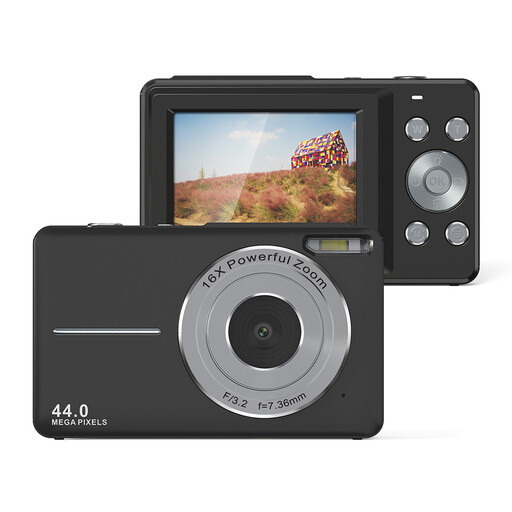 No image available
The product title lists 4K, 64 MP and 16X zoom. Check whether the framing at the wide end is wide enough to capture a whole courtyard façade.
First work out the framing you can achieve from an accessible position, then carefully align the camera with the building’s lines. In changing light, compare shots taken with adjusted exposure. Canon also lists exposure bracketing for the PowerShot G7 X Mark III.
No. Panasonic quotes a range of 24–360 mm in full-frame equivalent for the Lumix TZ300. The long end helps with distant details, but for a wide view, what matters most is the wide-angle view you can use from your position.
No. Under Section 59 of the German Copyright Act (UrhG), freedom of panorama covers, among other things, permanent works in public streets, roads or squares and the exterior view of buildings. Whether the conditions apply to a particular courtyard and your position, and whether you’re allowed to take photos there, must be assessed in context. The relevant source is the legislation published by the Federal Ministry of Justice and the Federal Office of Justice.
Not simply because the façade is the main subject. The Berlin Commissioner for Data Protection and Freedom of Information points out that identifiable people may constitute personal data. You need an appropriate legal basis under data protection law for taking and using the photos. Section 22 of the German Art Copyright Act (KunstUrhG) generally requires consent to distribute or publicly display portraits. What applies in a particular case depends on the circumstances in which the photo was taken and how it is used.
For online purchases, consumers generally have a 14-day right to cancel. The Verbraucherzentrale explains the conditions and when the cancellation period starts. Your statutory rights against the seller are separate from any voluntary guarantee. Check the specific purchase and guarantee terms.