Choose your compact camera based on whether you want to capture the whole bridge, distant structural details or a fixed composition from where you’re standing. A travel zoom gives you more flexibility to frame different shots, while a prime lens calls for a suitable viewpoint. For handheld shots in low light, also consider the lens speed at the focal length you’re using and the image stabilisation. Moving subjects such as trains will also need an appropriate shutter speed.
Which camera suits you?
For bridge panorama photography
If you want to fit the arches, road and riverbank into one shot, the wide-angle range is a useful starting point when comparing cameras for your chosen viewpoint. The City of Cologne lists pedestrian and cycle paths on both sides of the Hohenzollern Bridge.
For photographing structural details
If you want to capture distant girders, connections or sections of the bridge in greater detail without changing position, compare the optical telephoto range. Panasonic and Sony’s specifications for their travel zooms show a clear difference in their 35mm-equivalent focal lengths.
For photographing in the evening light
For handheld shots of illuminated bridges, it’s worth checking the lens speed at the focal length you’ll actually use, along with the image stabilisation. Stabilisation specifications refer to camera movement, not movement in the subject.
What to look for when buying
First compare the framing you need from accessible viewpoints, then check the telephoto range, lens speed and stabilisation for the subjects you want to photograph.
| What you’re looking for |
What to check |
Who it matters most to |
| Capturing the whole bridge |
Compare the 35mm-equivalent wide-angle focal length and photo angle of view for your chosen viewpoint. |
If I want to show the arches, road and riverbank together, a sufficiently wide angle of view is essential; around 33% of consumers prioritise an overall view. |
| Capturing distant details |
Check the model’s maximum optical telephoto focal length and image stabilisation. |
If I want to photograph distant steel arches in greater detail without changing position, I look for a good optical telephoto range; around 27% of consumers prioritise this kind of detail. |
| Photographing in the evening light |
Compare lens speed at the focal length you’ll use, image stabilisation and the available shutter speed settings. |
If I’m photographing illuminated buildings handheld, I consider moving parts of the scene as well as stabilisation; around 27% of consumers put low-light photography first. |
| Taking the camera with you |
Compare the dimensions and weight of the camera when ready to use, as well as a prime lens or zoom. |
If I want a camera that’s easy to take along on a longer photo walk, size and a suitable composition matter to me; around 13% of consumers place particular importance on taking their camera with them regularly. |
Common buying mistakes
-
Comparing only the maximum zoom
A camera’s longer telephoto reach alone doesn’t tell you how well it performs in low light. The wide-angle range also matters when you want to capture the whole scene.
Compare the wide-angle and telephoto ends separately, and check the lens speed and stabilisation at the focal lengths you plan to use.
-
Expecting a prime lens to work like an optical zoom
With the Fujifilm X100VI and Ricoh GR IV, you can’t use optical zoom to bring a distant bridge girder closer.
Choose a prime lens if its angle of view suits the viewpoints available to you. Otherwise, consider a model with a built-in zoom.
-
Confusing image stabilisation with freezing movement
Stabilisation can counteract camera movement, but it won’t automatically keep a passing train or pedestrians in sharp focus.
For moving parts of the scene, make sure you also consider the shutter speed.
Brands and models to consider
Panasonic
The LUMIX TZ99 and TZ300 offer different telephoto ranges, while the DC-L10 has a shorter zoom with a quoted aperture of F1.7–2.8.
- Panasonic quotes 24–720 mm for the TZ99 and 24–360 mm for the TZ300 in 35mm-equivalent terms; the DC-L10 covers 24–75 mm.
- The different focal length ranges can help you choose, but they don’t prove that a camera will deliver a particular image quality in low light.
Sony
The RX100 VII combines a compact zoom range with a viewfinder and optical image stabilisation for photos.
- Sony quotes a 35mm-equivalent range of 24–200 mm, a 1.0-type sensor and an electronic viewfinder.
- According to Sony, the maximum aperture changes from F2 at the wide-angle end to F4.5 at the telephoto end.
Fujifilm
The X100VI is designed for photographers who want to make a deliberate choice to shoot with a fixed angle of view.
- Fujifilm quotes a 35mm-equivalent focal length of 35 mm, an F2 aperture and built-in 5-axis image stabilisation; the six-stop figure applies under the stated CIPA conditions.
- The prime lens has no optical zoom for distant bridge details.
Ricoh
The GR IV offers a fixed angle of view that’s slightly wider than the Fujifilm X100VI’s.
- Ricoh quotes an APS-C sensor, 5-axis image stabilisation and a 35mm-equivalent focal length of approximately 28 mm.
- With a fixed angle of view, you can’t use optical zoom to make a distant detail appear larger in the frame.
Canon
The PowerShot V1 is an option if a wide photo angle of view matters more to you than a long telephoto range.
- Canon quotes a photo angle of view of 107–46.8 degrees and 3.1× optical zoom.
- Canon lists photo and video angles of view separately; for bridge photography, the photo figure is the one to use.
Compact cameras at Joybuy
The following Joybuy picks include compact cameras for photo walks. Pay particular attention to whether the zoom type and image stabilisation suit the bridges you want to photograph.
 No image available
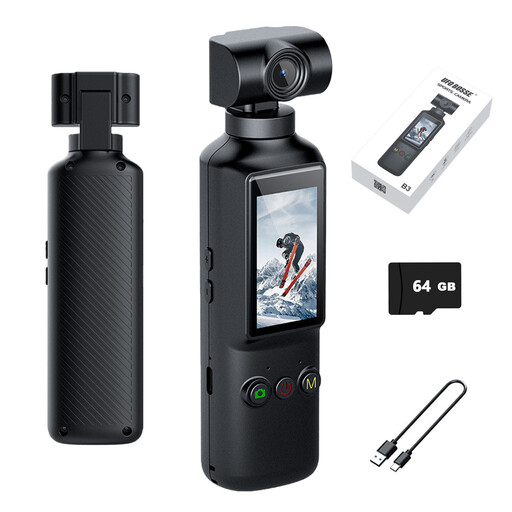
KINSI mini pocket camera, 16 MP
The rotating lens offers a way to adjust the angle of view for different subjects.
The title specifies a 270° rotating lens, 16 MP photo resolution and 4K video at 30 frames per second.
View at Joybuy
 No image available
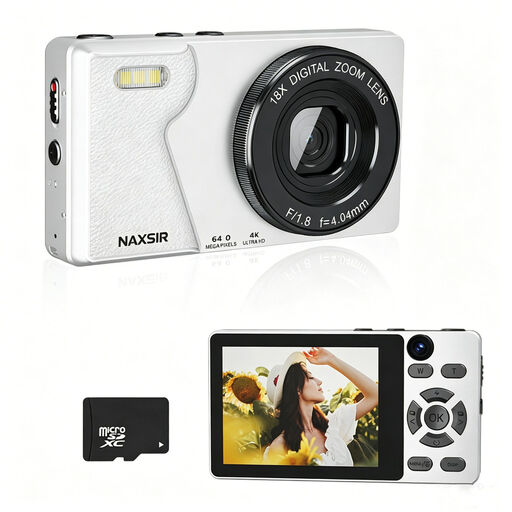
NAXSIR digital camera, 64 MP, 18× digital zoom
Digital zoom can change the framing, but it isn’t the same as optical telephoto reach.
The title specifies 64 MP photo resolution, autofocus and a 32 GB memory card.
View at Joybuy
 No image available
KOMERY G7-A, pink, 80 MP
The stated 18× zoom is digital zoom, so it won’t replace optical zoom for distant bridge details.
The title specifies 80 MP and 4K.
View at Joybuy
 No image available
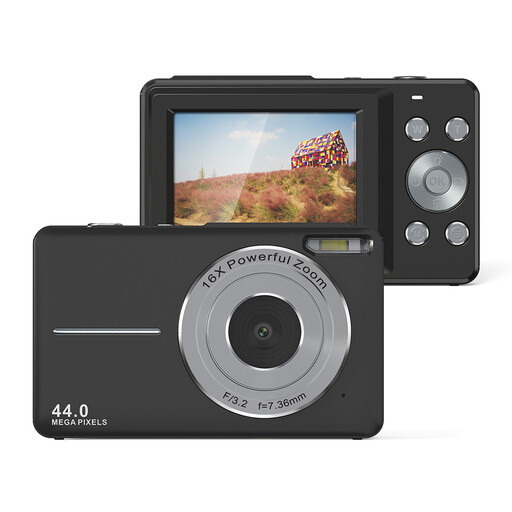
Songdian pocket camera, black, 64 MP
The 16× zoom is digital, so check whether this type of magnification suits the subjects you want to photograph.
The title specifies 64 MP photo resolution.
View at Joybuy
 No image available
Songdian digital camera, white, 8× optical zoom
Optical zoom is useful for changing the framing without moving from your position; the description also mentions electronic image stabilisation.
The title specifies 5K and 64 MP.
View at Joybuy
Frequently asked questions
Is image stabilisation enough to get a sharp shot of a moving train?
No. Image stabilisation counteracts camera movement, but how a train appears in the shot also depends on the shutter speed. Choose an exposure time that’s suitable for moving subjects.
Do I need an interchangeable lens for these compact cameras?
No, the models described here have built-in lenses. Before you buy, check whether the fixed angle of view or optical zoom range will be sufficient from the viewpoints you have in mind.
What should I know about a fault or buying online in Germany?
Your statutory rights against the seller are separate from any voluntary guarantee. Consumers generally have a 14-day right to cancel online purchases; the consumer advice centre explains the relevant conditions.
Can I photograph a permanent structure in a public place and publish the image?
Under certain conditions, § 59 UrhG permits photographs and the public display of permanent works situated on public paths, roads or squares. For buildings, this provision covers only the exterior view; it does not give you access to restricted locations or address separate questions about people shown in the image.


