Start by considering the composition you need from an accessible path: a zoom lens is a good choice if you want to photograph landscapes and distant details without changing lenses, while a prime lens is better suited to carefully composed views. For close-ups, check the focusing distance; for handheld photography, consider the weight, viewfinder or screen, and stabilisation. If it’s windy, you’ll also need a sufficiently fast shutter speed, as stabilisation won’t freeze moving flowers.
Which camera is right for you?
Heather landscape photographers
If you want to capture carpets of flowers and the horizon from an accessible spot, look at the angle of view at the wide end of the lens and make sure you can frame your shots comfortably. The Lüneburg Heath Nature Park describes heather in bloom as a landscape subject; Canon Germany and Fujifilm offer options with different fixed and variable angles of view.
Path-bound detail hunters
If you want to photograph more distant patches of heather without leaving designated paths, the optical reach of your camera is key. Lüneburger Heide GmbH notes that visitors must remain on designated paths in the nature reserve.
Close-up flower enthusiasts
If individual flowers within reach of the path are your main subject, check the focusing distance for the zoom setting and shooting mode you’ll actually use. Sony Germany and Panasonic list different focusing ranges for their models.
What should you look for when buying?
| Priority |
What to check |
Who will find this most important? |
| Landscapes and angle of view |
Compare the focal length at the wide end, and check whether the camera has a viewfinder or screen. |
If I want to frame wide heathland views from a permitted spot, the right angle of view matters. Around 29% of consumers prioritise landscape framing. |
| Distant subjects |
Check whether the zoom range is optical and applies to photos; also compare sensor size and the maximum aperture at the telephoto end. |
If I want to stay on a designated path and photograph more distant patches of heather, I need the right framing without moving closer. Around 29% of consumers put reach for distant subjects first. |
| Close-up flowers |
Check the focusing distance for the zoom range and shooting mode you’ll be using. |
If individual flowers are my main subject, the camera needs to focus at a distance I can reach from the path. Around 21% of consumers prioritise flower close-ups. |
| Handheld use |
Check the weight, image stabilisation, viewfinder or vari-angle screen, and shutter speed controls. |
If I’m taking handheld photos on a longer walk, a camera that’s easy to carry and lets me control shots in changing conditions is important. Around 21% of consumers prioritise ease of handheld use. |
Avoid common buying mistakes
-
Comparing only the highest zoom factor
A longer telephoto reach doesn’t automatically mean better image quality. The Panasonic TZ99 and TZ300 also differ in sensor size and aperture values.
Think about how often distant subjects will really be your priority, then compare each model’s focal length range for photos, sensor size and maximum aperture at the telephoto end.
-
Confusing stabilisation with freezing moving flowers
Image stabilisation helps counter camera shake, but it won’t automatically prevent motion blur from plants moving in the wind.
When it’s windy, check the shutter speed and review your shots. Sony Germany notes that faster shutter speeds are needed to freeze movement in an image.
-
Assuming weather resistance without the required accessories
Fujifilm describes the X100VI lens’s weather resistance as requiring an adapter ring and protective filter.
Before buying, check the conditions attached to the manufacturer’s claim and what’s included with the specific model.
The adapter ring and protective filter may also be required for the weather resistance described.
A guide to relevant brands
Sony
The RX100 VII combines a compact body with a 24–200-mm zoom and an electronic viewfinder. Sony Germany lists optical stabilisation for photos and an F2.8–4.5 aperture.
- The variable angle of view can be useful on a walk, for landscapes and changing compositions.
- The focusing distance varies between the wide and telephoto ends, so check it for the close-up subjects you have in mind.
Canon
The PowerShot G7 X Mark III is suited to subjects at close to medium range. Canon Germany lists a 24-mm wide-angle lens, a 4.2x zoom and a tilting screen.
- Canon gives an aperture of F1.8–2.8 and a weight of around 304 g, including the battery and memory card.
- Its reach is shorter than that of the travel zoom models featured here.
Panasonic
The Lumix TZ300 and TZ99 offer different zoom ranges for subjects photographed from the path. Panasonic lists 24–360 mm and a 1.0-inch type sensor for the TZ300; the TZ99 offers 24–720 mm for 4:3 photos and has a 1/2.3-inch sensor.
- The models offer different levels of reach for framing more distant subjects.
- Compare reach, sensor size and aperture values together; a longer zoom alone doesn’t tell you anything about image quality.
Ricoh
The GR IV is an APS-C compact camera with a fixed angle of view of around 28 mm in 35 mm equivalent terms. Ricoh Imaging Europe lists an F2.8 aperture and five-axis sensor stabilisation.
- The fixed angle of view suits carefully composed shots.
- Without optical zoom, you can’t change the angle of view to frame distant flowers.
Fujifilm
The X100VI combines an APS-C sensor with a fixed 35-mm equivalent angle of view and a hybrid viewfinder, according to Fujifilm.
- The fixed angle of view works well for carefully chosen compositions.
- There’s no optical zoom for distant individual subjects. The lens weather resistance described by Fujifilm requires additional accessories.
Compact cameras at Joybuy
This selection includes compact digital cameras for photography and capturing moments on the go. Compare the listed features with the compositions you want and how you plan to shoot handheld.
 No image available
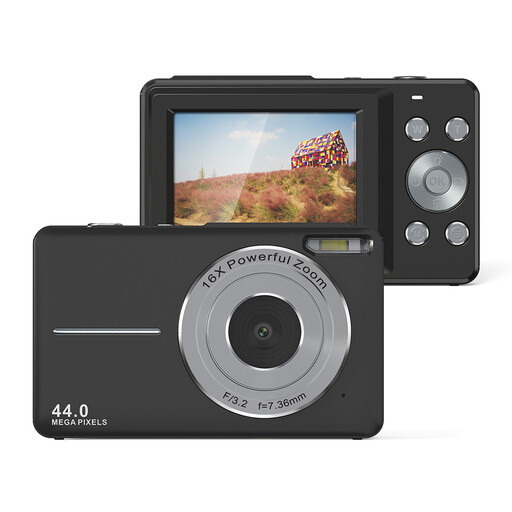
Songdian Pocket Camera 4K 64MP, 16X Zoom, Black
Listed as a pocket camera for photography and video, it’s a compact option for taking with you on the go.
It’s listed with 4K, 64MP and 16X Zoom. Check whether the zoom is optical or digital, and compare the focusing range and viewfinder or screen with the subjects you have in mind.
View at Joybuy
 No image available
KOMERY G7-A 4K Digital Camera, 80MP, Pink
Described as a portable camera for photography, it’s designed for taking pictures on the go.
The product title lists 4K, 80MP and 18X Zoom. Check whether the zoom is optical or digital, and look at the focusing range and framing options for landscapes and flowers.
View at Joybuy
Frequently asked questions
When should I plan a trip to photograph heather in bloom?
According to the Lüneburg Heath Nature Park, common heather usually flowers from August to September, while bell heather flowers from July. As of 5 November 2026, the usual flowering period for common heather has passed for this year; this doesn’t confirm when flowers will actually be visible on a future day out.
Does image stabilisation help when flowers sway in the wind?
Image stabilisation counteracts camera shake, but it won’t automatically freeze a moving subject. A sufficiently fast shutter speed is also important for flowers moving in the wind; Sony Germany recommends faster shutter speeds to freeze movement in the image.
Can I step into the heath to take close-ups?
In the Lüneburg Heath Nature Reserve, you should stay on the designated paths: Lüneburger Heide GmbH highlights this requirement. The Lower Saxony Water Management, Coastal Defence and Nature Conservation Agency lists a 2020 regulation amended in 2025. Rules may differ at other photography locations.
What should I check about weather resistance and accessories?
Check the manufacturer’s information for the specific model and what’s included in the box. Fujifilm describes the X100VI lens’s weather resistance as requiring an adapter ring and protective filter, so don’t assume this feature is available without the accessories.


