Detail hunters in the old town
If you want to capture high-up or distant timber-framed details without changing lenses, pay particular attention to optical telephoto reach.


If distant carvings or roof details are your priority, optical telephoto reach is an important factor to consider. For photographing entire houses in narrow lanes, you’ll also need a sufficiently wide angle of view. If you often shoot in the shade, a model with a larger sensor and a shorter telephoto range could be a good compromise, but it can’t guarantee a particular result.
If you want to capture high-up or distant timber-framed details without changing lenses, pay particular attention to optical telephoto reach.
If you want to capture entire façades from close range, you’ll need a sufficiently wide angle of view. Think about where you’ll be standing to keep the building’s lines as straight as possible.
For shaded façades or twilight shots, it’s worth weighing up sensor size against telephoto reach.
Best if: You want to fill the frame with distant carved beams and roof details from a public path.
Trade-off: The long-zoom models mentioned have a 1/2.3-inch sensor; the DC-TZ99 has a maximum aperture of F6.4 at the telephoto end.
Best if: You also photograph shaded façades and don’t need particularly long telephoto reach.
Trade-off: From the same spot, distant details will appear smaller because of the shorter maximum focal length.
| Priority | What to check before buying | Who is it most important for? |
|---|---|---|
| Distant timber-framed details | Optical telephoto focal length at the long end in the photo format you use; telephoto aperture and image stabilisation. | If I want to capture carvings or roof details from a distance, optical telephoto reach matters most. Around 33% of consumers put distant details first. |
| Entire façades in narrow lanes | Full-frame-equivalent focal length at the wide end; enough room to fit the façade in from your usual shooting position. | If you want to photograph an entire timber-framed house from a narrow lane, focus on the angle of view. Around 27% of consumers prioritise capturing the whole façade. |
| Low-light photography | Sensor format, maximum aperture at the focal length you’ll use and image stabilisation. | If I want to capture details on shaded façades, light matters more than the longest possible telephoto reach. Around 20% of consumers put low-light capability first. |
| Travelling light on city walks | Weight including the battery and memory card; charging method and what’s included with the exact model version. | If you want to carry your camera comfortably on longer city walks and charge it while you’re out, check its weight and charging method. Around 20% of consumers prioritise travelling light. |
Manufacturers may list optical zoom separately from digital or combined zoom figures. These numbers don’t describe the same type of magnification.
When comparing cameras for distant architectural details, look at the optical focal length at the long end and the photo mode it applies to.
Telephoto reach and a wide angle of view help you capture different compositions. Tilting the camera sharply upwards can make vertical building lines converge.
Check both ends of the focal-length range and think about how much space you’ll have at your usual shooting locations. Keeping the camera as level as possible helps prevent vertical lines from converging.
Canon lists the older SX740 HS as discontinued; its model name and battery differ from those of the Lite Edition.
Check the full model name, battery and what’s included against the specific product description.
The PowerShot SX740 HS Lite Edition is a compact travel zoom camera designed for capturing distant details.
The DC-TZ99 offers a long travel zoom, while the DC-TZ300 pairs a shorter zoom with a 1-inch sensor.
The DSC-RX100M7A is a compact 1-inch alternative for buyers who are happy with mid-range telephoto reach.
The Joybuy camera deals below include zoom specifications. For distant façade details, check whether the specific optical focal-length range is listed.
 No image available
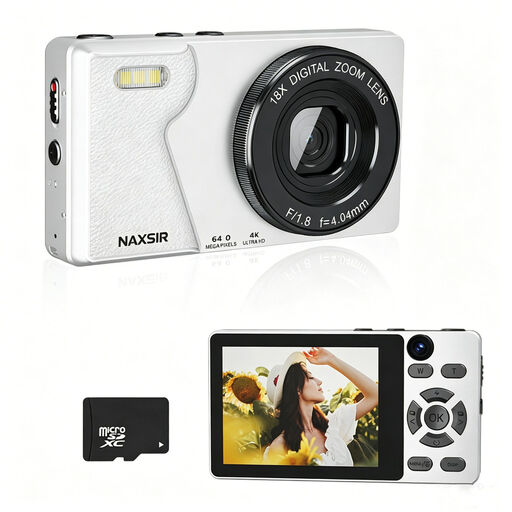
The title mentions digital zoom; before buying, check the optical focal-length range if you want to capture distant timber-framed details.
The product title lists a photo resolution of 64 MP and a 32 GB memory card.
 No image available
The product title mentions 18x zoom but doesn’t specify the type; check the optical focal-length range before choosing this camera for distant details.
The title lists 4K and 80 MP.
 No image available
For distant timber-framed details, the specified optical focal length is what matters; according to the description, the additional 18x zoom mentioned is digital.
The product title lists 12x optical zoom, 4K, 64 MP and Wi-Fi.
 No image available
The product title mentions 18x zoom but doesn’t specify the optical focal length at the long end. Check this if you want to capture distant details from the same spot.
The description mentions 5K video; the title lists 80 MP and the white version.
 No image available
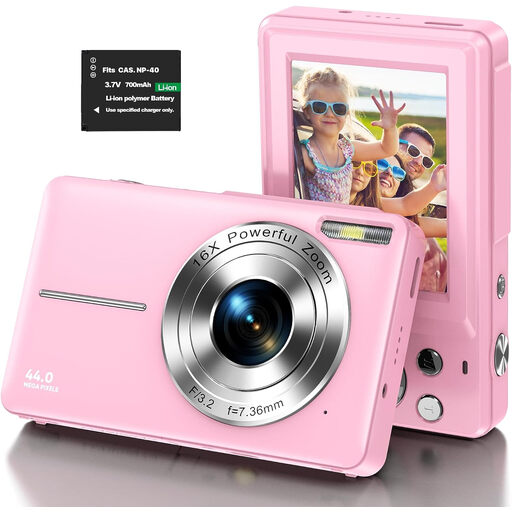
The description calls the 16x zoom digital, so check the optical focal-length range separately if you want to capture distant façade details.
The title lists 4K, 44 MP and the pink version.
No, zoom ratios alone aren’t enough to compare cameras. Compare the optical, full-frame-equivalent focal length at the long end and the shooting mode: Canon lists 960 mm for the SX740 HS Lite Edition, while Panasonic lists 720 mm for the DC-TZ99 when shooting 4:3 photos. Digital or combined zoom figures aren’t the same as these optical focal lengths.
If possible, find a spot where the house fits in the frame while you hold the camera level. Sony points out that tilting the camera sharply upwards makes vertical lines converge. If you can’t avoid tilting it, leave some room in the frame for perspective correction later.
Check the exact model version, battery and what’s included. Canon lists an NB-15L battery for the SX740 HS Lite Edition, but this model doesn’t support USB charging; Panasonic lists USB-C charging for the DC-TZ300. Canon has a German-language support page for the Lite Edition with manuals and firmware information.
Subject to certain conditions, § 59 UrhG permits the photographic reproduction and public display of works that remain permanently on public paths, streets or squares; for buildings, this applies only to their exterior appearance. This isn’t blanket permission to include identifiable people or to publish images in every context. If your publication includes personal data, you’ll need to check the relevant data protection requirements separately. Any specific access or photography rules at the location may also apply.