Small kitchen with no space for an appliance
You’d like to wash dinner plates in a machine, but there’s no spare space for a slim freestanding or integrated model, and you’ll need to factor in the worktop too.


First, measure the space available, the room needed to open the door and your dinner plates: a dishwasher’s place settings alone won’t tell you whether your plates will fit in the rack. If there’s no suitable space for an appliance, a worktop model could be a good option. A model with a water tank may work if there’s no fixed water supply, while a suitable space for a 45 cm freestanding or integrated model can fit more dishes without permanently taking up worktop space. In every case, check the drainage and compare the Eco figures for the specific model.
You’d like to wash dinner plates in a machine, but there’s no spare space for a slim freestanding or integrated model, and you’ll need to factor in the worktop too.
If you regularly have plates and other dishes to wash together, the usable load matters more than simply choosing the narrowest appliance.
You’ll need a solution for the water supply. If you’re considering a model with a tank, you should also check where the waste water can drain safely.
First, check that the appliance and your plates will fit in the space available. Then compare load capacity and the water connection; once you’ve settled on a type, it’s worth considering energy use and noise levels too.
This is for people who want to machine-wash dinner plates despite having limited storage space.
| Consideration | What to check before buying | Who it matters to most |
|---|---|---|
| Space and plate fit | Check the height, width, depth, door opening and rack against your dinner plates. | If I have limited worktop space, I want to know whether the appliance will really fit with the door open and whether my plates will fit in the rack. Around 33% of consumers prioritise available space and plate fit. |
| Load capacity | Compare a typical evening’s washing-up with the rack layout and the manufacturer’s stated place settings. | If there are several plates and glasses to wash after a meal, I want to fit in as much of a typical load as possible. Around 27% of consumers prioritise load capacity per cycle. |
| Water supply and drainage | Check the connection type and how to route the drain hose safely, following the model’s instructions. | If there’s no fixed water supply where I’ll put the appliance, I need a suitable way to supply water and somewhere for the waste water to drain. Around 20% of consumers prioritise the connection at the installation site. |
| Energy use and noise | Once you’ve found a suitable capacity, compare the EU label figures for Eco energy use, programme duration and dB(A). | If the appliance will run regularly or be close to the living area, I want to compare energy use and noise before choosing. Around 20% of consumers prioritise running costs or noise. |
Place settings describe a standardised capacity, not the diameter of your plates. If your plates don’t fit, you may need to run extra cycles or wash them by hand.
Measure the largest dinner plates you use regularly and check the rack and door opening on the specific model.
Depth, height, door clearance and hose routing all need space too. They can affect where you put the appliance or access to neighbouring cupboards.
Compare all the external dimensions and allow for the open door and hose route at the intended location.
A tank can replace a fixed water supply, but the wash water still needs to drain away. You’ll also need to fill the tank.
Before buying, check the model’s instructions to find out how to connect the drain safely.
Eco figures apply to a specific programme. Load capacity and the number of cycles you’ll need also matter in everyday use.
Compare the energy use figures alongside the capacity that suits you and the amount of washing-up you typically have.
The models covered here range from a small worktop appliance to a freestanding 45 cm dishwasher.
The TSG 7405 is a worktop model, so you’ll need room for an appliance that’s 55 cm wide, as well as its connections.
The SPV2IKX10E is a fully integrated 45 cm option for a suitably prepared kitchen run.
The Amazonia Nano range includes a slim worktop model as another option.
This selection includes compact worktop dishwashers for tight spaces, including models with a tank and models that connect to a water supply.
 No image available
For a spot without a fixed water supply; you’ll still need to plan for drainage.
5-litre water tank; 5+1 wash cycles.
 No image available
A compact worktop option if a tank-operated model suits your space; you’ll need to check the drainage here too.
37 × 50 cm; 5-litre water tank; 9 wash programmes; energy class D.
 No image available
For small spaces, if three place settings suit your usual load and you can use a tank or connect it to a water supply.
3 place settings; 7 programmes; energy class C; 56.3 dB.
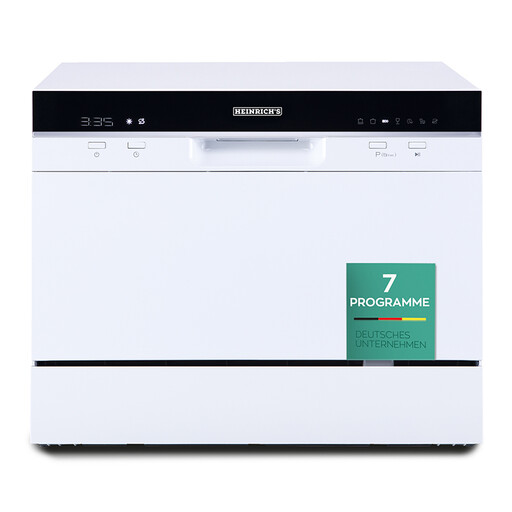 No image available
For a larger worktop load, if a water connection is available where you’ll put it.
6 place settings; 7 programmes; energy class D; 47 dB.
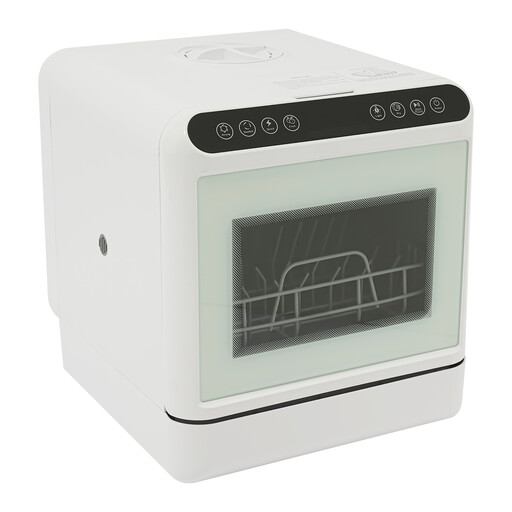 No image available
For small kitchens and limited space; if you use the tank, you’ll also need to plan for a drain connection.
1.32Gal integrated water tank; hot-air drying; 72h storage function; for 4–6 people.
No, the external dimensions alone aren’t enough to tell you. Check the installation instructions for the specific model, including the door opening, hose routing and required clearances. A freestanding worktop model isn’t automatically designed to be installed inside a cupboard.
The tank listed for the Midea MDWMT201DW can replace a fixed water supply. You’ll still need to check that there’s a suitable drain and that you can position the appliance as instructed for the model.
The German Federal Environment Agency recommends using the Eco programme, running the machine as full as possible and not pre-rinsing dishes with warm water. Compare the Eco label figures and follow the instructions for cleaning the specific model.
The EU energy label includes figures such as kWh per 100 Eco cycles and litres per Eco cycle. To estimate your own electricity costs, you’ll also need the expected number of cycles and your electricity tariff. Check too that the load capacity suits the dishes you need to wash.
In Germany, new mains-powered household dishwashers use the EU energy label, with classes from A to G. The European Commission introduced this scale on 1 March 2021. Check the label for the specific model: an older A+++ rating is not part of the same scale.