Writers with limited desk space
If you write feedback alongside papers and a mouse, your keyboard should leave enough room for your other work essentials and your hands.


When giving feedback at a small desk, choose a keyboard that leaves enough room for your mouse, papers and hands. The German Federal Institute for Occupational Safety and Health (BAuA) recommends arranging your keyboard and mouse flexibly and using a hand and arm support. Then check the specific DE-QWERTZ layout and connection for your device: the keyboard’s form factor or manufacturer’s claims alone cannot tell you whether it will feel more comfortable to type on.
If you write feedback alongside papers and a mouse, your keyboard should leave enough room for your other work essentials and your hands.
When writing longer texts, easy-to-reach keys, a suitable desk layout and a typing feel that works for you matter more than simply choosing the smallest design.
If you switch between computers or tablets while writing, check the connection and layout of the specific keyboard variant for each device.
Plan your keyboard setup around your mouse, papers and the space you need for your hands. The BAuA recommends arranging these work essentials flexibly on your desk.
| Criteria | What to look for | Who is this important for? |
|---|---|---|
| Desk space and layout | Measure the available width and depth of your chosen space. Compare the keyboard’s dimensions and check that your mouse and frequently used keys are easy to reach. | If I need to use my keyboard, mouse and papers together on a small desk, the layout is crucial. Around 31% of consumers prioritise saving space. |
| Typing comfort | Check how easy frequently used keys are to reach, the typing feel and whether there is enough room for your hands in front of the keyboard. | When writing longer feedback, I want to reach the keys comfortably and maintain a suitable posture. Around 31% of consumers primarily prioritise typing comfort. |
| Layout and connection | Check the specific DE-QWERTZ layout, as well as Bluetooth, any USB port you need and how device switching works on the model in question. | If I write in German or switch between work devices, the key layout and connection need to be right. Around 25% of consumers prioritise layout or connectivity. |
| Ease of use | Check the power supply, the connection you need and – if you use several devices – how to switch between them. | If I want to keep setup and ongoing adjustments to a minimum, ease of use is important. Around 13% of consumers primarily prioritise straightforward operation. |
Your mouse, papers and hands need space too. A very small keyboard may also have a different key layout from the one you are used to.
Measure the available space with all the work essentials you use at the same time, and check that the keys you need are there.
The key labels depend on the specific variant. For example, a Joybuy listing for the CHERRY KW 7100 MINI BT explicitly states that it has a US-international QWERTY layout, even though CHERRY also makes a DE variant.
Before buying, check the selected layout variant and, where provided, the manufacturer’s part number.
Specifications for the MX Keys Mini for Business do not automatically apply to a standard MX Keys Mini or a bundle offer.
Check the full model name, layout, connection type and what’s included with the specific variant on offer.
The KW 7100 MINI BT is a compact scissor-switch keyboard. CHERRY also makes a DE variant.
The MX Keys Mini range is designed for compact workspaces. Specifications for the Business version do not automatically apply to other variants.
The PERIBOARD-409 U is a wired mini keyboard, also available from Perixx with a German QWERTZ layout.
The K3 Pro is a low-profile mechanical keyboard in a 75% layout; Keychron offers DE-ISO as a selectable layout.
The Lyra is a compact scissor-switch keyboard that Trust says can switch between devices using wireless connections.
The models below include compact keyboards for small workspaces, including a QWERTZ Bluetooth keyboard and mechanical options with different connection types.
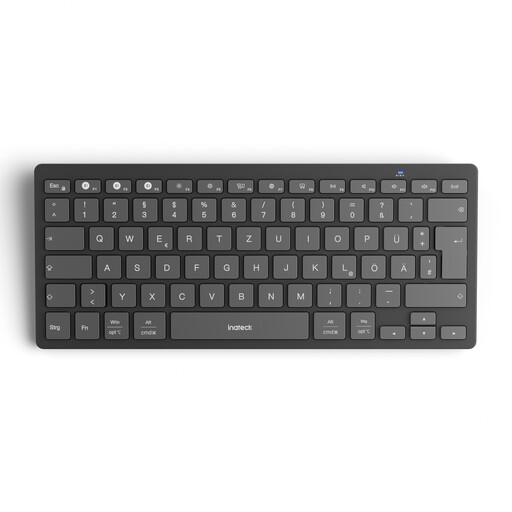 No image available
Could suit you if you want a keyboard with a built-in touchpad and device switching for a tight workspace.
A QWERTZ layout and 285 mm body width are listed.
The manufacturer lists Bluetooth connections for up to three devices and a key travel of 1.5 mm.
 No image available
Could suit you if you’re looking for a compact mechanical model with a German layout and several connection options.
The model is described as a 65% keyboard with low-profile MX Speed switches and RGB lighting.
Bluetooth, 2.4 GHz wireless and USB-C are listed as connection options.
 No image available
Could suit you if you’re looking for a compact mechanical model with an ISO-DE layout and customisable features.
The 75% layout, hot-swap and VIA compatibility are listed; the model name specifies an aluminium case.
Bluetooth, 2.4 GHz wireless and USB-C are listed as connection options.
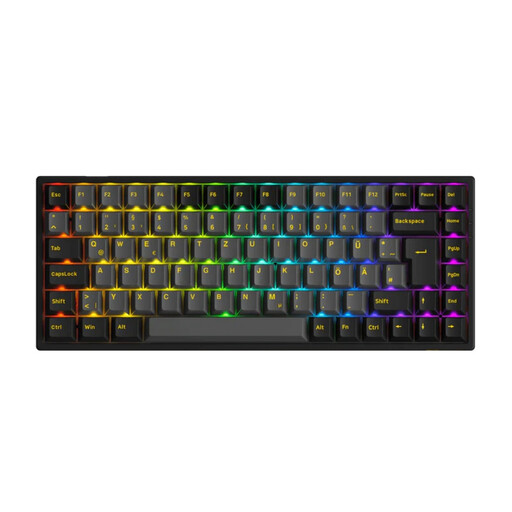 No image available
Could suit you if you prefer a compact mechanical keyboard with a German layout and several connection options.
The model is described as a 75% keyboard with an ISO-DE layout and V3 Pro Cream Yellow switches.
Bluetooth, 2.4 GHz wireless, USB-C and hot-swap are listed.
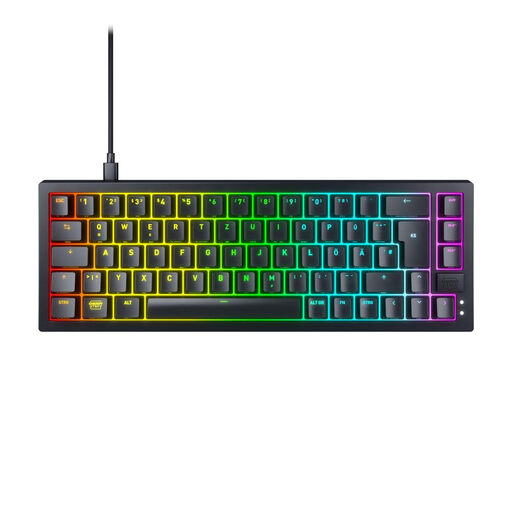 No image available
Could suit you if you write at a fixed computer and want a compact wired keyboard with a German layout.
The model is listed as measuring 32.5 × 11 × 3.7 cm and coming with a USB-C to USB-A cable.
The product name specifies hot-swappable switches and RGB lighting.
As well as checking the keyboard’s dimensions, make room for your mouse and a hand and arm support. The BAuA recommends arranging work essentials flexibly, so check your posture at your fully set-up workstation rather than assuming that a “compact” keyboard is necessarily ergonomic.
Check the instructions for your specific model to see whether it uses replaceable batteries or a rechargeable battery. The German Environment Agency recommends disposing of old electrical equipment separately from household waste and removing and recycling any detachable batteries separately.
For a consumer purchase in Germany, your statutory rights against the seller are separate from any voluntary guarantee. If there’s a fault, the first step is to seek a remedy from the seller, such as a repair or replacement; any additional guarantee is subject to its own terms. The Verbraucherzentrale explains the difference.
Within its scope, ASR A6 sets out requirements for screen-based workstations in workplaces and home offices; it does not automatically apply to every private desk. For fixed screen-based workstations such as those in offices, the BAuA says that the Workplace Ordinance requires the keyboard and screen to be separate. Whether this applies to a particular workstation depends on how it is set up and used, and does not create a general requirement to buy a specific keyboard model.