Photographers who want to handle backlight
If you want to retain detail in both bright skies and shaded façades, check for RAW and exposure bracketing. Canon Germany describes HDR as combining several shots of the same subject.


For Berlin courtyard façades in strong backlight, check for RAW and exposure bracketing, as well as the angle of view you need from the position you can actually access. A compact camera saves you changing lenses, while a mirrorless camera gives you more choice of lenses, but a complete kit may take up more space and require extra accessories. Exposure bracketing is best suited to subjects that are as still as possible, and the images may need to be merged afterwards; Canon Germany describes this as taking several shots of the same subject.
If you want to retain detail in both bright skies and shaded façades, check for RAW and exposure bracketing. Canon Germany describes HDR as combining several shots of the same subject.
If you can barely change your position, the angle of view is crucial: check whether you can capture the façade as you want it from where you can stand.
If you want to take your camera with you on city walks, compare a compact camera with a fixed lens or travel zoom with a mirrorless camera kit with an interchangeable lens.
A good fit if: You want to choose the angle of view for the courtyard and other architectural shots by selecting the lens.
The trade-off: The camera body’s weight doesn’t tell you how heavy the complete kit will be; check the lens, what’s included and the total weight.
A good fit if: You want to carry less and are happy to shoot with a fixed angle of view. Ricoh gives the GR IV’s focal length as approximately 28 mm equivalent in 35 mm format.
The trade-off: Without optical zoom, you can’t adjust your framing or capture distant details as flexibly from the same position.
A good fit if: You want to capture both wide views and distant details from the same spot. For 4:3 photos, Panasonic gives the TZ99’s focal length as 24–720 mm equivalent in 35 mm format.
The trade-off: With the TZ99, bear in mind its 1/2.3-inch sensor and F3.3–6.4 aperture for shaded subjects; this does not imply a blanket performance comparison.
| What you need | What to check before buying | Who is this important to? |
|---|---|---|
| Bright and dark areas | Check RAW, the exposure bracketing function and how much work is needed to merge the shots. | If I want to edit bright areas of sky and dark façade details at the same time, I look for RAW and exposure bracketing; around 36% of consumers put handling backlight first. |
| The right framing for the façade | Consider the angle of view at the wide-angle end and where you’ll actually be shooting from; with a mirrorless camera, check the specific lens. | If I can’t step back any further in the courtyard, the angle of view needs to be wide enough to capture the whole scene from the position I can access; around 29% of consumers prioritise this framing. |
| Portability | Compare the weight and dimensions, including the battery, card and lens if applicable. | If I want to carry as little as possible on city walks, I compare the complete kit rather than just the camera body; around 21% of consumers put ease of carrying first. |
| What’s included in the kit | Check whether the product is a body only or a kit, and which lens and charging accessories are included. | If I want to start taking photos without having to put a kit together, what’s actually included is crucial; around 14% of consumers prioritise a complete kit. |
A long focal length makes distant details look bigger, but it doesn’t give you a wider angle of view for capturing an entire façade.
First check the 35 mm equivalent at the wide-angle end, then consider whether it’s wide enough for the framing you want from the position you can access in the courtyard.
According to Canon, the weight quoted for the Canon EOS R50 is for the black body with battery and card, not every possible kit.
Compare the specific lens, what’s included and the total weight of the kit.
You may need to buy a suitable lens or other accessories separately.
Under certain conditions, Section 59 of the German Copyright Act (UrhG) covers works visible from public paths, streets or squares; for buildings, the rule applies only to the exterior view.
Take photos from a permitted position and check the rules for the specific courtyard separately.
The EOS R50 is an APS-C mirrorless camera. For architectural photography, you’ll need to choose a suitable RF or RF-S lens.
The Alpha 6700 is an APS-C camera body with an E-mount, which you can pair with a suitable lens.
The X-S20 is a mirrorless camera option that you can pair with RAW and a suitable interchangeable lens.
The GR IV is aimed at travellers who prefer a compact camera with a fixed angle of view.
The Lumix TZ99 is a travel-zoom compact camera for capturing different views of façades without changing lenses.
A selection of Joybuy products for travel photography and light packing.
 No image available
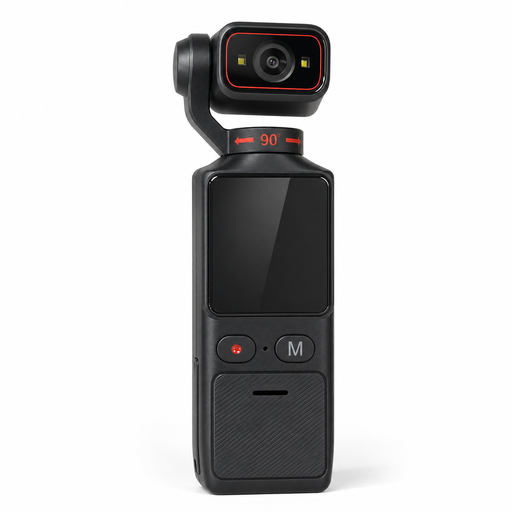
Described as a pocket camera, it may suit consumers who want to travel light on city walks.
The product title lists 4K, electronic image stabilisation, a 180°-swivelling lens, Wi-Fi and a 1.69-inch touchscreen.
First, check the exposure and whether the camera shoots in RAW. If the difference in brightness is still large, you can take several shots with the same framing as an exposure bracket, then merge them afterwards. Adobe recommends using a tripod where possible and keeping the aperture constant; movement between shots can make merging them more difficult.
There’s no general answer, as stabilisation specifications and conditions vary by model. Adobe recommends keeping the camera steady when merging shots; whether handheld photos work will also depend on movement and shooting conditions.
First check which lens and charging accessories are actually listed as included. If a product is faulty, your statutory rights are against the seller and are separate from any voluntary guarantee. Most online purchases of goods generally come with a right to cancel, usually within 14 days of receipt; bear in mind that exceptions may apply and check the terms of your specific purchase. The German consumer advice centre explains the distinction and the relevant conditions.
Under certain conditions, Section 59 of the German Copyright Act (UrhG) permits the use of images of works permanently situated beside public paths, streets or squares; for buildings, this applies to the exterior view. This does not give you blanket permission to enter or photograph every private courtyard. If people are recognisable, additional data protection requirements apply to taking and using the images. The Berlin Commissioner for Data Protection and Freedom of Information also distinguishes images taken purely for personal or family purposes that do not leave the private sphere.