Players with limited desk space
You need room for your monitor and peripherals, and want to position your PC next to them or elsewhere in your workspace. Measure the actual device rather than relying on the word ‘mini’.


Start by choosing a PC to suit the railway game you want to play, then measure the space available, including room for your monitor, peripherals and airflow. A mini PC isn’t automatically the right choice just because of its size. For large transport networks, check the CPU, RAM and graphics separately: Urban Games notes that the simulation workload in Transport Fever 3 increases as maps and networks grow. A dedicated GPU is worth considering if the game’s requirements and your preferred graphics settings call for one.
You need room for your monitor and peripherals, and want to position your PC next to them or elsewhere in your workspace. Measure the actual device rather than relying on the word ‘mini’.
You create sprawling maps with lots of vehicles and want to match the CPU, RAM and graphics to the requirements of your chosen game. According to Urban Games, the simulation workload in Transport Fever 3 can increase as maps and transport networks grow.
You want to check exactly what comes with a PC and find out which parts can be replaced later. Compact models can differ in areas such as memory, storage and what’s included in the box.
First, decide on your game, preferred resolution and map size. Then weigh up desk space, graphics, simulation performance and features according to your own priorities.
| Priority | What to check before buying | Who is it important to? |
|---|---|---|
| Space and connections | Compare the PC’s dimensions and orientation with the space available; check the monitor and USB connections on the exact model. | If my desk also needs to fit a monitor, mouse and keyboard, the actual amount of space the PC takes up matters to me. Around 25 % of consumers rank space requirements as their top priority. |
| Performance for large networks | Consider the requirements of your chosen game alongside the CPU, RAM and graphics; take map size and game progress into account. | For large or long-running transport networks, I want to make sure the CPU and RAM suit the game, rather than focusing only on the graphics card. Around 25 % of consumers put simulation performance first. |
| Graphics for your chosen game | Match the full GPU specification to the game, resolution and settings you want; only check VR if you plan to use it. | If image detail, resolution or planned VR use matters to me, I want to know the exact graphics variant. Around 20 % of consumers prioritise graphics or VR. |
| Noise at your desk | Look for measurements taken under load on the exact configuration; don’t mistake fan and power modes for noise measurements. | If the PC sits close to where I’m seated, quiet operation matters more to me than having the smallest possible case. Around 15 % of consumers put quiet operation first. |
| Features and future costs | Check the operating system, RAM, SSD and what’s included with the exact model; find out which components can actually be replaced. | If I need to keep track of what’s included in the purchase and possible future changes, I check carefully for missing components and upgrade limitations. Around 15 % of consumers prioritise features and future costs. |
Compact PCs and gaming ranges include different graphics solutions. Specifications can also vary within the same product range.
Check the full CPU, GPU and RAM specifications of the model on offer against your game’s requirements. Don’t judge its suitability by the case size or range name alone.
Urban Games says that the simulation workload in Transport Fever 3 increases as maps and transport networks grow. A more powerful GPU alone won’t answer every question about performance.
Consider the CPU and RAM as well as the GPU, resolution and map size you want.
For the DIY configurations described by Framework, you may need to source the storage drive and operating system yourself.
Compare what’s actually included and check which extra components you’ll need before choosing a configuration.
Depending on the DIY configuration, you may need to buy a storage drive or operating system separately if they aren’t included.
GMKtec describes the EVO-X2’s LPDDR5X memory as non-upgradeable.
If you might need more RAM later, check whether the exact model is upgradeable before buying. With soldered RAM, you can’t meet extra memory needs by replacing the RAM modules.
The ROG NUC 2025 series is aimed at buyers looking for a compact gaming PC with dedicated graphics.
The EVO-X2 is a compact mini PC where the graphics variant, dimensions and memory upgrade options all matter when choosing.
The Framework Desktop may suit buyers who want to compare its connections, SSD expansion and maintenance options with the space they have available.
The MS-S1 MAX is a compact workstation whose specifications and orientation should be checked against your workspace.
When comparing the A9 Mega, the key is to check which processor, graphics and RAM configuration is on offer.
The following options are compact PCs with integrated graphics. Check that the exact specifications and operating system requirements match your game and preferred settings.
 No image available
Worth considering for a space-saving setup if your chosen game is compatible with macOS; check the system requirements before buying.
Apple M6 with 12-core CPU and 12-core GPU; 16 GB unified memory; 256 GB SSD; Thunderbolt 4 and HDMI.
 No image available
Could suit a compact workspace, provided your chosen game runs on macOS; check the system requirements against this exact configuration.
Apple M6 with 12-core CPU and 12-core GPU; 24 GB unified memory; 512 GB SSD; Thunderbolt 4 and HDMI.
 No image available
A compact option if its processor and integrated graphics meet your chosen game’s requirements at your preferred settings.
AMD Ryzen 5 6600H; Radeon 660M; 12 GB LPDDR5; 512 GB NVMe SSD; two M.2 slots.
 No image available
Check the actual graphics and processor performance against your game and preferred resolution, rather than judging suitability by the product name.
AMD Ryzen 7 7735HS; Radeon 680M; 16 GB RAM; 512 GB SSD; two M.2 slots and several display outputs.
 No image available
The stated case dimensions can help you check whether it will fit in a tight space; remember to check your game’s requirements too.
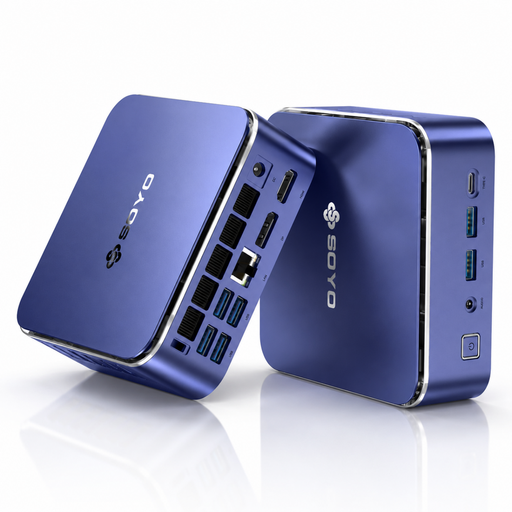
AMD Ryzen 5 7535HS; Radeon 660M; 16 GB LPDDR5; 512 GB NVMe SSD; 128 × 128 × 47,6 mm.
It depends on the game and the size of your maps. The developer recommends 16 GB RAM for Transport Fever 2 on Windows and Linux. That isn’t a general requirement for every railway game, nor a promise of performance on large Transport Fever 3 maps.
No, not for the standard PC mode: Gaugepunk Games describes playing on PC, with VR as an optional extra. If you want to play in VR, check the headset requirements and the space you’ll need separately.
Check CPU, GPU, RAM and VRAM usage separately rather than immediately changing only the graphics settings. According to Urban Games’ documentation, high GPU usage may indicate a graphics bottleneck. Individual CPU cores under heavy load while the GPU is underused may point to the simulation as the bottleneck.
For a typical online purchase by a consumer, you usually have a 14-day right to cancel. The Verbraucherzentrale explains that you must notify the retailer of your decision to cancel. Separately, faulty goods are covered by a statutory guarantee of at least two years from receipt, as explained by Your Europe for EU purchases. The terms of your specific purchase apply; a voluntary manufacturer’s warranty is not the same as the statutory guarantee.