
Lieferung heute & morgen

Qualitätsgarantie

Willkommens-Angebote freischalten: KOSTENLOSE Lieferung | Bis zu 80 % RABATT | Kostenlose 30-Tage-JoyPlus-Testphase
App herunterladen
By a Joybuy Product Recommendation Officer, 28 August 2026
A good compartment lunch box is the foundation for a fresh and varied lunch on the go. But the market is flooded with products that often fail to deliver on their promises. A leaky box in your work bag or a soggy salad from mixed ingredients are common frustrations. Before you make a purchase, it's crucial to understand the typical weak points that often only become apparent after a few weeks of use.
Common problems with low-quality models include:
To avoid these issues, you should focus on three core parameters. These objective criteria will help you make an informed assessment of the quality of a bento box or meal prep container.
The material is the basis for durability and safety. High-quality lunch boxes are often made of polypropylene (PP), a robust and heat-resistant plastic. The key feature to look for is the BPA-free label. BPA (Bisphenol A) is a plasticiser suspected of leaching into food when heated. A BPA-free container is therefore a fundamental requirement for a lunch box for work and everyday use, especially if you plan to heat food in it.
Leak-proofing depends directly on the quality of the seal and the lock. Making a lunch box truly leak-proof requires more than just a simple flip-top lid. Look for these features:
The compartments determine how flexibly you can plan your meals. A food container with dividers can have either fixed partitions or removable inserts. Removable trays offer more flexibility and make it easier to clean and heat food separately.
Also, check the specifications for practical use:
Based on these objective criteria, we have identified some models that are well-suited for specific use cases.
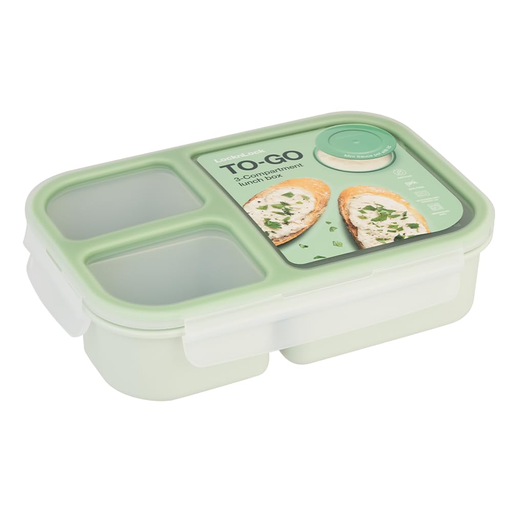
Why it's a great fit: Ideal for professionals who take a varied meal to work. The three compartments allow for separating the main course, side dish, and snack, while the integrated sauce container keeps dressing secure.
The four-sided locking system with a silicone seal ensures a reliable seal and prevents liquids and solids from mixing—a direct countermeasure to leaky compartments.
The combination of fixed compartments and a separate, sealed sauce container offers thoughtful organisation in a compact form. It is microwave and dishwasher-safe.

Why it's a great fit: This salad-to-go container is specifically designed to keep salad fresh and crisp until it's time to eat. The multi-part design consistently separates lettuce, toppings, and dressing.
It solves the core problem of soggy salads with a removable three-compartment tray for toppings and a separate, sealed dressing pot. The ingredients are only combined just before eating.
A complete solution for salad fans: The box includes not only the compartments and sauce pot but also a matching cutlery set. Everything is BPA-free, microwave-safe, and freezer-safe.
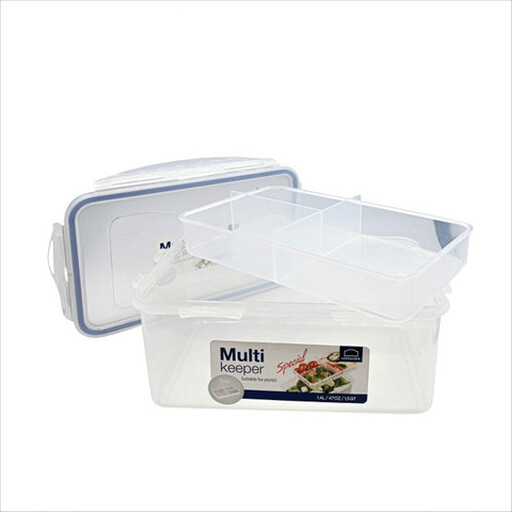
Why it's a great fit: With a 1.4-litre capacity and a simple divider, this container is ideal for preparing and storing larger meals. It's designed for the entire meal prep cycle: freezing, transporting, and reheating.
This model is explicitly designed for use in the freezer and microwave (without the lid). The high-quality PP material withstands temperature fluctuations, thus preventing material fatigue and warping.
Its versatility, from freezer-safe to microwave-safe, combined with its large volume and leak-proof design, makes it a workhorse for weekly meal prepping.
We have compiled a complete, up-to-date list of products that fully meet these strict selection criteria and safety standards.
Most high-quality plastic boxes are declared dishwasher-safe. However, for the long-term durability of the seal, it is advisable to occasionally wash the lid, and especially the silicone seal, by hand. Removable inserts make it easier to thoroughly clean all corners.
It is advisable to let very hot food cool for a few minutes before sealing the lid tightly. This prevents a build-up of pressure inside, which could deform the lid or compromise the seal. It also protects the material.
BPA-free means that the plastic was manufactured without the chemical Bisphenol A. This substance is associated with various health concerns, especially if it leaches from the plastic when heated or when it comes into contact with acidic foods. For food storage containers, this is an important safety feature.