
Lieferung heute & morgen

Qualitätsgarantie

Willkommens-Angebote freischalten: KOSTENLOSE Lieferung | Bis zu 80 % RABATT | Kostenlose 30-Tage-JoyPlus-Testphase
App herunterladen
A foldable wagon promises to be the ideal companion for family outings, festivals, or hauling heavy groceries. But the reality is often different: a promising model quickly proves to be impractical or defective. Before you make a decision, it's crucial to understand the common pitfalls that only become apparent after the purchase.
Many buyers focus on advertised features while overlooking critical design details. Here are three common traps that lead to frustration and unnecessary expense:
A good foldable wagon should be an investment that makes daily life easier, not harder.
To avoid buyer's remorse, focus on objective and verifiable product specifications. These three parameters are crucial for the longevity and functionality of your wagon.
The maximum load capacity (in kg) and cargo volume (in litres) are key performance indicators. Ensure the stated load capacity applies to dynamic use—that is, while in motion. A wagon that can hold 200 kg when stationary is not necessarily designed to pull that weight over uneven ground. The cargo volume indicates how much bulky gear will fit. 100 litres is often sufficient for weekly groceries, while 150 to 200 litres is more practical for camping or festival equipment.
The wheels determine where and how effectively you can use your collapsible transport cart.
A locking brake on at least two wheels also ensures safety when loading and unloading on slopes.
A good collapsible wagon should fold intuitively and without force. The most common is the concertina-style folding mechanism, where the wagon is pulled up from the centre. The crucial factor is the packed size (the dimensions when folded). Measure the available space in your car boot or cellar and compare it with the manufacturer's specifications to ensure the foldable hand cart can be stored compactly.
Instead of making a blanket recommendation, we have matched models based on specific user profiles.
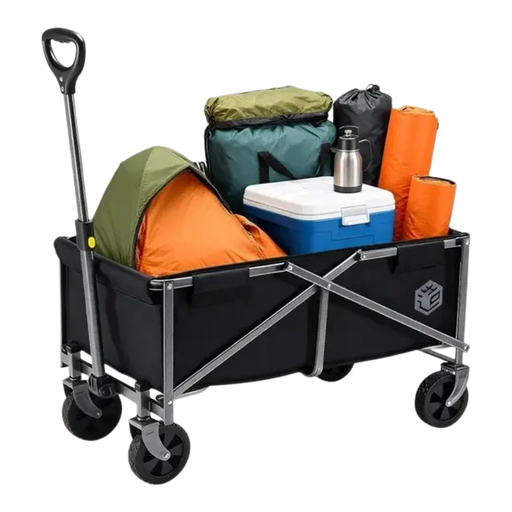
Why This Fits Their Persona: Ideal for the weekly shop, transporting recycling, or a short trip to the local park. This model focuses on the essentials: solid, basic functionality for everyday tasks on paved surfaces.
The integrated, no-assembly design bypasses "Folding Frustration." The mechanism is straightforward and built for durability with normal use. The 100 kg load capacity is realistically sized for its intended purpose.
Compact packed size; folds in seconds according to the manufacturer; 360° swivel wheels for high manoeuvrability.
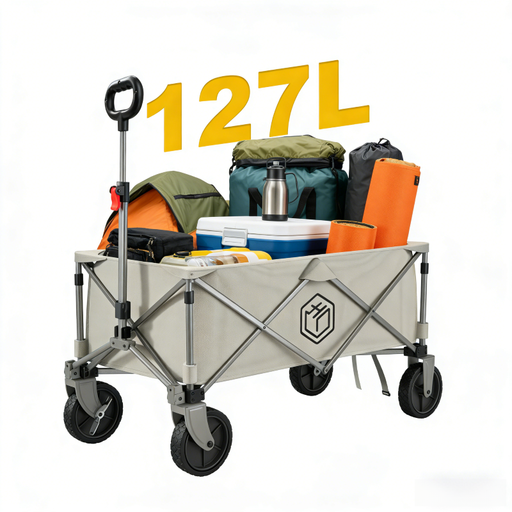
Why This Fits Their Persona: This wagon is an all-rounder for families needing a robust solution for picnics, sporting events, and larger shopping trips. It offers a high load capacity yet remains nimble enough for city use.
The frame, made of robust steel tubing, counteracts the "Frame Trap." The high 200 kg load capacity is designed for demanding family activities. The dual brake on the front wheels provides extra stability and safety.
High 200 kg load capacity; 127-litre cargo volume; 360° swivel wheels with locking brakes for excellent manoeuvrability and a secure stance.
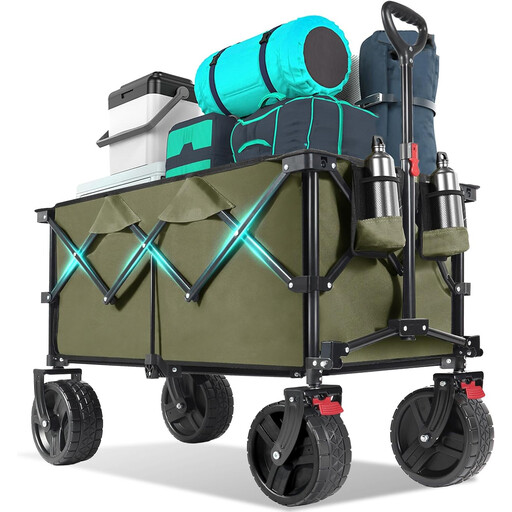
Why This Fits Their Persona: Designed for festival-goers, campers, and beach lovers who need to transport heavy gear over difficult terrain. Its large volume and specialised wheels make it an outdoor workhorse.
This model solves the "Wheel Deception" with its 7-inch all-terrain wide wheels, explicitly designed for sand, mud, and grass. The robust 600D Oxford fabric and aluminium alloy frame prevent the "Frame Trap."
Very large 200-litre cargo volume; extra-wide tyres for maximum off-road capability; high 200 kg load capacity.
We have compiled a complete, up-to-date list of products that fully meet these strict selection criteria and all relevant safety regulations.
The maximum load capacity stated by the manufacturer should be seen as an upper limit and not be permanently maxed out. More important than the number itself is the even distribution of weight in the wagon. Heavy items should be placed centrally and as low as possible to keep the centre of gravity low and prevent tipping.
Only wagons with wide tyres are suitable for sandy surfaces. Narrow hard plastic or rubber wheels will immediately dig into the sand, making transport impossible. Look for a tyre width of at least 8-10 cm for effective weight distribution.
Maintenance is straightforward. Clean the fabric liner with a damp cloth and a mild soap solution. Let the fabric dry completely before folding the wagon to prevent mould growth. Regularly remove dirt and sand from the wheel axles and folding mechanism joints to keep them running smoothly.