
Lieferung heute & morgen

Qualitätsgarantie

Willkommens-Angebote freischalten: KOSTENLOSE Lieferung | Bis zu 80 % RABATT | Kostenlose 30-Tage-JoyPlus-Testphase
App herunterladen
Choosing the right material for your patio flooring is a decision that should be driven by functional requirements and long-term considerations. Factors such as weather resistance, maintenance effort, and the type of installation are crucial for the longevity and usability of your outdoor space. Modern composite materials like WPC (Wood-Plastic Composite) offer an alternative to classic wooden decking, especially in the form of user-friendly interlocking systems.
When planning a new floor for a patio or balcony, various materials are available. The decision depends on site-specific conditions, budget, and personal preferences regarding appearance and maintenance.
WPC tiles consist of a mixture of wood fibres and plastic. This combination aims to merge the natural look of wood with the durability and low-maintenance qualities of plastic.
Besides WPC, classic wooden planks (e.g., larch, Douglas fir, Bangkirai), stone slabs, or ceramic tiles are common options. These differ significantly in terms of cost, installation effort, and maintenance. Wood requires regular treatment, while stone slabs are very durable but also complex to install.
The following products have been selected based on their technical specifications and practical benefits for typical outdoor DIY projects.

Why We Recommend This Product These outdoor patio tiles combine ease of use with the material advantages of WPC. The integrated interlocking system allows for a tool-free and rapid installation, making the product particularly appealing for renovating balconies or smaller patio areas. According to the manufacturer, the material consists of 60% wood fibres and 30% polymer, which is intended to ensure high weather resistance.
Advantages:
Who It's For: This product is suitable for DIY enthusiasts seeking a quick and straightforward solution for flooring on balconies, patios, or garden paths, who also value a low-maintenance surface.
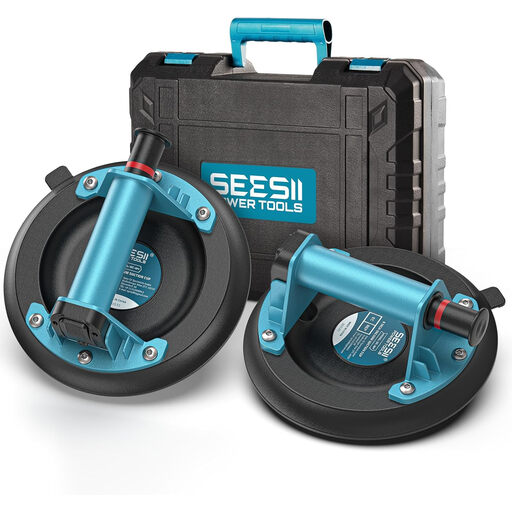
SEESII Vacuum Suction Lifter Tiles, 2-Set 8" Glass Suction Lifter Max.200KG
Why We Recommend This Product When laying large-format and heavy patio slabs, secure handling is critical. This suction lifter for tiles is a specialised tool for laying patio slabs that reduces physical strain and enables precise placement. With a stated suction capacity of up to 200 kg per lifter, it offers a high safety margin for materials like ceramic, glass, or natural stone.
Advantages:
Who It's For: This tool is aimed at ambitious DIYers and professional users who are laying large-format tiles or slabs and prioritise safety, precision, and efficiency.

emmama Floor Scrub Brush with Long Handle, 2 in 1 Scrubber and Squeegee
Why We Recommend This Product The longevity of a patio floor also depends on proper care. This patio cleaning scrub brush is a multifunctional tool that simplifies cleaning. The combination of stiff bristles for removing stubborn dirt and an integrated squeegee for water removal makes it particularly efficient. The adjustable handle and angled brush head allow for an ergonomic working posture.
Advantages:
Who It's For: This cleaning tool is for all homeowners looking for an effective and ergonomic solution for the regular maintenance of their paved outdoor and indoor surfaces.
The products presented here represent a selection for specific use cases. For a broader overview of designs, materials, and formats that might suit your individual project, it's worth taking a look at our complete range.
Explore our full range of patio tiles
1. How do you install interlocking tiles on a balcony? Installing interlocking tiles is generally straightforward. The subfloor must be solid, clean, and level. Start in one corner and connect the tiles by pressing or hooking the interlocking connections together. If necessary, the tiles can be cut to size with a simple saw (e.g., a jigsaw with a fine blade) to fit edges or obstacles. A slope of 1-2% on the subfloor is beneficial to allow water to drain away.
2. What is the difference between WPC and BPC? WPC stands for Wood-Plastic Composite and uses wood fibres as a filler. BPC stands for Bamboo-Plastic Composite and uses bamboo fibres instead. Bamboo is considered a fast-growing renewable resource. In terms of properties like weather resistance and maintenance, both materials are very similar. The choice between WPC and BPC is often a matter of personal preference regarding the origin of the raw material and the specific product characteristics of the manufacturer.
3. What tools do I need to lay patio slabs? The required tools for laying patio slabs depend on the type of slabs and the installation method. For interlocking tiles made of WPC, you usually only need a tape measure and possibly a saw for cuts. When laying heavy stone or ceramic slabs in a gravel bed or on pedestals, you will also need a spirit level, a rubber mallet, a guide line, and potentially a slab lifter or a suction lifter for tiles to position the heavy slabs securely.