
Lieferung heute & morgen

Qualitätsgarantie

Willkommens-Angebote freischalten: KOSTENLOSE Lieferung | Bis zu 80 % RABATT | Kostenlose 30-Tage-JoyPlus-Testphase
App herunterladen
Compostable disposable plates are practical for barbecues, birthday parties, picnics, buffets and catering events. They reduce washing-up and can be sorted or disposed of immediately after the meal. However, the label alone is not enough to base your choice on. The material, coating, size and disposal instructions determine whether a plate is suitable for hot food, greasy dishes or transport.
A plate may be described as compostable without belonging in every food-waste bin. In Germany, regional rules apply to organic waste. Some waste management providers do not accept certified compostable products in the food-waste bin, while others distinguish between industrial composting and home garden composting.
Before buying, you should therefore check:
Sugarcane and bagasse plates are made from fibres left over from sugarcane processing. Even so, whether a particular product may be disposed of with organic waste in your area depends on local regulations.
Oil, sauces and very moist foods put more strain on disposable plates than dry snacks. With thin biodegradable paper plates, stability may decrease if food is left on them for a longer period. Therefore, look for terms such as grease-resistant, oil-resistant, water-repellent or a suitable inner coating.
For curry, barbecue food, salads with dressing or takeaway meals, deep plates or divided versions are often more practical. For hot liquids, you should also check whether the manufacturer explicitly approves this type of use.
Disposable plates measuring 23 cm are suitable for standard main courses and take up relatively little space on a buffet. For smaller desserts or cakes, 15 cm may be enough. For an event with lots of guests, a disposable plate set containing 50 pieces is often easier to manage than several smaller packs.
Do not plan only for the number of people. You may need extras for second helpings, separate courses, damaged plates or guests who use one plate for savoury food and a second for sweet dishes. For catering and takeaway, it is also important to check whether the plate fits into existing packaging.
Bagasse refers to pressed sugarcane fibres. Sugarcane plates are often offered for hot and cold food. Even so, the product information should clearly state whether the plate is grease-resistant, water-resistant or suitable for microwave use.
Paper and card plates may have a food-safe inner coating. One example from the range is the “Jeden Tag Paper Plate 23cm White”: according to the product description, these plates are made from sturdy, food-safe card with a food-safe inner coating. They are designed for hot and cold food and offer grease resistance. The description also points out that they are not microwave-safe and should not be used with boiling liquids.
Reusable versions made from melamine or plastic are an alternative if the plates are intended to be used and washed repeatedly. Melamine should not be confused with compostable disposable plates. For all products, follow the supplier’s material and care instructions.
A diameter of around 22.5 to 23 cm is suitable for main courses, barbecue food and buffet portions. Smaller 15 cm plates are better suited to cake, fruit, finger food or desserts. A plate measuring 27 or 28 cm offers more surface area, but also requires more storage space.
Three-section plates or plates with three compartments keep side dishes, main courses and sauces separate. This is useful for buffets, community events and takeaway meals when different foods should not mix. Check that the individual compartments are large enough for your portions.
“Microwave-safe disposable plates” should only be described as such when the product information explicitly confirms this use. Ochama sugarcane-fibre plates are listed as microwave-safe and resistant to water and oil. Even so, only use the plates within the stated conditions, and do not heat food for longer or at a higher temperature than specified.
Avoid heating products in the microwave if this use has not been expressly approved. This applies particularly to plates with an unknown coating or products whose descriptions contain no information about microwave use.
The following selection categorises products by pack size, material, shape and stated purpose. It does not replace checking the latest product details and disposal instructions.
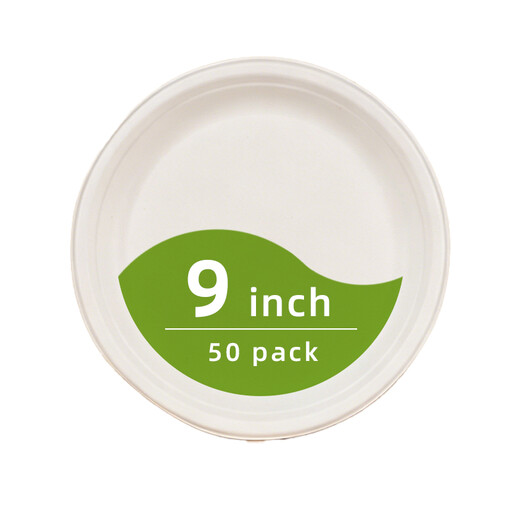
Why this product suits this profile: The pack of 50 plates and 23 cm diameter are designed for private celebrations, barbecues and picnics with several guests. According to the product name, the bagasse plates are suitable for hot and cold food.
The information about the sugarcane material, 23 cm size and 50-piece quantity makes the product easier to compare than vague environmental advertising.
50 pieces; 23 cm format; according to the product name, intended for hot and cold food as well as picnics, birthdays and barbecues.
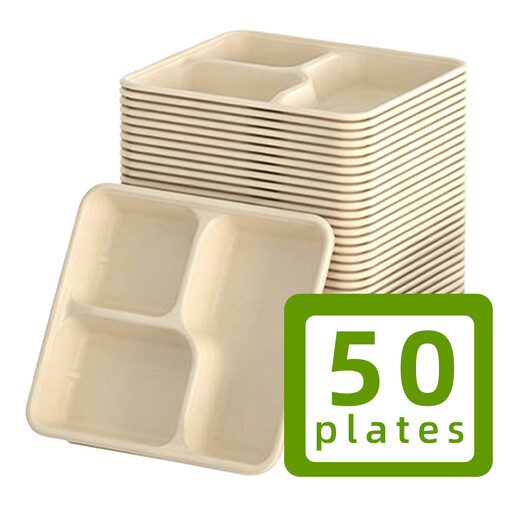
Why this product suits this profile: The three-section design is suitable for people who want to serve the main course, side dishes and sauce separately. The pack contains 50 pieces and measures 21.6 × 23.7 cm according to the product name.
The divided design reduces the mixing of different foods. The supplier also states that the plates are oil-resistant; check the complete product information before use.
Three compartments; 50 pieces; 21.6 × 23.7 cm format; according to the product name, intended for catering, buffets and takeaway.
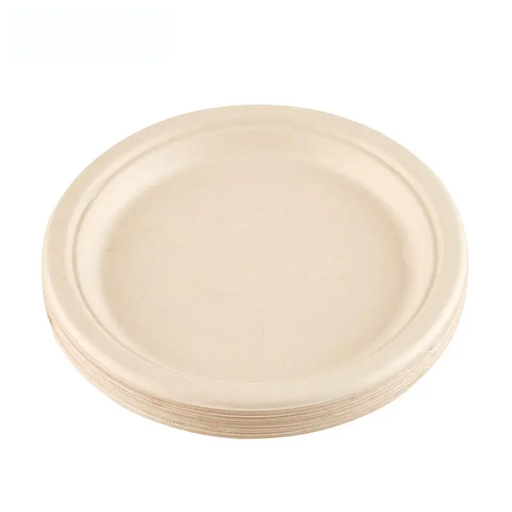
Why this product suits this profile: With a diameter of around 22.5 cm, this format is aimed at households and event organisers specifically looking for a microwave-safe option that is resistant to water and oil.
The product description explicitly states that the plates are microwave-safe and resistant to water and oil. This makes it easier to choose the right option for hot, moist foods.
Food-safe sugarcane fibres; approximately 22.5 cm diameter; according to the product description, microwave-safe and resistant to water and oil.
We have put together a complete, regularly updated list of products that fully meet these strict selection criteria and the safety regulations applicable in the EU.
Before buying, you can quickly tick off these points:
This depends on the material and the product’s approved uses. Sugarcane and bagasse plates are often offered for hot and cold food. For boiling liquids, very oily dishes or food left on the plate for a longer period, follow the manufacturer’s specific instructions.
Not automatically. Disposal rules vary from one region to another. Even if a product is described as compostable, the local waste management provider may not allow it in the food-waste bin. The information on the packaging and the regulations set by your local authority are decisive.
Allow for at least one plate per guest and an additional plate for each extra course. For a buffet or barbecue, a reserve of around 10 to 20 per cent is recommended, depending on the choice of food and the length of the event. Separate plate sizes may be useful for cake, salads and main courses.