
Lieferung heute & morgen

Qualitätsgarantie

Willkommens-Angebote freischalten: KOSTENLOSE Lieferung | Bis zu 80 % RABATT | Kostenlose 30-Tage-JoyPlus-Testphase
App herunterladen
Anyone who travels frequently by car, camper, or boat knows the challenge: keeping food and drinks reliably cool, especially on warm days. A conventional cool box with ice packs quickly reaches its limits. A compressor cool box provides a powerful and flexible solution, cooling independently of the ambient temperature and even offering a freezing function.
This article serves as your guide. We'll introduce how they work, explain key selection criteria, and present a selection of models to help make your decision easier.
Choosing the right model depends on your individual needs. Three criteria are particularly important: power supply, cooling performance, and capacity.
One of the greatest strengths of a compressor cool box is its flexible power supply. Most models can be connected to a vehicle's electrical system (12V for cars, 24V for trucks) as well as a standard wall outlet (230V). This makes a car cool box with 12V and 230V connections exceptionally versatile. You can pre-cool the box at home and then seamlessly continue running it in your vehicle.
A crucial feature is the integrated battery protection system. This system monitors the vehicle's battery voltage and automatically shuts off the cool box before the battery is discharged to a point where the engine won't start. Look for models with a multi-level adjustable battery monitor (e.g., low, medium, high) to tailor the cut-off threshold to your vehicle's battery and usage patterns.
Unlike thermoelectric cool boxes, whose cooling performance is highly dependent on the ambient temperature, a compressor cool box works just like a conventional refrigerator. A compressor pressurises a refrigerant, which generates active and powerful cooling.
This allows the interior to be set precisely to a desired temperature between approximately +20°C and -20°C. As a result, the unit functions not only as a 12V car fridge but also as a fully-fledged freezer for your car. You can make ice cubes, safely transport frozen goods, or simply chill your drinks to the perfect temperature—regardless of whether it's 15°C or 35°C outside.
Capacity is measured in litres and is a key factor.
Modern units often offer useful extra features. A cool box with app control allows for convenient monitoring and temperature adjustment via your smartphone. Other practical features include sturdy wheels and retractable handles for easy transport, interior lighting, separate cooling zones, or a reversible door hinge.
Based on the criteria mentioned, we have compiled a selection of models that cover a range of different needs.

Why it stands out: With a 50-litre capacity, practical wheels, and a removable divider, this model offers a well-designed combination of space and mobility. The two compartments help keep items organised and minimise odour transfer.
Advantages:
Who is it for? Ideal for families, anglers, or campers who need ample storage for longer trips and value ease of use.

Why it stands out: This model is designed for durability and reliability. A special feature is its ability to operate stably at an incline of up to 40 degrees, making it an excellent choice for use on boats or in off-road vehicles.
Advantages:
Who is it for? Perfect for boat owners, off-road enthusiasts, and anyone looking for a durable camping cool box for demanding environments.
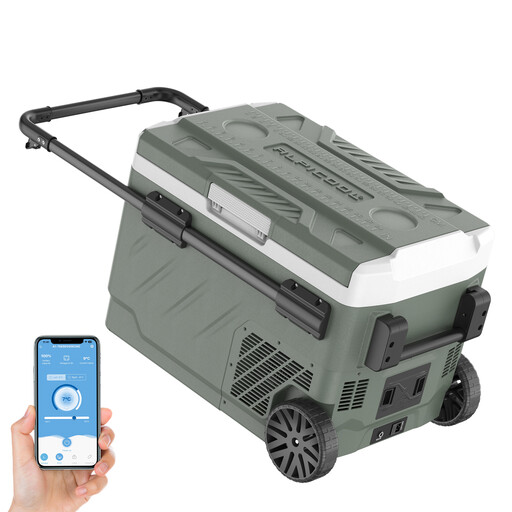
Why it stands out: The standout feature of this 40-litre model is its dual-zone technology. Two independently controlled compartments allow you to cool and freeze simultaneously, offering maximum flexibility for storing different types of food.
Advantages:
Who is it for? For users who want maximum flexibility, such as cooling drinks while simultaneously transporting ice or frozen items.
The selection of portable cooling units is vast, with many other sizes and feature sets available. If the models presented here don't perfectly match what you're looking for, it's worth exploring the wider range.
Discover our full range of 12V portable car refrigerators.
The main difference lies in the cooling technology. A compressor cool box works like a household refrigerator, reaching very low temperatures (down to approx. -20°C) regardless of the outside temperature. A thermoelectric box only cools to a certain level below the ambient temperature (e.g., 20°C below) and generally cannot freeze.
Modern compressor cool boxes are equipped with a multi-stage battery protection system. This monitors the car battery's voltage and automatically shuts the unit off before the battery becomes critically discharged. This ensures that your vehicle will still be able to start.
The power consumption is relatively low. The compressor only runs when needed to maintain or lower the internal temperature. Once the target temperature is reached, it switches off. Many models also feature an ECO mode, which further reduces energy consumption and extends runtime, a particularly useful feature when operating on battery power.