
Lieferung heute & morgen

Qualitätsgarantie
App herunterladen
Kategorien
A compressor cooler is fundamentally different from thermoelectric models due to its cooling technology. While the performance of thermoelectric coolers depends on the ambient temperature, a compressor system operates just like a home refrigerator. It provides consistent, powerful cooling down to freezing temperatures, regardless of high external temperatures. This makes it the preferred solution for users who need reliable cooling and freezing performance on the go, whether as a camping fridge, in a truck, or on a boat.
The right model for you depends on a careful analysis of technical specifications matched to your individual needs.
The internal capacity, measured in litres, determines how much food and drink you can store. However, it's equally important to check the external dimensions to ensure it fits in its intended space in your vehicle (e.g., trunk, footwell, truck cabin). Models with a 15-25 litre capacity are suitable for short trips or solo travellers, while 35-60 litre versions can meet the needs of families or longer journeys.
A key feature of a compressor cooler is its wide temperature range, typically from +20°C down to -20°C. This allows it to function as a refrigerator or a portable freezer. Some models offer a dual-zone system with a removable divider, enabling simultaneous cooling and freezing in a single unit. The cooling speed—the time it takes to reach a set temperature—is another indicator of the compressor's efficiency.
Power supply flexibility is crucial for mobile use. Standard operation includes using a 12V/24V DC power source (from a car or truck's accessory socket) and a 230V AC connection for stationary use. An integrated, multi-level battery protection system (often adjustable to Low, Medium, and High settings) is an essential feature. It prevents deep discharge of the vehicle's battery by automatically shutting off the cooler when the voltage drops to a critical level. The energy efficiency rating provides information on power consumption during operation.
Modern units increasingly offer convenience features that enhance their practical value:
Based on an analysis of technical specifications and practical utility, we present three standout models.
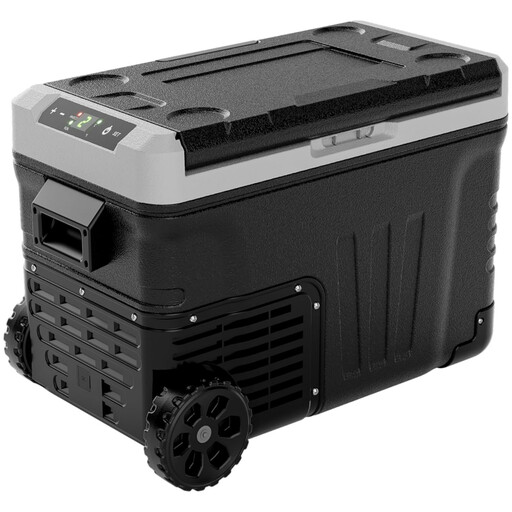
Why we analysed this product: This model combines a medium capacity with a flexible dual-zone design and practical transport features. Its combination of app control, wheels, and dual power options covers a wide range of requirements.
Pros:
Who it's for: Ideal for families and campers who need a flexible cooling and freezing solution with ample capacity for multi-day trips and who value easy transport.
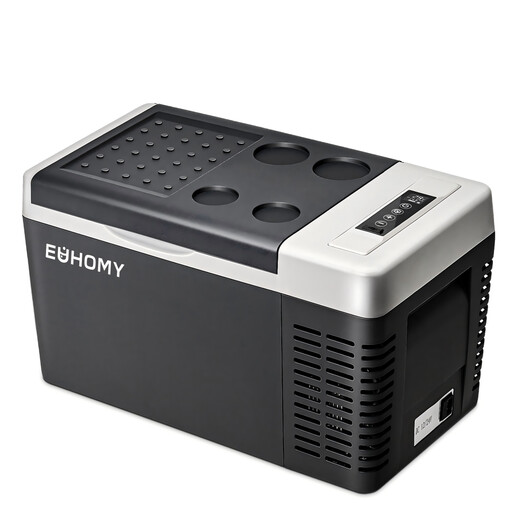
Why we analysed this product: This model's strength lies in its compact design and high efficiency. It's designed for scenarios where space is limited, but cooling performance cannot be compromised.
Pros:
Who it's for: Perfect for solo travellers, couples, or professional drivers who need a space-saving yet powerful 12V electric cooler for daily use.
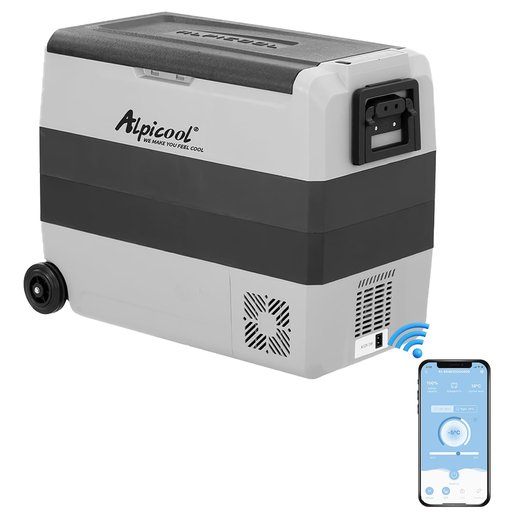
Why we analysed this product: This model addresses the need for maximum capacity and flexibility. With a 60-litre volume and an optional dual-zone function, it's designed for demanding, long-term use.
Pros:
Who it's for: A fitting solution for truck drivers, boat owners, large families, and van-life enthusiasts who need a truck fridge or a cooler for extended camping adventures with maximum storage and high functionality.
The models featured here cover common requirement profiles. However, if you require a different capacity, specific dimensions, or alternative features, you can find a wider selection of units in our main category.
Discover More Portable Camping Fridge Freezers
1. How noisy is a compressor cooler? Modern compressor coolers have low noise emissions. Most models operate at a volume between 40 and 45 decibels (dB). This is comparable to a quiet whisper or the sound of a modern home refrigerator and is generally not considered disruptive in a vehicle cabin or tent.
2. How does the battery protection on a 12V cooler work? The battery protection is an electronic circuit that monitors the voltage of the connected power source (e.g., the car battery). If the voltage drops below a predefined threshold, the electronics automatically shut off the cooler. This prevents a deep discharge of the vehicle's battery, ensuring there is enough power left to start the engine. Typically, there are three adjustable levels (e.g., Low, Medium, High) to adapt the protection to different battery types and usage scenarios.
3. Can a compressor cooler also heat? No, a standard compressor cooler is designed exclusively for cooling and freezing. Its technology is based on a refrigeration cycle that removes heat from the interior. A heating function is not technically part of its design. Models with a heating function are typically based on thermoelectric technology (Peltier elements), which, however, offer significantly lower cooling performance.