
Lieferung heute & morgen

Qualitätsgarantie

Willkommens-Angebote freischalten: KOSTENLOSE Lieferung | Bis zu 80 % RABATT | Kostenlose 30-Tage-JoyPlus-Testphase
App herunterladen
By the Joybuy Product Recommendation Officer, July 04, 2026
Anyone who spends a lot of time on the road—whether for camping, in a van, or on long-haul truck journeys—knows the problem: conventional ice packs and basic coolers quickly reach their limits. Food spoils, and drinks turn lukewarm. A compressor cooler offers a reliable solution. It functions like a small, portable refrigerator, keeping its contents consistently cool or even frozen, regardless of the ambient temperature. This article serves as a guide to help you understand how they work and find the right model for your needs.
The range of available models is vast. To make the right choice, you should consider several technical parameters that are crucial for practical use.
The usable volume, specified in liters, determines how many provisions you can store. A compact 9 to 15-liter cooler may be sufficient for a truck driver or a day-tripper. Families or van-lifers who want to be self-sufficient for several days often need models with 40 liters or more. Pay attention not only to the internal volume but also to the external dimensions to ensure the portable refrigerator fits into your vehicle or boat.
Power supply flexibility is a key feature. Most models are designed as a 12V electric cooler for connection to the cigarette lighter socket in a car or truck. Many also offer a 24V connection and an adapter for a 230V home outlet. For maximum independence, especially for van life or camping, a battery-powered cooler is a smart option. Some units can even be charged via solar panels. An integrated, multi-level battery protection system prevents the vehicle's battery from being drained.
A high-quality compressor cooler can reach temperatures as low as -20°C, providing a true cooler with a freezer function. This allows you to not only chill drinks but also safely transport frozen goods. Models with two separate temperature zones (dual-zone) offer the ability to cool and freeze simultaneously. Other useful features can include app control, interior lighting, or an especially quiet operation that won't disturb your sleep in the camper.
Based on the criteria mentioned, we have compiled a selection of models with different specializations.

Why It Stands Out: The ECOFLOW GLACIER Classic is distinguished by its outstanding versatility. It offers two independently controlled temperature zones and can be powered by an optional 298 Wh battery. According to the manufacturer, this allows for up to 39 hours of off-grid cooling.
Pros:
Who It's For: This model is aimed at campers, boat owners, and van-lifers seeking a powerful and versatile cooling solution for extended, off-grid adventures.
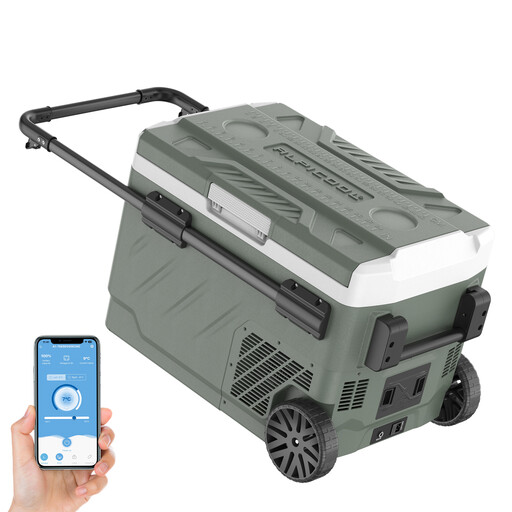
Why It Stands Out: The Alpicool 40L car refrigerator combines a generous capacity with practical details for transport. The integrated wheels and extendable handle make it significantly easier to move, while app control provides a modern user experience.
Pros:
Who It's For: Ideal for families and groups who need a spacious and easy-to-move camping fridge for trips and vacations.

Why It Stands Out: This model focuses on maximum compactness and low weight. With just a 9-liter capacity and weighing only 6.7 kg, the Alpicool C9PT is an extremely space-saving solution.
Pros:
Who It's For: The perfect choice as a truck fridge, for commuters, or solo travelers who need a reliable but discreet cooling option for daily use.
This selection represents just a small sample of the available models. Depending on your specific needs, there are numerous other sizes, features, and designs that might be perfect for your plans.
Discover our entire range of mobile cooling solutions in the Cool Cars category and find the right device for your next adventure.
A compressor cooler uses a refrigerant circuit, similar to a household refrigerator. This allows it to achieve very low temperatures (even below freezing) regardless of the ambient temperature and operate very energy-efficiently. In contrast, a thermoelectric cooler can only cool down to a certain level below the ambient temperature (e.g., 20°C) and consumes comparatively more power to do so.
Power consumption depends on the size, insulation, set temperature, and ambient temperature. While the compressor is running, the power draw is often between 45 and 60 watts. However, because the compressor only runs intermittently to maintain the temperature thanks to good insulation, the average consumption over 24 hours is significantly lower. Precise figures can be found in the technical specifications provided by the respective manufacturer.
Yes, most compressor coolers are designed as a cooler with a freezer function. They typically reach temperatures of -18°C to -20°C, which matches the standard for household freezers. This makes them excellent for safely transporting frozen goods or making ice cubes on long journeys.