
Lieferung heute & morgen

Qualitätsgarantie

Willkommens-Angebote freischalten: KOSTENLOSE Lieferung | Bis zu 80 % RABATT | Kostenlose 30-Tage-JoyPlus-Testphase
App herunterladen
Reliable on-the-go cooling is essential for many activities, whether it's camping, long road trips, or the daily professional life of a truck driver. A compressor cooler offers a high-performance and efficient solution that far exceeds the capabilities of conventional coolers. Unlike thermoelectric models, it functions just like a home refrigerator, able to cool and even freeze regardless of the ambient temperature.
This article serves as a guide. It explains the most important selection criteria and presents a range of models with different features to help make your decision easier.
The right model depends heavily on your specific needs. You should consider three key aspects in your decision.
The flexibility of the power supply is a crucial feature. Most models are designed as 12V/230V electric coolers, allowing them to be operated in a vehicle (via the cigarette lighter) and from a standard wall outlet. For maximum independence, a cooler with a battery is a smart option. These models can run for hours or even days without an external power source. Some units can also be connected to mobile solar panels and used as a solar-powered cooler, which is particularly advantageous for extended stays off the grid. Look for an integrated battery monitor that protects your vehicle's battery from deep discharge.
A key strength of compressor units is their ability to function as a portable fridge-freezer. Temperatures can be precisely set, often in a range from +20°C to -20°C. Models with two independently controlled zones offer exceptional flexibility: you can chill and freeze simultaneously. This is ideal for keeping drinks cold while safely storing frozen goods. Cooling speed is also a relevant factor; some devices can cool their contents down to the desired temperature in a short amount of time.
The capacity, specified in litres, should match your requirements. For day trips or individuals, smaller models under 30 litres are often sufficient. Families or users who need to store provisions for several days should consider models with 40 litres or more. A durable construction is essential for a camping cooler or car cooler to withstand the rigours of transport. The noise level, measured in decibels (dB), is especially important if the cooler will be operated in the sleeping area of an RV or a truck cabin. Levels below 45 dB are considered quiet and generally do not disturb sleep.
Here is a selection of units that cover different requirements and applications.

What sets it apart: The ECOFLOW GLACIER is a versatile device that stands out with its dual-zone cooling and numerous power options. It can be used as a refrigerator and freezer at the same time and offers excellent off-grid capability with an optional battery.
Pros:
Who it's for: This model is aimed at demanding users such as van-lifers, campers, and boat owners who need a flexible and powerful cooling solution for multi-day trips and value the option of off-grid operation.
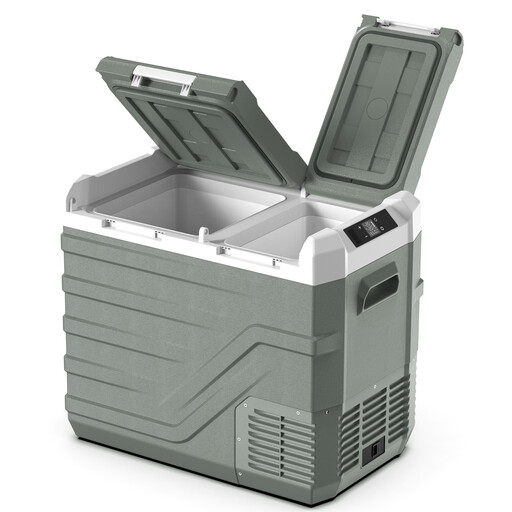
What sets it apart: The Alpicool NLS55 is a compressor cooler that also features two separately controlled zones and offers a good ratio of capacity to external dimensions. The integrated battery monitor makes it a practical solution for in-vehicle use.
Pros:
Who it's for: Ideal for truck drivers, RV travellers, and families looking for a reliable fridge-freezer combination with smart energy management for longer journeys.
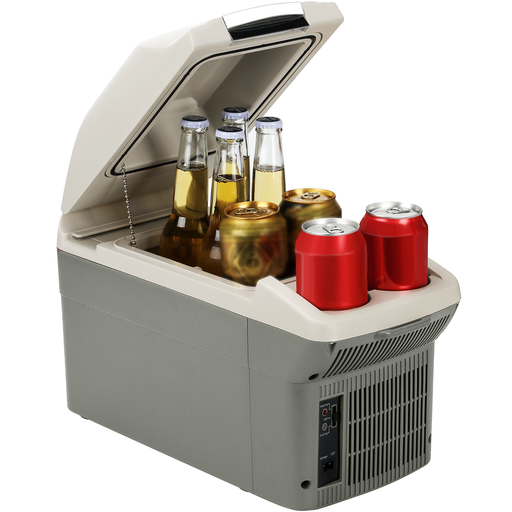
What sets it apart: The ICEROVER PN-09 is a thermoelectric cooler and represents a compact alternative for shorter trips. Its strength lies in its dual function for cooling and warming, as well as its vehicle-optimised design.
Pros:
Who it's for: This device is a great choice for commuters, day-trippers, or as a secondary unit in the car to keep snacks and drinks cool or warm for short periods. It is not designed for freezing or long-term off-grid use.
If these models don't meet your specific requirements, or if you are looking for different sizes and features, you can find a wider selection in our category.
Discover more insulated freezer coolers here
1. How much power does a compressor cooler use? Power consumption depends on several factors: the set temperature, ambient temperature, volume, and insulation of the cooler. However, compressor coolers are very efficient because the compressor only runs when the internal temperature needs to be adjusted. The average consumption is often between 40 and 60 watts during the cooling cycle. Models like the EcoFlow GLACIER provide consumption figures for specific scenarios (e.g., 190 Wh/24h for cooling at 4°C), which offers a good benchmark.
2. Can you run a compressor cooler continuously in a car? Yes, this is possible as long as the cooler has an integrated battery monitor. This feature, as offered by the Alpicool NLS55 for example, cuts off the power supply before the vehicle's battery voltage drops to a critical level. For worry-free continuous operation, especially when the vehicle is parked, it is recommended to connect it to a separate auxiliary battery or use a cooler with a battery.
3. What is the difference between a compressor cooler and a thermoelectric cooler? The main difference lies in the cooling technology and performance.