
Lieferung heute & morgen

Qualitätsgarantie

Willkommens-Angebote freischalten: KOSTENLOSE Lieferung | Bis zu 80 % RABATT | Kostenlose 30-Tage-JoyPlus-Testphase
App herunterladen
Reliable cooling is essential, whether you're travelling, camping, or for professional daily use. But the market for portable coolers is overwhelming, and not every device delivers on its promise. The wrong choice often leads to lukewarm drinks, spoiled food, or in the worst-case scenario, a dead car battery. As your Joybuy Product Recommendation Officer, I'll help you identify the crucial features to make an informed decision.
Before you invest, you should be aware of three common pitfalls that often lead to disappointment:
To avoid these problems, you should check three core technical parameters. These define the performance and reliability of a portable cooling and freezing solution.
The crucial difference lies in the technology. A compressor cooler works just like your home refrigerator. It uses a refrigerant and a compressor to actively remove heat.
Thermoelectric boxes are only suitable for keeping already chilled drinks cold for a few hours. For everything else, especially for storing food on longer trips, compressor technology is the right choice.
A good camping cooler must be flexible and safe to operate. Look for two features:
The capacity is specified in litres and should match your intended use case.
A Dual-Zone Cooler provides maximum flexibility. These models have two separate compartments whose temperatures can be controlled independently. This allows you to chill drinks and deep-freeze food at the same time.
Here are some models that represent a smart choice for specific user groups based on objective technical features.
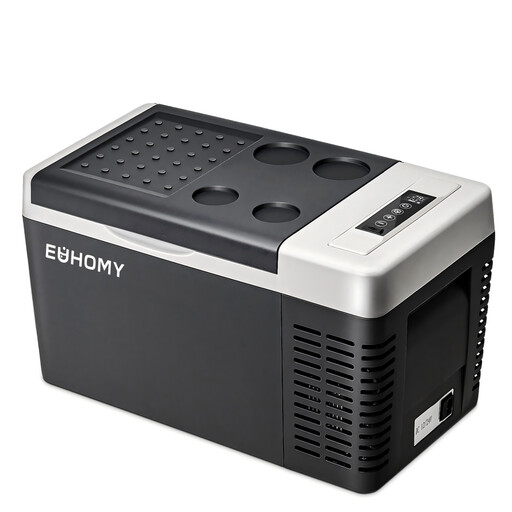
Why This Fits Their Persona: Ideal for short trips or as a compact addition to your car. The 18-litre volume is sufficient for drinks and provisions for one to two people without taking up much trunk space.
Delivers true compressor performance down to -20°C, bypassing the performance trap of thermoelectric boxes. The integrated 3-stage battery monitor reliably protects against draining the vehicle battery.
Compact design with full-fledged cooling and freezing functions. App control offers added convenience. Includes 12/24V DC and 100-240V AC adapters for flexible use.
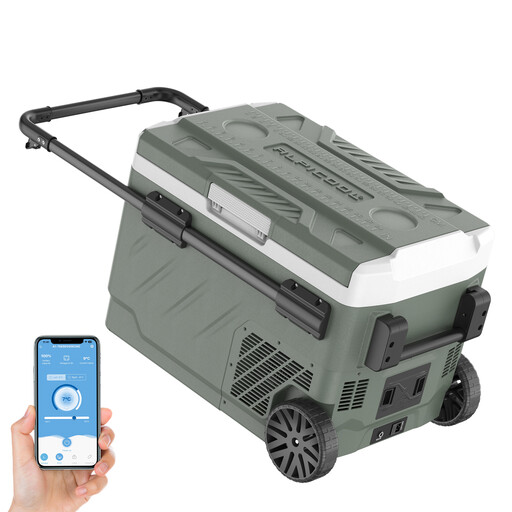
Why This Fits Their Persona: Perfect for family vacations or as a permanent fixture in an RV. The 40-litre capacity and dual zones allow for simultaneous storage of chilled drinks and frozen food for the grill. Wheels and a telescopic handle make it easy to transport to the campsite.
The dual-zone function solves the problem of having to choose between cooling and freezing. The solid insulation and efficient compressor (with ECO mode) prevent continuous operation and reduce power consumption and noise levels.
Flexible, separately controlled temperature zones. High mobility thanks to sturdy wheels and a retractable handle. Additional features like an integrated cutting board and LED interior lighting are practical details for camping.

Why This Fits Their Persona: Designed for professional use in trucks, for long expeditions, or for large groups needing a self-sufficient and extensive food supply. The massive 95-litre volume provides space for a week's worth of provisions or more.
Solves the capacity problem once and for all. The double-door, dual-zone design allows for optimized access to chilled or frozen items without affecting the temperature in the other compartment, bypassing the insulation trap common in large boxes.
Very large 95-litre capacity. Independently controlled zones with separate lids for maximum efficiency. Comprehensive control options via touchscreen and app, plus a USB port for charging devices.
We've compiled a complete, up-to-date list of products that fully meet these strict selection criteria and rigorous safety standards.
1. How much power does a compressor cooler use? Power consumption depends on the size, set temperature, ambient temperature, and the quality of the insulation. A modern 40-litre compressor cooler consumes about 45-60 watts on average, but only when the compressor is actively running. In ECO mode and with good insulation, the compressor only turns on periodically, which often reduces the average consumption over 24 hours to between 0.5 and 1 kWh.
2. Can I run a compressor cooler with a power station or solar panel? Yes, this is a very common application, especially for off-grid camping. Many users power their electric car cooler with a portable power station, which can in turn be charged by a solar panel. Ensure the power station has a 12V DC output (cigarette lighter socket) and that its capacity is sufficient for the planned duration of use.
3. How long does a compressor cooler keep its temperature without power? This depends directly on the quality and thickness of the insulation, as well as the outside temperature. A well-insulated model can maintain its temperature for several hours, especially if it is fully loaded and not opened frequently. According to manufacturer specifications, some models can retain the cold for several hours after being turned off, which is useful for short ferry crossings or shopping trips.