
Lieferung heute & morgen

Qualitätsgarantie

Willkommens-Angebote freischalten: KOSTENLOSE Lieferung | Bis zu 80 % RABATT | Kostenlose 30-Tage-JoyPlus-Testphase
App herunterladen
By the Joybuy Product Recommendation Officer, July 28, 2026
Anyone who relies on chilled drinks and fresh food while on the go knows the problem: many devices advertised as "coolers" turn out to be inadequate, leading to frustration instead of refreshment. Before you make a decision, it's crucial to understand the most common pitfalls, which often only become apparent after the purchase.
A mobile cooling solution is an investment in comfort and independence, whether for camping, long-haul truck journeys, or family holidays in an RV. But the market is flooded with products making lofty claims. We'll show you what to look for to make an informed choice.
Many buyers focus on superficial features like price or the advertised volume, overlooking crucial technical details. This often leads to disappointment.
The Technology Trap: Thermoelectric Instead of Compressor The most common mistake is buying a thermoelectric cooler assuming it will cool like a refrigerator. These models can often only lower the internal temperature by a specific amount (e.g., 15–20°C) below the ambient temperature. On a hot summer day with 30°C inside the car, that still means a lukewarm 10–15°C inside—not cold enough for safe food storage and a far cry from ice-cold drinks. A true cooler with a freezer function absolutely requires compressor technology.
Lack of Power Supply Flexibility A device that only has a 12V car connection is only half the solution. For use at a campsite, at home, or in a hotel room, an additional 230V connection is essential. Professional users like truck drivers also need compatibility with 24V electrical systems. An integrated battery monitor is also not a luxury but a necessity to prevent the cooler from draining the vehicle's battery.
Misleading Volume Specifications The volume listed in litres says little about the actual usable storage space. A poorly shaped interior, a protruding cooling unit, or a lack of dividers can drastically reduce the effective volume. It's frustrating when the 1.5-litre bottles you bought don't end up fitting upright.
To avoid the mistakes mentioned above, you should focus on three core technical aspects. These determine the performance, versatility, and practical utility of your portable cooler.
For reliable and powerful cooling that is independent of the ambient temperature, there is no substitute for a compressor cooler. Similar to your refrigerator at home, a compressor unit can reach and maintain temperatures down to a freezing -20°C.
A high-quality 12V and 230V electric cooler offers maximum flexibility. Look for models that can be powered by both direct current (DC) from the vehicle (12V for cars, 24V for trucks) and alternating current (AC) from a wall socket (100-240V). A multi-stage battery monitor is an indispensable feature that protects the vehicle battery from deep discharge by automatically shutting off the cooler when the battery level is low.
Modern compressor coolers offer a wide temperature range, often from +20°C to -20°C. Models with two separately controlled zones are particularly practical. This allows you to use one side for chilling drinks and the other for freezing food. A mobile cooler with app control via Bluetooth or Wi-Fi further enhances convenience, as you can monitor and adjust the temperature without having to open the unit.
We have matched several models to typical use cases based on the criteria above.
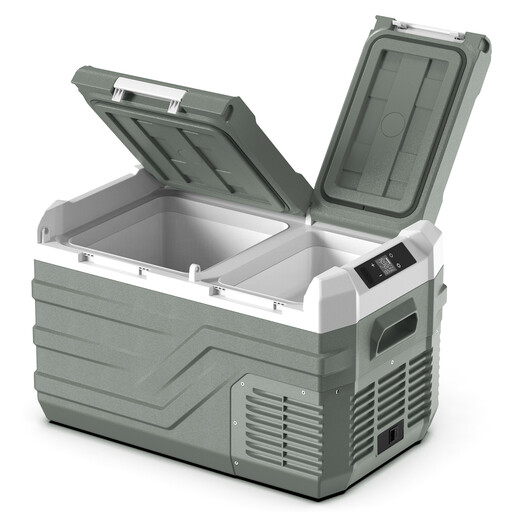
Why this model is a good fit: At 23 litres, it offers enough space for weekend trips without being bulky. The compressor technology ensures reliable cooling, and the dual-zone function is a remarkable feature in this compact class.
This model uses genuine compressor technology instead of unreliable thermoelectric and supports operation on 12V/24V DC as well as 100-240V AC.
Compact design with two separately controlled temperature zones and quiet operation of under 45 dB, according to the manufacturer.
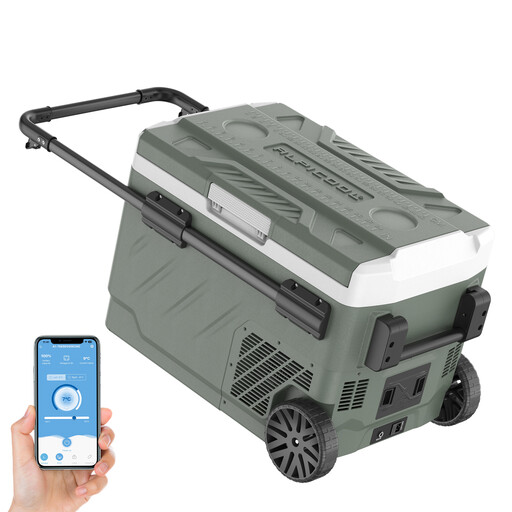
Why this model is a good fit: With a 40-litre volume, two zones, and practical details like wheels and a retractable handle, this cooler is ideal for families in an RV or on longer road trips. The app control offers added convenience.
Solves the problem of unwieldy size with integrated wheels and offers true freezing performance with its dual-zone function, going beyond simple cooling.
A great balance of capacity and portability, supported by app control, transport wheels, and a reversible door for flexible placement.

Why this model is a good fit: With an enormous 95-litre capacity, two separate zones with their own lids, and full 12V/24V/230V compatibility, this unit is designed for continuous use in a truck or on long expeditions.
Addresses the need for very large storage space and professional-grade power connections (including 24V for trucks) that are often missing from standard models.
Very large volume with two separately accessible and controllable zones, Wi-Fi app control, and an integrated USB port for charging devices.
We've compiled a complete, up-to-date list of products that fully meet these strict selection criteria and relevant safety regulations.
A compressor cooler works like a household refrigerator and can cool and even freeze (typically down to -20°C) regardless of the outside temperature. A thermoelectric cooler can only lower the internal temperature by a fixed amount below the ambient temperature, which is often insufficient for safe cooling in high heat.
Power consumption varies depending on the size, set temperature, and ambient temperature. However, modern units are very efficient. Many models feature an ECO mode that further reduces power draw. The power consumption is often around 45-60 watts during the cooling cycle. Once the target temperature is reached, the compressor turns off and consumes minimal power until it needs to cycle on again.
Yes, many compressor coolers can be operated in conjunction with a solar panel setup and a sufficiently sized battery (e.g., a power station). This is a popular solution for off-grid camping. Make sure the solar panel's output and the battery's capacity are matched to the cooler's consumption to ensure continuous operation.