
Lieferung heute & morgen

Qualitätsgarantie

Willkommens-Angebote freischalten: KOSTENLOSE Lieferung | Bis zu 80 % RABATT | Kostenlose 30-Tage-JoyPlus-Testphase
App herunterladen
As a Joybuy Product Recommendation Officer, I see customers struggle daily with the vast selection of mobile cooling units. A high-quality compressor cooler is a significant investment for any camper, truck driver, or outdoor enthusiast. However, the market is flooded with devices whose marketing promises often fall short in practice. This guide will help you identify the crucial features and avoid common purchasing traps, enabling you to make an informed decision.
Before we dive into the technical details, let's look at the three most common and costly mistakes buyers make. Knowing these is the first step toward a satisfying purchase.
To avoid a poor investment, focus on three core technical aspects. These determine the performance, efficiency, and longevity of your portable cooler.
By far the most important decision is the choice of cooling technology. A compressor cooler works just like your home refrigerator. It uses a refrigerant and a compressor to actively remove heat from the interior.
This makes it the only reliable choice for a portable car refrigerator that needs to cool and freeze dependably, even in high ambient temperatures.
A flexible power supply is crucial for mobile use. Look for models that can be operated with both 12V/24V DC (direct current from the vehicle) and 100-240V AC (alternating current from a wall socket).
Another important feature is the integrated battery protection system. This is usually adjustable in three stages (High, Medium, Low) and automatically shuts off the cooler before the vehicle's battery is too deeply discharged. This prevents you from being stranded with a dead battery—an indispensable safety feature for any RV or camping cooler.
The required size depends on the trip duration and the number of people. As a rule of thumb:
For maximum flexibility, consider a dual-zone cooler. These models have two separate compartments whose temperatures can be regulated independently. This allows you to cool and freeze food simultaneously—a significant advantage on long journeys.
Here are three recommendations tailored to different use cases that meet the criteria mentioned above.
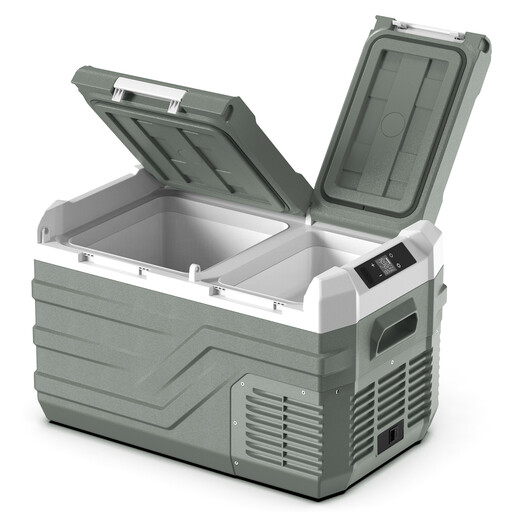
Why it's a good fit: At 23 litres, it's compact enough for the trunk of a standard car, yet its compressor technology delivers genuine cooling and freezing performance. Ideal for short trips where you don't want to go without chilled drinks and fresh snacks.
This model is a true compressor cooler, thereby bypassing the "technology fallacy." Despite its compact size, it offers a dual-zone function, which is uncommon for this class.
Compact design with true freezing capability down to -20°C and a flexible power supply (12/24V DC, 100-240V AC).
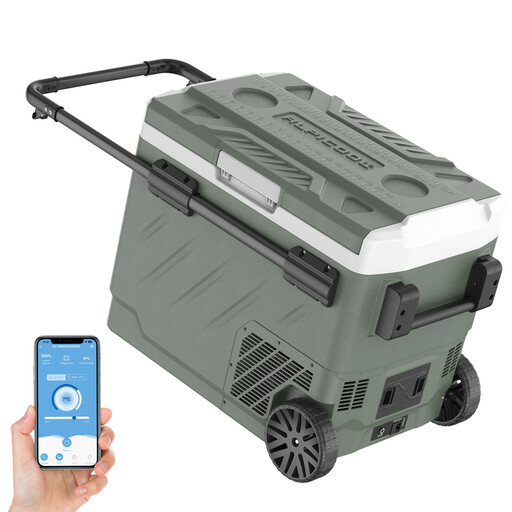
Why it's a good fit: With a 49-litre capacity and two independently controlled zones, this cooler is ideal for families or extended off-grid tours. It offers enough space to simultaneously cool and freeze supplies for several days. The transport wheels and retractable handle make it easy to move around.
This model solves the "incorrect capacity planning" problem with its generous and intelligently divided volume. The dual-zone function provides the flexibility needed for long journeys.
Large volume (49L) with true dual-zone control, app management, and practical mobility features like wheels and a handle.
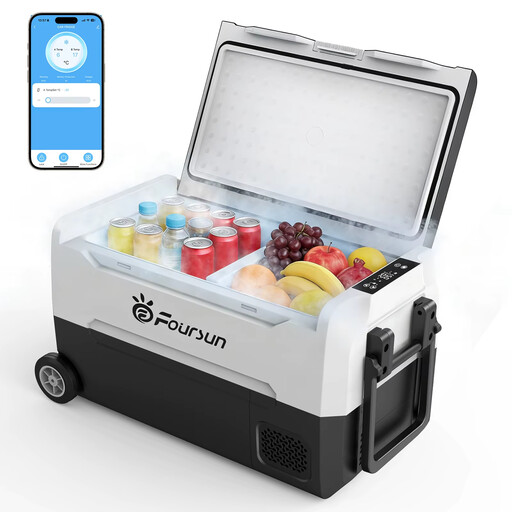
Why it's a good fit: At 35 litres, this cooler offers a well-balanced size for a wide range of applications. Control via a Bluetooth app is a modern convenience feature that allows you to monitor and adjust the temperature without having to open the cooler.
The app control and the explicitly mentioned ECO mode directly address concerns about high power consumption and battery strain. This enables more efficient use, especially during off-grid camping.
Remote control and monitoring via a smartphone app, plus an efficiency-focused ECO mode.
We have compiled a complete, up-to-date list of products that fully meet these strict selection criteria and applicable regulations.
The runtime depends on several factors: the car battery's capacity, the set temperature, the ambient temperature, the cooler's insulation, and how often it is opened. A modern, efficient 40-litre camping cooler can often run for 24 to 48 hours on a typical 80 Ah car battery in moderate temperatures with the battery protection system active, all without needing to start the engine.
It's not essential for day trips. However, if you're travelling for longer than a weekend and want to transport both fresh food (e.g., vegetables, dairy) at around 4°C and frozen goods (e.g., meat, ice cream) at -18°C, a dual-zone cooler is a significant upgrade in convenience and almost indispensable.
The compressor's power consumption, measured in watts (e.g., 60 W), is nearly identical at both voltages. The difference lies in the current (amperes), which is higher at 12V than at 230V to achieve the same power output. The energy efficiency of the cooler itself does not change. The key factor for total consumption is how often and for how long the compressor needs to run to maintain the temperature (its duty cycle).