
Lieferung heute & morgen

Qualitätsgarantie

Willkommens-Angebote freischalten: KOSTENLOSE Lieferung | Bis zu 80 % RABATT | Kostenlose 30-Tage-JoyPlus-Testphase
App herunterladen
Reliable on-the-go cooling isn't a luxury; it's a necessity—whether for camping, long road trips in an RV, or for professional drivers on the job. However, the market for mobile cooling solutions is crowded and filled with marketing promises that often fall short. Choosing the wrong cooler not only leads to lukewarm drinks but also to wasted money and, in the worst-case scenario, a dead vehicle battery.
This guide will help you identify the crucial features and avoid common pitfalls, enabling you to make an informed decision and select a compressor cooler that truly meets your needs.
Before we dive into the technical details, let's look at the three most common and costly mistakes buyers make.
To make a future-proof choice, focus on these three core aspects. They determine the performance, efficiency, and practicality of your mobile cooling solution.
By far the most important feature is the cooling technology. A compressor cooler offers decisive advantages:
Flexibility in power supply is crucial for mobile use. A good model should offer multiple connection options:
Pay attention to the power consumption, often specified in watts (power draw) or kWh/24h (energy consumption over 24 hours). Many models feature an ECO mode, which reduces the compressor's output and further lowers energy consumption—ideal for running on a vehicle battery or a power station.
Think carefully about what you need to cool. The volume is given in litres and determines how much food and drink will fit.
Some advanced models offer a dual-zone cooler. These have a divider and allow you to run two different temperature zones simultaneously—for example, one zone for cooling drinks and another for deep-freezing food. Features like a cooler with app control allow for convenient monitoring and temperature adjustment via your smartphone.
Here are some models that represent a considered choice for specific user groups, based on objective features.

Why it's a good fit: With 55 litres of space, this cooler offers ample room for a family's provisions for a long weekend. The integrated wheels and handle make transport from the car to the campsite much easier. The app control is a convenient extra for monitoring the temperature without having to open the lid.
It uses a real compressor for reliable cooling down to -20°C and includes an integrated battery protection system. The large single compartment maximises usable storage space.
Large volume (55L), flexible power supply (12/24V DC & 100-240V AC), convenient app control, and transport wheels.
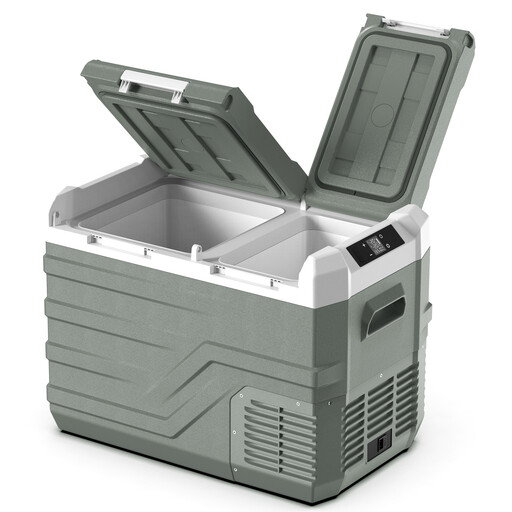
Why it's a good fit: The compact design with a dual-zone function is ideal for use in tight spaces like a truck cab. It allows you to keep drinks cool while simultaneously storing frozen items for meals on the road. The two separate lids minimise cold loss when opening.
Offers true compressor performance with two independently controlled zones. The three-stage battery protection system reliably safeguards the vehicle battery, which is essential for professional use.
Dual-zone cooler, separate lids, compact dimensions, and quiet operation at under 45 dB according to the manufacturer.

Why it's a good fit: This device is designed for maximum self-sufficiency. With the optional 298Wh plug-in battery, it can run for up to 39 hours without an external power source, according to manufacturer EcoFlow. Its compatibility with solar panels and dual-zone function make it the ideal solution for long, off-grid trips.
It not only offers a compressor and battery protection but also solves the power supply problem with an optional battery and solar charging capability. This completely prevents any strain on the vehicle's battery.
Optional battery operation, solar charging capability, dual-zone cooling, and very quiet operation at under 39 dB according to the manufacturer.
We have compiled a complete, up-to-date list of products that fully meet these strict selection criteria and UK safety regulations.
1. How loud is a compressor cooler in operation? The noise level is an important factor, especially if you plan to sleep in the same space (e.g., in a campervan). Modern compressor coolers are relatively quiet. Most manufacturers specify a noise level of under 45 decibels (dB), which is comparable to a quiet conversation or a modern refrigerator. Models focused on quiet operation can even achieve levels below 40 dB.
2. Can I leave a compressor cooler in my car permanently? Yes, as long as the cooler has a reliable, multi-stage battery protection system. This safety mechanism is crucial. You can typically choose between three levels (e.g., High, Medium, Low). The high setting shuts the cooler off earliest, offering the most protection for your starter battery, while the low setting allows for a longer runtime but can be risky for vehicles with only one battery.
3. How much power does a 12V electric cooler use? Power consumption depends heavily on the set temperature, ambient temperature, insulation, and operating mode (MAX or ECO). In ECO mode, the compressor runs less frequently and at a lower power, significantly reducing consumption. A typical value for a 40-litre cooler in refrigeration mode (approx. 4°C) is around 0.5-1.0 amp-hours (Ah) per hour on average. For freezing, the consumption is correspondingly higher. These values are helpful for sizing an auxiliary battery or a solar panel system.