
Lieferung heute & morgen

Qualitätsgarantie

Willkommens-Angebote freischalten: KOSTENLOSE Lieferung | Bis zu 80 % RABATT | Kostenlose 30-Tage-JoyPlus-Testphase
App herunterladen
Reliable cooling is essential, whether you're travelling, camping, or on the job. But the market for portable coolers is overwhelming, filled with marketing claims that often don't deliver. As a Joybuy Product Recommendation Officer, I see the common pitfalls that lead to costly purchasing mistakes every day. Before you invest, you should know the most common problems.
A well-informed decision protects you from these issues. A compressor cooler is often the technically superior solution.
To make the right choice, you should focus on three core technical parameters that determine performance and reliability.
The fundamental difference lies in how they work. A compressor cooler operates just like your home refrigerator. A compressor circulates a refrigerant to transfer heat out of the interior.
For reliable cooling in all weather conditions, compressor technology is the definitive choice.
A portable cooler often runs for hours or even days. Its power consumption is therefore a critical factor, especially when running on battery power.
The capacity should be based on your needs. Consider what you need to cool: upright 1.5-litre bottles, a week's worth of food, or just a few drinks?
Instead of presenting an overwhelming list, we've selected models that meet specific needs and avoid the common pitfalls mentioned.

Why This Fits Their Persona: Its compact size is ideal for the boot of a car or a smaller van. The 21-litre volume is enough to store provisions for one or two people over a weekend. The app control is a convenient feature in this price range.
The integrated three-stage battery monitor reliably prevents deep discharge of the vehicle battery. The compressor technology ensures consistent cooling performance down to -20°C, regardless of the outside temperature.
Control via smartphone app; Low power consumption in ECO mode (45W according to the manufacturer); Quiet operation at just 42 dB.
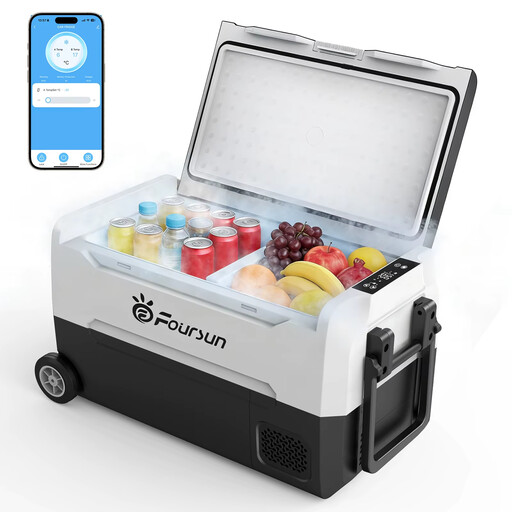
Why This Fits Their Persona: With 35 litres of capacity, this cooler offers enough space for a small family's provisions on a multi-day trip. The integrated wheels and handle make it much easier to transport from the car to the tent or holiday rental.
The volume is practical and not limited by a poor design. The ECO mode ensures very low energy consumption (0.18 kWh/day according to the manufacturer), which protects the vehicle battery even during longer stops.
Remote control via Tuya Smart App; Compatible with 12V/24V DC and 100-240V AC; Integrated wheels for easy transport.

Why This Fits Their Persona: Ideal for use in an RV, for truck drivers, or for large groups. The large capacity of almost 50 litres and the two separate cooling zones allow for simultaneous storage of refrigerated and frozen goods without odour transfer.
The dual-zone design solves the problem of poor organisation in large coolers. The robust, shockproof construction and reliable battery monitor are designed to meet the demands of continuous use.
Two separate cooling zones; LCD touch panel and Bluetooth control; Very quiet operation at 40 dB, suitable for sleeping cabins.
We have compiled a complete, up-to-date list of products that fully meet these strict selection criteria and EU safety regulations.
1. How loud is a compressor cooler during operation? Modern compressor coolers are surprisingly quiet. Many models operate at a noise level below 45 decibels (dB), which is comparable to a quiet conversation or a modern refrigerator. This is quiet enough to sleep in an RV or van without being disturbed. Pay attention to the decibel rating in the product specifications.
2. How do I properly connect a compressor cooler in my car? Most models come with a 12V cable for the cigarette lighter socket. Ensure the plug is firmly seated in the socket to guarantee a stable power supply. For vehicles with multiple 12V outlets, it's advisable to use the one rated for higher loads (often noted in the vehicle's owner's manual). For a permanent installation, such as in a camper van, direct wiring to the battery via an appropriate fuse is recommended.
3. Do I need a second battery to run the cooler? For weekend trips or daily use where the vehicle is driven regularly, the starter battery combined with a reliable, three-stage battery monitor is usually sufficient. For longer off-grid trips lasting several days without running the engine (e.g., wild camping), a separate leisure battery—ideally a LiFePO4 battery—is a very wise investment. It ensures the cooler can run continuously without jeopardising the vehicle's ability to start.