
Lieferung heute & morgen

Qualitätsgarantie

Willkommens-Angebote freischalten: KOSTENLOSE Lieferung | Bis zu 80 % RABATT | Kostenlose 30-Tage-JoyPlus-Testphase
App herunterladen
By the Joybuy Product Recommendation Officer, July 28, 2026
Anyone who relies on fresh food and chilled drinks while on the go knows the challenge: an unreliable cooler can quickly ruin a trip. The market is flooded with devices whose marketing promises often fall short in practice. Before you make a decision, it's crucial to understand the common pitfalls that lead to disappointment and unnecessary expense.
1. The 'Budget' Cooling Performance Trap: Many models advertised as an electric cooler use thermoelectric technology. These devices often only cool to 15–20°C below the ambient temperature. On a hot summer day inside a car, this means the internal temperature will barely drop below 15°C—too warm for most foods. In contrast, a true compressor cooler functions like a home refrigerator and can reliably reach freezing temperatures.
2. The Dead Car Battery in the Morning: A 12V cooler without intelligent battery protection can completely drain your vehicle's battery overnight. Many basic models have an inadequate protection mechanism or none at all, which becomes a significant problem, especially when camping or on long tours.
3. Poor Insulation and Build Quality: What good is powerful cooling if the cold can't stay inside the box? Poor insulation leads to high power consumption, as the compressor has to run constantly. Furthermore, many cheap coolers are not designed for mobile use and cannot withstand the stresses of uneven roads or use on a boat.
To avoid these problems, you should base your selection on objective technical parameters. Three criteria are decisive for a functional and durable mobile cooling solution.
The core component of any high-performance cooler is its cooling technology.
car fridge and even as a portable freezer. They are also more energy-efficient than other systems.For reliable cooling when camping, in an RV, or on long drives, a compressor cooler is the proper choice.
A flexible and safe power supply is essential for mobile use.
12V/230V cooler): A good model has both a 12/24V DC connection for the vehicle's cigarette lighter and a 100-240V AC adapter for a wall socket at home or at the campsite. This allows you to pre-cool the box on the mains and continue running it seamlessly in the car.The right size and internal layout depend on your individual needs.
cooler with freezer function): Some models offer two separate compartments with individually adjustable temperatures. This allows you to chill food and store frozen goods simultaneously. This is a significant advantage for longer trips in a camping fridge, as it offers the functionality of a complete home appliance on the go.Based on these objective criteria, we have identified several models that represent a well-considered choice for specific use profiles.
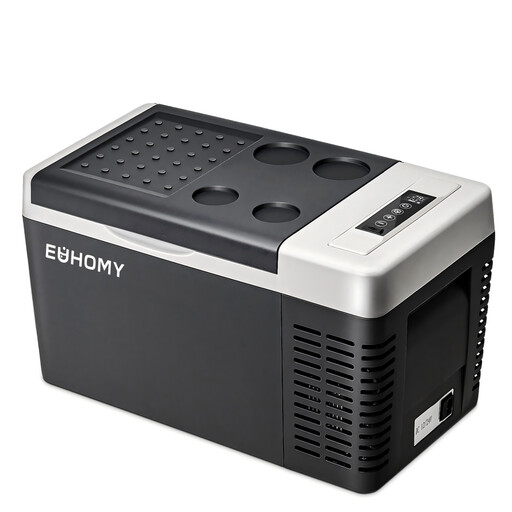
Why This Fits Their Persona: At 18 litres, this cooler is compact enough for the boot of a small car or the passenger seat. It is ideal for commuters, day-trippers, or solo campers who need reliable cooling for the essentials without sacrificing much space.
The compressor technology provides true cooling and freezing performance, bypassing the trap of ineffective thermoelectric devices. The integrated three-stage battery monitor reliably protects against draining the vehicle battery.
Compact dimensions with full-fledged compressor performance. App control offers added convenience for monitoring the temperature.
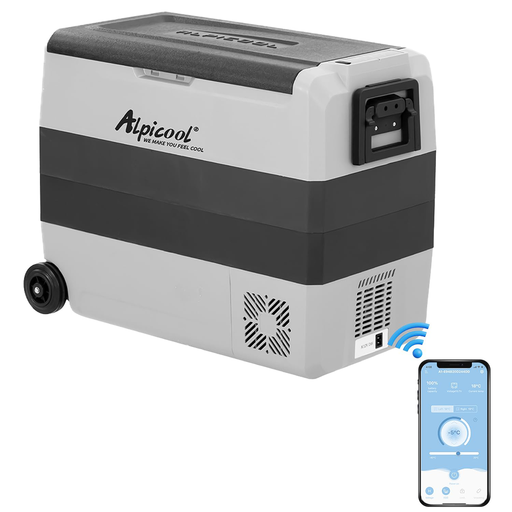
Why This Fits Their Persona: With a 60-litre capacity and two separately controlled zones, this model is designed for families or long trips in an RV. It offers enough space to be self-sufficient for a whole week, and the wheels make it easy to transport from the vehicle to the campsite.
The dual-zone function with a removable divider solves the problem of having to choose between cooling and freezing. The robust construction with wheels and a sturdy handle addresses the weaknesses of poorly made coolers.
Large, flexible capacity with true dual-zone control. The well-designed mobility, thanks to wheels and a folding handle, is a practical advantage for a heavy unit.

Why This Fits Their Persona: For users who venture off the beaten path and strive for maximum independence. Ideal for overlanding, boat trips, or multi-day wild camping where an external power source is not always available.
This model completely bypasses the dead car battery trap by running on an optional, slide-in battery pack. According to the manufacturer, this allows for a runtime of up to 39 hours. The ability to charge it via a solar panel offers ultimate self-sufficiency.
Off-grid operation through an optional battery and solar charging capability. The dual-zone cooling and robust, heavy-duty construction are designed for demanding applications.
We have compiled a complete, up-to-date list of products that fully meet these strict selection criteria and German safety regulations.
Power consumption depends on the size, set temperature, ambient temperature, and insulation. A typical 40-litre model consumes about 45 to 60 watts during operation. However, thanks to good insulation and efficient compressors, the device does not run continuously. Many models feature an ECO mode that further reduces consumption by optimising the compressor speed. On average, you can expect a consumption of about 0.5 to 1 kWh over 24 hours.
Yes, most modern compressor coolers are designed for mobile use and also function when tilted. Many manufacturers specify a maximum inclination of 30 to 45 degrees. This ensures that the cooler continues to operate reliably on a rocking boat or during off-road driving without damaging the compressor.
A single-zone cooler has a single interior compartment where the temperature is uniformly regulated. It can be used as either a refrigerator or a freezer, but not both at the same time. A dual-zone cooler (cooler with freezer function) has two separate compartments whose temperatures can be set independently. This allows you to chill drinks in one compartment (e.g., at 5°C) while freezing food in the other (e.g., at -18°C).