
Lieferung heute & morgen

Qualitätsgarantie

Willkommens-Angebote freischalten: KOSTENLOSE Lieferung | Bis zu 80 % RABATT | Kostenlose 30-Tage-JoyPlus-Testphase
App herunterladen
Anyone who travels frequently knows the challenge: keeping food and drinks reliably cool, whether on long car journeys, camping trips, or out on a boat. A compressor cooler offers a high-performance solution that works regardless of the ambient temperature. Unlike thermoelectric models, it can not only cool but also deep-freeze.
This article serves as your guide. We'll explain how they work, outline key selection criteria, and present a curated selection of models with various features to help you make an informed decision.
Selecting the right model depends on your individual needs. The following criteria will help you make the right choice.
Capacity, measured in litres, is a crucial factor. Consider how many people you'll be catering for and for how long you need to store food.
Some models offer a dual-zone cooler. These separate compartments can be temperature-controlled independently. This allows you to, for example, chill drinks in one section while deep-freezing food in the other, significantly increasing flexibility.
A portable cooler needs to be versatile. An electric cooler with 12V/230V support is the standard here. It can be powered by a vehicle battery (12V/24V) as well as a standard wall outlet (230V).
Look for integrated battery protection. This feature prevents the cooler from completely draining your vehicle's battery. Typically, there are several protection levels (e.g., low, medium, high) that you can set according to your battery's condition. Energy consumption, often specified in watts (W), is also relevant, especially for off-grid operation.
Modern compressor coolers offer useful features that enhance usability:
Here is a selection of models that cater to different needs. The descriptions are based on data provided by the manufacturers.

Why it stands out This model combines a generous capacity with a practical dual-zone layout. The ability to cool and freeze simultaneously makes it a versatile companion.
Features
Who it's for Ideal for RV and truck drivers, boat owners, and campers who need ample storage and the flexibility of two temperature zones for extended trips.
See Details for the EUHOMY Cooler
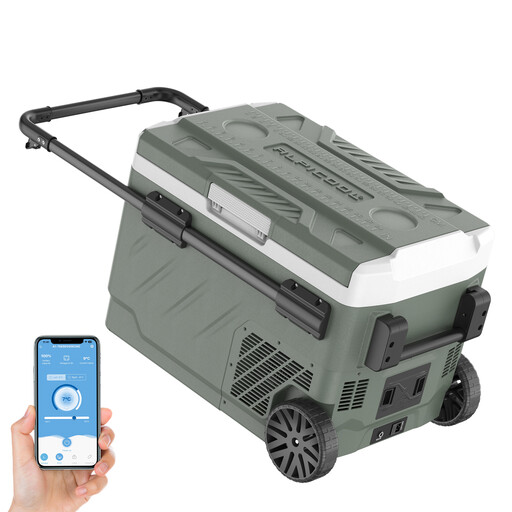
Why it stands out The Alpicool cooler is designed for mobility and user-friendliness. With robust wheels, a telescopic handle, and a reversible door, it adapts to various usage scenarios.
Features
Who it's for A great choice for anyone who frequently moves their car fridge or camping fridge, such as for fishing trips, road trips, or picnics.
See Details for the Alpicool Cooler

Why it stands out The ECOFLOW GLACIER focuses on high efficiency and off-grid freedom. With an optional plug-in battery, it can run for up to 39 hours without an external power source, according to the manufacturer.
Features
Who it's for Perfect for van life enthusiasts, off-grid campers, and anyone seeking maximum independence from power sources and needing a high-performance portable freezer for demanding adventures.
See Details for the ECOFLOW GLACIER
The models featured here cover common use cases. However, if you're looking for a different size, specific features, or a simpler solution for chilling drinks, other alternatives are available.
Explore Our Full Range of Beverage Coolers
1. How much power does a compressor cooler use? Power consumption varies by model, set temperature, ambient temperature, and operating mode (ECO or MAX). Most models have a rated power between 45 and 60 watts. In ECO mode and with good insulation, the compressor only turns on when needed, which lowers the average consumption.
2. Can a compressor cooler also freeze? Yes, most compressor coolers can reach temperatures as low as -20°C. This means they function not only as a refrigerator but also as a fully-fledged portable freezer, perfect for making ice cubes or transporting frozen goods.
3. What is the advantage of a compressor cooler over a thermoelectric one? The main advantage is its cooling power. A compressor cooler achieves the set temperature regardless of the outside temperature and can also deep-freeze. A thermoelectric cooler typically only cools to a certain level below the ambient temperature (e.g., 15-20°C) and is less effective in high heat. Additionally, compressor units are often more energy-efficient during operation.