
Lieferung heute & morgen

Qualitätsgarantie

Willkommens-Angebote freischalten: KOSTENLOSE Lieferung | Bis zu 80 % RABATT | Kostenlose 30-Tage-JoyPlus-Testphase
App herunterladen
Warm drinks on a hot summer day or unreliable food cooling on long journeys can put a damper on your travels. A dependable mobile cooling solution is therefore essential for outdoor enthusiasts, campers, and professional drivers. A compressor cooler offers a high-performance and efficient way to keep food and drinks fresh, or even deep-frozen, regardless of the ambient temperature.
This article serves as a practical guide. It explains the key criteria to consider when making your selection and presents a range of models with different features to help you make an informed decision.
Choosing the right model depends heavily on your specific needs. Whether it's for a weekend trip, van life, or professional use in a truck, the following three criteria will help you make a well-informed choice.
Flexibility in power options is crucial for mobile use. Most models can be powered via the 12V or 24V socket in a vehicle (12V cooler). For use at a campsite or at home, an additional 230V AC connection is a practical feature.
For maximum off-grid independence, models with a built-in or optional battery are worth considering. A cooler with a battery can keep items chilled even when the vehicle is turned off, without draining the starter battery. Some advanced units can even connect directly to solar panels, turning them into a true solar-powered cooler for extended off-grid adventures. Pay attention to the stated energy consumption (in watts or amp-hours) to estimate the runtime.
Unlike thermoelectric coolers, whose performance depends on the ambient temperature, compressor coolers work just like a conventional refrigerator. They can precisely maintain a set temperature, often within a range of +20°C to -20°C.
This allows not only for chilling drinks but also for safely storing perishable foods or deep-freezing supplies. An electric cooler with a freezer function is therefore especially versatile. Models with two separate temperature zones (dual-zone) offer added convenience, as they can cool and freeze simultaneously.
If you plan to use the cooler in a camper, van, or the sleeper cab of a truck, noise level is a key consideration. A quiet compressor cooler operates at a noise level below 45 decibels (dB), which is roughly equivalent to a quiet library and won't disturb your sleep.
For off-road use or on bumpy roads, a rugged, shockproof design is also important. Reinforced corners, sturdy handles, and a durable casing are features that ensure the device's longevity. A cooler for trucks or off-road use should be designed to function reliably even at inclines of up to 30 degrees.
Based on the criteria mentioned, we have compiled a selection of models that are well-suited for different user groups due to their specific features.

Why It Stands Out: The ECOFLOW GLACIER is distinguished by its outstanding flexibility. With two independently controlled temperature zones, a rapid cooling function, and the option to power it via an optional battery or solar, it is designed for demanding, off-grid use.
Pros:
Who It's For: Ideal for van owners, boaters, and campers who need a self-sufficient, high-performance, and flexible cooling solution with a freezer function for multi-day trips.
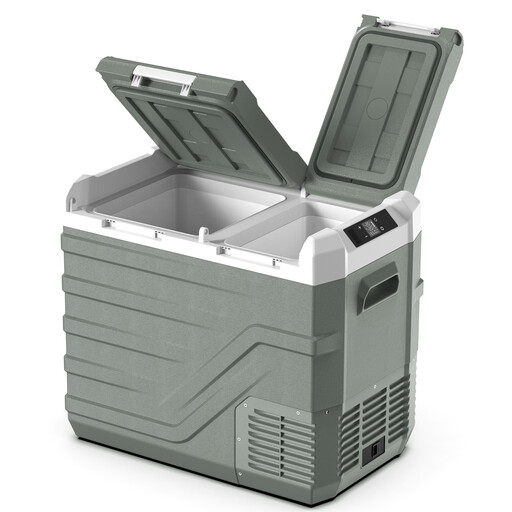
Why It Stands Out: The Alpicool NLS55 combines a generous capacity with smart dual-zone control and a three-stage battery protection system. This makes it a reliable car refrigerator for families and extended trips.
Pros:
Who It's For: A great choice for families, RV travellers, and anyone looking for a large, versatile cooler with two temperature zones for long road trips.
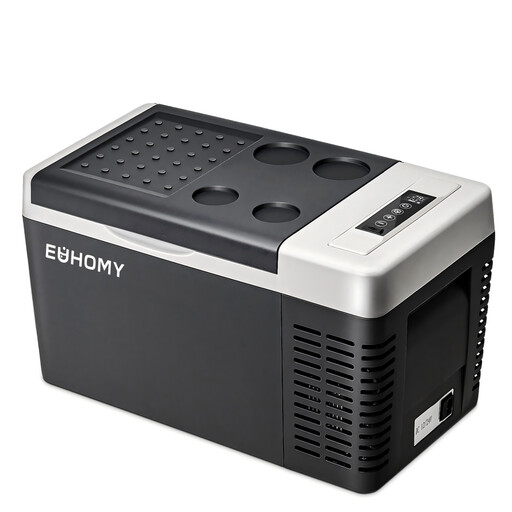
Why It Stands Out: This model from EUHOMY is a compact and lightweight solution that features modern app control and exceptionally quiet operation. Its magnetic lid ensures efficient insulation.
Pros:
Who It's For: Perfect for commuters, truck drivers, or campers who need a small, quiet, and technologically advanced camping cooler for shorter trips or daily use.
If the portable coolers featured here don't quite meet your needs, or if you're looking for a stationary solution for your home, workshop, or garden shed, exploring other categories might be helpful.
Discover our selection of refrigerators without water dispensers to compare more models and sizes.
1. What is the difference between a compressor cooler and a thermoelectric cooler? A compressor cooler uses a refrigerant circuit, similar to a household refrigerator. It can reach and consistently maintain temperatures regardless of the outside temperature, even in the freezing range down to -20°C. A thermoelectric cooler can only lower the internal temperature by a certain amount (e.g., 20°C) below the ambient temperature and is less effective in high heat.
2. How loud is a compressor cooler? Modern models advertised as a quiet compressor cooler have a noise level between 38 and 45 decibels (dB). This is comparable to the sound in a library or a quiet whisper and is generally not considered disruptive, even when used in a sleeper cab.
3. Can a compressor cooler also be powered by solar? Yes, some models are specifically designed to run on solar power. Such a solar-powered cooler will have a dedicated port for a solar panel, often in combination with a built-in or external battery. This allows for completely off-grid cooling and is ideal for extended stays in nature.