
Lieferung heute & morgen

Qualitätsgarantie

Willkommens-Angebote freischalten: KOSTENLOSE Lieferung | Bis zu 80 % RABATT | Kostenlose 30-Tage-JoyPlus-Testphase
App herunterladen
Reliable cooling is essential when travelling, camping, or for daily use in a truck. But the market for portable cooling solutions is crowded and full of marketing hype. As your Joybuy Product Recommendation Officer, I'm here to help you separate fact from fiction and make an informed decision. Before you invest, you should know the three most common pitfalls that lead to disappointment and unnecessary expense.
The 3 most common pitfalls when buying an electric cooler:
To avoid a poor investment, focus on the core technical specifications. These determine the performance, reliability, and real-world usability of your future compressor cooler.
The most important factor is the cooling technology. Cheaper thermoelectric coolers (Peltier elements) can often only lower the internal temperature by about 15–20°C below the ambient temperature. On a hot 30°C summer day, they will barely reach refrigerator temperatures.
A compressor cooler, on the other hand, works just like a conventional home refrigerator. It reliably reaches and maintains the set temperature, regardless of the outside temperature. This allows not only for true cooling but also deep-freezing down to -20°C. That makes it the only dependable solution for a camping fridge or a portable freezer.
A modern 12V electric cooler should offer maximum flexibility in its power supply. Look for the following connection options:
An indispensable feature is an integrated, multi-level battery protection system. This automatically shuts off the cooler before the vehicle's battery voltage drops to a critical level, ensuring your vehicle will still start even after being parked for a long time. Models with an optional cooler with a battery offer additional independence from the vehicle's electrical system.
Check the internal dimensions and layout before you buy. A dual-zone cooler offers the greatest advantage: you can use one compartment for cooling drinks and a second for freezing food simultaneously. The temperature of both zones can often be controlled independently. This is especially practical for longer trips with a cooler for a campervan or boat. Look for a well-designed interior without obstructive components to make the most of the available volume.
Instead of an overwhelming list, we present a few models tailored to specific use cases that successfully avoid the pitfalls mentioned above.

Why this model fits: Ideal for short trips and budget-conscious beginners who need reliable compressor performance. With 42 litres, the cooler offers enough space for a long weekend's worth of supplies without taking up too much room in the trunk.
The integrated 3-stage battery protection system reliably prevents the vehicle's battery from draining—a common problem with cheaper models that lack this safety feature.
Offers both 12V/24V DC and 100-240V AC connections for flexible use. The ECO mode and quiet operation under 45 dB are optimised for in-vehicle use.

Why this model fits: Designed for maximum self-sufficiency and performance. The option to use a separate battery makes this cooler independent of the vehicle, ideal for multi-day stays off the grid.
It counters the pitfall of unrealistic runtimes with a transparent solution: an optional 298 Wh battery provides up to 39 hours of off-grid operation, according to the manufacturer's specified conditions.
True dual-zone functionality (cooling/freezing) and a rapid cooling feature (from 25°C to 0°C in 40 mins, per the manufacturer). The quiet 38 dB operation is designed for use in a camper's sleeping area.
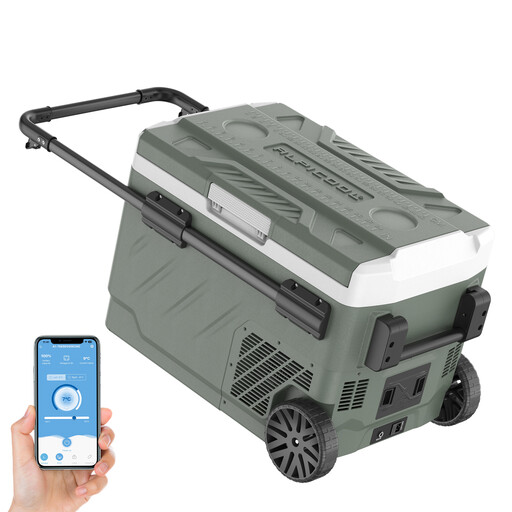
Why this model fits: A workhorse for intensive use. The combination of rugged wheels, a retractable handle, and dual-zone control makes this cooler extremely practical for family outings or use in a truck.
It addresses the pitfall of unclear volume with a transparent layout: 31.6 L in the main compartment and 8.4 L in the smaller one. The app control also allows for precise temperature management, rather than relying on inaccurate estimates.
Independent control of both zones via app or display. Practical details like a reversible door, integrated LED light, and an included cutting board enhance its everyday utility.
We have compiled a complete, up-to-date list of products that fully meet these strict selection criteria and all relevant safety standards.
The noise level is measured in decibels (dB). Models designed for use in sleeping cabins often operate at levels below 45 dB, which is comparable to a quiet conversation or a library. Look for this value in the technical specifications. Furthermore, the compressor doesn't run continuously; it only cycles on as needed to maintain the temperature.
Always use the designated 12V/24V socket (cigarette lighter). It is crucial to choose a model with a multi-level battery protection system. Set this to a high or medium protection level. This will shut off the cooler in time, before the battery voltage drops too low, ensuring your engine will still be able to start.
Yes, many modern compressor coolers are designed for solar operation. You can run them either via a power station that is charged by solar, or, with some models, connect them directly to a compatible solar panel. Check the manufacturer's specifications for the maximum input voltage (V) and power (W) of the solar port to ensure compatibility.