What should you look for when buying?
When sewing cotton aprons at the kitchen table, you can organise your buying criteria around what matters most to you.
| Priority |
What to check when buying |
Who is this most important for? |
| Simple seams |
Check for a straight stitch, reverse sewing or securing stitches, speed control and an easy-to-understand stitch selector. |
If I mainly sew hems and pockets, I want to select stitches quickly and control the speed easily. Around 36% of consumers prioritise simple basic seams. |
| Thick seams |
Check for slow sewing, presser-foot pressure adjustment and a suitable needle; test your own combination of fabric layers if possible. |
When sewing over folded ties or pocket edges, I want to be able to sew slowly over the thicker sections. Around 29% of consumers prioritise control when sewing over these seams. |
| Table space and storage |
Compare the available space, room for the fabric, weight and dimensions, both with and without the extension table. |
If I sew at the kitchen table and put the machine away afterwards, I need a setup that fits and accessories that are easy to handle. Around 21% of consumers prioritise having a flexible sewing space. |
| Extra embellishment |
Check for the lettering and decorative stitches you want, and see how easy the stitch memory functions are to use. |
If you want to add lettering or decorative details to your aprons, you’ll need more than basic utility stitches. Extra embellishment is the main buying priority for around 14% of consumers. |
Joybuy products
The following products are described as household or mini sewing machines with features for simple sewing tasks. If you’re specifically looking for a computerised machine, check the product description for the version you’re considering.
 No image available
Household mini sewing machine with 12 stitch types
Its described compact design makes it a practical option for a flexible sewing space; check that the controls and work area suit your table.
12 stitch types, single and twin needles, two speed settings, free arm and sewing kit.
View at Joybuy
 No image available
Electric sewing machine for beginners, 12 stitch programmes
Forward and reverse sewing are listed for simple sewing tasks; compare the stated fabric thickness with your folded apron layers.
12 stitch programmes, two speeds and hand or foot control. The stated maximum fabric thickness is 2.5 mm.
View at Joybuy
 No image available
Portable sewing machine with 12 stitches, pink
The description lists hems and cotton as suitable uses; test thicker seams with your own combination of fabrics.
12 stitch patterns, two speed settings, LED light and thread cutter. Mains or battery power is listed.
View at Joybuy
 No image available
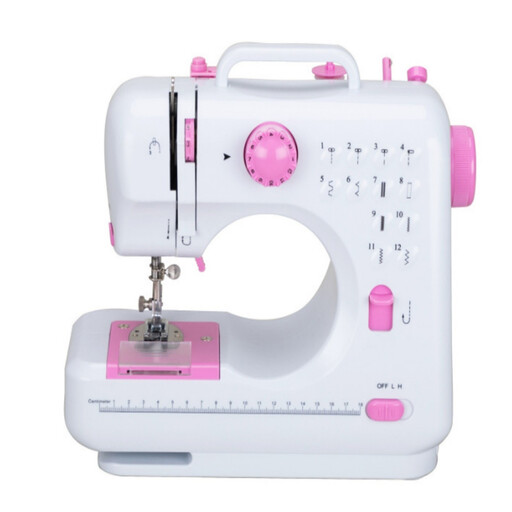
IAGREEA mini sewing machine with 12 stitches, pink
The description lists hems and cotton; test the specific combination of fabric layers beforehand if you plan to sew thicker tie ends.
12 stitches, two speed settings, LED light and thread cutter. Mains or battery power is listed.
View at Joybuy
 No image available
IAGREEA YASM-505A mini sewing machine with 12 stitches, purple
This is described as a compact household mini sewing machine; before buying, check that its features meet your apron-sewing needs.
12 built-in stitches, forward and reverse sewing, and switchable low and high speeds. Mains adaptor or battery power is listed.
View at Joybuy
Frequently asked questions
Do I need a machine with lots of stitches for a cotton apron?
You don’t necessarily need a wide choice of stitches for a simple apron. A guide from Brother Sewing Machines Europe describes hemming the edges; alphabets and stitch memory are mainly useful if you want to add decoration or lettering to your apron.
How can I sew and clean the machine safely for the first time?
Read the manual for your specific model before sewing or cleaning it. The manual for the Janome 230DC Limited Edition, for example, says to unplug the machine before cleaning, switch it off when working near the needle and keep its ventilation openings clear. These instructions apply to the model named.
What rights do I have when buying online from a trader?
For a typical online purchase from a trader in the EU, you generally have a 14-day right to withdraw from the contract from the date you receive the goods; statutory exceptions and return costs should be checked separately. If goods are faulty, you have a statutory minimum guarantee of two years against the seller. The European Union’s consumer information distinguishes these rights from an additional manufacturer’s guarantee.
What does the CE marking on an electric sewing machine mean?
According to Your Europe, the CE marking shows that the manufacturer declares the product meets the applicable EU requirements; it isn’t a general quality mark and doesn’t guarantee a particular sewing result. The Low Voltage Directive 2014/35/EU applies to electrical equipment with a rated voltage of 50 to 1,000 V AC or 75 to 1,500 V DC. Whether it applies to a particular device depends, among other things, on its rated voltage; the consolidated text on EUR-Lex applies from 30 May 2026.


