For cushion piping, start by checking that the presser foot suits both the cord thickness and your exact machine model. You’ll also need to be able to control how the fabric layers feed through. Next, measure the space you have for the machine, cushion and, if needed, extension table. A test seam using the thickest planned combination of layers will tell you more than a general performance claim.
Who these machines may suit
Sewists who focus on piping
If you want to sew cord neatly along straight edges, curves and corners, the presser foot’s guidance and compatibility are key. BERNINA describes piping as cord wrapped in a strip of fabric and sewn along an edge or between fabric layers.
Sewists working with sturdy cushion fabrics
When working with several layers or sturdy material, you’ll want to sew across bulky seams slowly and with control. Janome, Singer and W6 list features on their respective models that may help; a test seam will show whether they’re suitable for your particular combination of fabrics and layers.
Sewists with limited table space
You need room to support and turn the cushion beside the needle, but you may also want to be able to store the machine and accessories away. Janome and bernette describe the models mentioned as having a removable extension table.
What to look for when buying
First, test the foot and fabric feed with your material. Then check the usable work area, followed by the controls that can help you sew corners.
| What you need |
What to check when buying |
Who it matters most to |
| Guiding piping evenly |
Check the cord thickness, full model name and compatibility list. Janome specifies cords up to 5 mm for its piping foot; you should confirm separately whether it’s compatible with the 230DC Limited Edition. |
If I want to guide the cord evenly around curves and corners, I’ll check the groove, cord thickness and machine compatibility first. Around 33% of consumers prioritise piping guidance. |
| Fabric layers and bulky seams |
Test your chosen fabric, interfacing, cord and thread together. Check the bulkiest seam crossing, as well as the top and underside. |
When sewing several layers, I want to be able to sew through the bulkiest crossing with control. Around 25% of consumers prioritise fabric feed. |
| Work and storage space |
Measure your table space with the cushion in motion, as well as your storage space. For the specific model, also check the size of the extension table and whether it can be removed. |
If my sewing table is small, I need room for the cushion while I sew, and storage space for the machine and accessories afterwards. Around 25% of consumers say space is the deciding factor. |
| Speed and needle position |
Try slow sewing, start/stop controls and the needle stop at a test corner. |
On short seams, I want to control the speed and needle position at corners. Around 17% of consumers prioritise these controls. |
Common misconceptions
-
More stitch programmes automatically mean better piping guidance
The number of stitches doesn’t tell you whether the presser foot will guide the cord neatly along the seam edge.
Check the foot, cord thickness and model compatibility first, then sew a test seam. Compare additional stitch programmes afterwards.
-
An accessory for a similarly named model is bound to fit too
An accessories list for the 230DC doesn’t automatically confirm compatibility with the Janome 230DC Limited Edition.
Check the full model name and presser foot part number against the manufacturer’s information.
-
The machine’s dimensions are all you need to check for space
While you sew, the cushion also needs to rest beside the needle and move freely. An extension table gives you a larger support area, but takes up more space too.
Allow for the fabric as you move it across the work area, and make room to store any removable parts.
-
‘Heavy Duty’ guarantees it can sew any thick piping seam
Singer states that the Heavy Duty 6605C has increased needle-piercing power. That doesn’t prove it can sew every combination of cord and fabric layers without difficulty.
Test the bulkiest planned seam crossing with the right foot and your chosen material.
Key brands at a glance
Janome
Janome describes the 230DC Limited Edition as a computerised sewing machine with speed control, adjustable presser foot pressure, a zip foot and an extension table.
- The manufacturer lists a removable extension table and a zip foot included with the machine.
- The accessories list for the piping foot names the 230DC, but not specifically the 230DC Limited Edition. Check compatibility for this exact version.
Singer
Singer lists increased needle-piercing power, a needle stop and 163 mm of space between the needle and the casing for the Heavy Duty 6605C. For the SC220, the manufacturer also describes features including speed control.
- These features give you specific points to compare against your sewing needs.
- The manufacturer’s claims about needle-piercing power and work space don’t prove that your particular cushion construction will work with the machine.
W6 Wertarbeit
W6 describes the N 3300 Pro as having adjustable presser foot pressure, a slow sewing option and a selectable needle stop.
- These features may be useful for sewing with control and turning at corners.
- W6 lists 120 programmes, while Testberichte.de lists 204 sewing programmes. As the figures differ, don’t treat them as a reliable comparison of the number of stitches and programmes available.
bernette
According to the manufacturer, the bernette 38 has stitch memory, speed control and a removable extension table. A separate presser foot set with a cording foot is also available for models 37 and 38.
- The extension table can help support the cushion; stitch memory and stitch selection may also come in handy for other projects.
- The cording foot isn’t confirmed as an included accessory. Check whether it suits your piping and the specific project.
Medion
The LIFE SD36 (MD11881) is a digital sewing machine with adjustable stitch length and an integrated accessories compartment.
- The accessories compartment provides space for small sewing essentials.
- Testberichte.de describes the model as being better suited to lightweight fabrics. For sturdy cushion fabrics and bulky piping seams, check the presser foot compatibility and sew a test seam.
Related products at Joybuy
The portable sewing machines listed are described as suitable for straightforward sewing jobs at home. Before using one for cushion piping, check whether the foot guidance and controls on the specific model meet your needs.
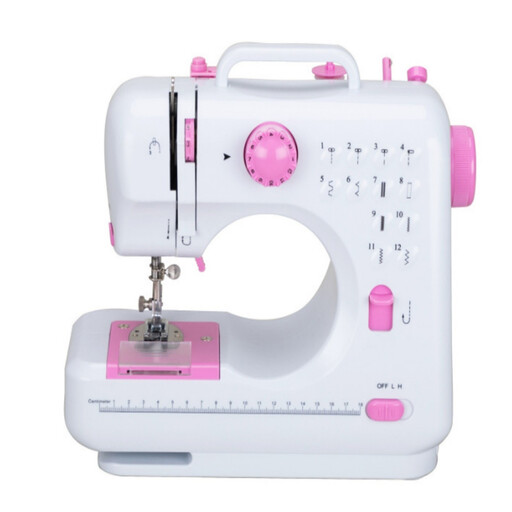 Image unavailable
IAGREEA mini sewing machine, 12 stitch patterns
The compact, portable design may suit you if you’re looking for a machine for straightforward sewing and DIY projects at home. Check whether the foot on the specific model provides the right guidance for piping.
Features listed include 12 stitch patterns, two speed settings and LED lighting.
View at Joybuy
 Image unavailable
Portable sewing machine, 12 stitch patterns, dual power
If you’re looking for a portable machine for straightforward sewing and alterations, the listed uses may be relevant. For cushion piping, check that the presser foot and controls on the model are suitable.
Features listed include two speed settings, a foot pedal or manual button, LED lighting and adjustable thread tension. An integrated compartment is provided for accessories.
View at Joybuy
Frequently asked questions
Do I need a special piping foot to sew piping on a cushion?
A grooved piping foot can guide the cord; depending on the piping and machine, a narrow foot may also let you sew close to the cord. What matters is that the specific foot is compatible and that you sew a test seam. The piping foot listed for the Janome 230DC isn’t confirmed as suitable for the 230DC Limited Edition just because the model names are similar.
What should I bear in mind before changing the foot or cleaning the machine?
The Janome 230DC Limited Edition manual says to switch off the machine before making adjustments around the needle area, and to unplug it before cleaning. This advice applies to the model mentioned; for other machines, follow their own manuals.
When shopping online in Germany, what’s the difference between the right to cancel, statutory rights and a guarantee?
The Consumer Advice Centre explains that distance contracts generally come with a 14-day right to cancel; exceptions and the exact start of the cancellation period depend on the circumstances. For new goods with defects, the seller is generally responsible for ensuring they are free from defects for two years. Statutory rights are different from a voluntary guarantee.
Is the CE marking on an electric sewing machine an independent quality mark?
No. According to the European Commission, for products covered by the relevant EU rules, the CE marking is the manufacturer’s declaration that the product meets the applicable requirements; there is no central EU body that awards a general CE certificate. The Low Voltage Directive covers electrical equipment within its specified voltage limits of 50 to 1,000 V AC. For the specific machine offered in Germany, check the marking and the relevant mains connection details.


