
Lieferung heute & morgen

Qualitätsgarantie

Willkommens-Angebote freischalten: KOSTENLOSE Lieferung | Bis zu 80 % RABATT | Kostenlose 30-Tage-JoyPlus-Testphase
App herunterladen
Construction toys for children can combine open-ended building, role play and creative problem-solving. However, choosing the right product is not always easy for parents, grandparents and other family members. A large number of pieces says little about actual suitability, while eye-catching extra features are no substitute for well-designed construction.
This buying guide explains what to look for in a building set for children and which models suit different play preferences.
A high piece count may seem attractive at first. What matters, however, is whether the pieces can be combined with one another and whether they can be used to create different models. A set with 30 well-matched magnetic tiles may be more useful for younger children than a large box containing lots of specialist pieces that are suitable for just one design.
So look for:
A construction toy for children aged 3 and over is not automatically equally suitable for every three-year-old. Fine motor skills, attention span and the ability to handle small parts vary from child to child. Warning notices are particularly important for magnetic tiles: Tokky sets contain small parts and strong magnets. If a magnet is swallowed, it can cause serious injuries. Damaged components should therefore be removed from use.
Lights, music and moving elements can enhance play. However, they should not be the sole reason for buying a set. For electronic functions, check the battery type, battery compartment and controls. A set with a simple connection mechanism may be more practical for younger children than a more technically complex model.
The manufacturer’s age recommendation is an important starting point. For children aged 3 and over, large, easy-to-grip components and simple connections are suitable. From around the age of 4, classic construction bricks with smaller elements can be introduced. More complex models with lots of details are often aimed at older children or teenagers.
A LEGO building set such as the Classic Medium Creative Brick Box 10696 is intended for children aged 4 and over according to the product details and contains 484 elements. By contrast, the Creator model “Cute Hamster with a Flower” is aimed at children aged 7 and over and includes 166 bricks. The number of pieces alone therefore does not determine the level of difficulty.
For plastic sets, details such as ABS plastic, smooth edges and careful workmanship provide useful guidance. These details should be verifiable in the product description. With magnetic tiles, it is particularly important that the magnets are securely enclosed within the components. Check the toy regularly for cracks, loose parts or protruding magnets.
For creative building, magnetic tiles offer an easy way to get started: the connections are made without conventional joining. Construction bricks, on the other hand, often allow for smaller details and more complex models. The two systems therefore suit different purposes.
Look for:
According to the product details, the dinosaur building set is made from BPA-free ABS plastic and features rounded edges. The standards CE and EN71 are also listed. It is intended for children aged 3 to 6. Nevertheless, children in this age group should be supervised while using it, particularly if any accessories are small.

Why this product suits the profile: With 32 magnetic tiles measuring 3.75 cm along each edge, this set offers an accessible introduction to building. The metal tin also provides convenient storage and makes the set easy to transport.
The number of pieces remains manageable rather than relying on lots of unused specialist elements. The manufacturer expressly highlights the presence of small parts and strong magnets.
Basic shapes for two- and three-dimensional constructions, no batteries required and compact packaging.
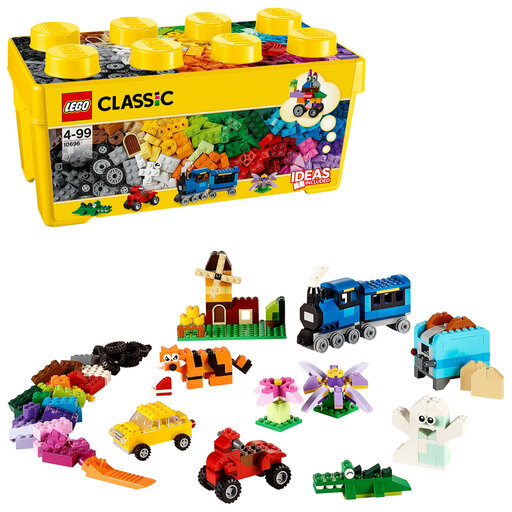
Why this product suits the profile: According to the product details, the box contains 484 elements in 35 colours, as well as windows, eyes, wheels and baseplates. This makes it suitable for open-ended building and repeated rebuilding from the age of 4.
The product description lists specific element types, colours and a storage box. This makes it easier to assess the actual contents of the set.
Lots of classic bricks, additional components for vehicles and buildings, ideas in the instructions and compatibility with existing LEGO sets.

Why this product suits the profile: The 76 transparent magnetic tiles allow for larger constructions, whether playing alone or in a group. According to the product details, the set is intended for children aged 3 and over.
The product details specify the tile size of 3.75 cm, enclosed magnets and clear warnings. Damaged pieces should be removed from use.
76 pieces for larger structures, a light-transmitting design and, according to the product details, compatibility with other standard magnetic tiles.

Why this product suits the profile: According to the product details, this detailed DIY model is intended for people aged 14 and over. It is suitable for teenagers or adults who enjoy a calm model-making and decorating process.
The age limit and warning about small and, in some cases, pointed parts are clearly stated. The set is not presented as a standalone toy for younger children.
62 laser-cut wooden pieces, no glue assembly according to the product description and a finished miniature kitchen to display.
We have put together a complete, regularly updated list of products that fully meet these strict selection criteria and the safety regulations applicable in the EU.
Sets with a clear age recommendation, easy-to-grip pieces and simple connections are suitable. With magnetic tiles, it is particularly important to follow the warnings about small parts and strong magnets. The magnetic sets mentioned are not intended for children under 3.
The lifespan depends on the material, connection mechanism and storage. Plastic pieces should be cleaned without water and protected from excessive heat. With magnetic tiles, regular checks for cracks or loose magnets are important. A box or tin helps keep all the pieces together and neatly stored.
Classic construction bricks and magnetic tiles generally do not require batteries. Sets with lights or music may require replacement batteries. DIY craft sets, such as weaving, bead or foil art sets, may require consumables later on. Before buying, check whether the set is ready to use straight away and which materials may need to be purchased separately.