
Lieferung heute & morgen

Qualitätsgarantie

Willkommens-Angebote freischalten: KOSTENLOSE Lieferung | Bis zu 80 % RABATT | Kostenlose 30-Tage-JoyPlus-Testphase
App herunterladen
Construction toys for children offer endless possibilities: kids can build towers, design vehicles, guide marbles through tracks, or recreate familiar play worlds. At the same time, building sets differ significantly in age recommendation, piece size, material, assembly method and play objective. For parents, grandparents, nurseries and schools, it is therefore worth taking a close look at the product details.
A large number of building blocks may look appealing at first glance. What really matters, however, is whether the pieces suit the child's age and experience. Many small elements can overwhelm younger children or be unsuitable due to choking hazards. A set with 250 larger blocks can be more practical for a toddler than a box containing several hundred small pieces.
Building blocks for ages 3+ are not automatically suitable for every three-year-old child. Alongside age, fine motor skills, patience and experience with building instructions all play a role. Sets containing marbles or very small components require particular attention. The manufacturer's age recommendation and safety warnings should be the deciding factors before purchase.
LEGO Minecraft, LEGO Disney or themed building sets for children often appeal to specific interests. However, they usually contain specific figures and models. If you are looking for free construction, LEGO Classic, wooden building blocks or an open-ended creative building toy are often a better fit. Before buying, you should be clear: is it about free building, role play, a marble run, or recreating a pre-defined model?
For children from 18 months, larger, easy-to-grip building blocks are sensible. The UNICO Plus set is, according to product details, intended for 18 months to 5 years. Sets for ages 3 or 4 may already contain smaller elements. Marbles and small figures pose a particular choking hazard. With younger children, direct supervision is necessary, even if the toy is generally intended for that age group.
Also pay attention to:
The CE mark should be present. Additionally, references to the EN 71 standard series or material properties can provide guidance. Such information does not replace checking the specific warnings.
Plastic building blocks are easy to clean and generally hold their shape well. Wooden blocks offer a different feel and are particularly suited to simple stacking and balancing constructions. With wooden building blocks, parents should look for smooth surfaces, cleanly finished edges and clear care instructions.
The connection between the blocks is also important. Interlocking systems hold models together, whereas loose blocks invite balancing, sorting and free stacking. For a marble run, components must also stand firmly enough so that the track does not shift at every touch.
A large set needs not only more storage space, but also a sufficiently large play area. The grey LEGO Classic 11024 Baseplate, for example, measures 38 × 38 cm and offers a grid of 48 × 48 studs. The green LEGO Classic 11023 Baseplate is more compact at roughly 25 × 25 cm. For small children's rooms or for transport, a smaller baseplate can be more practical.
A storage box reduces lost pieces. Particularly with LEGO Classic 10696 and LEGO Classic 10698, a storage container is included in the set. For nurseries and schools, labelled boxes or separate compartments should also be planned.
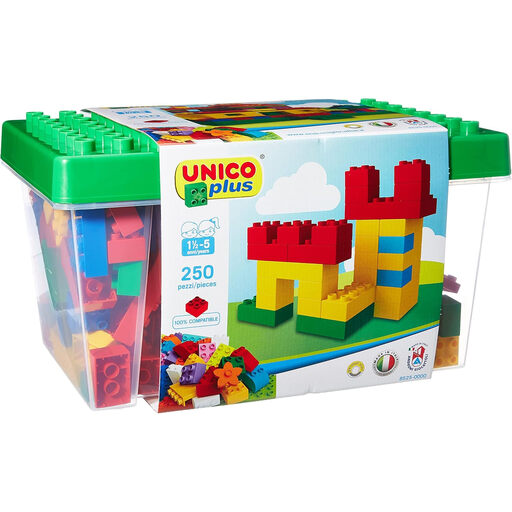
Why this product fits the profile: The box contains 250 colourful building blocks and is, according to product details, intended for children from 18 months to 5 years. This makes it an accessible introduction to creative building toys.
The age recommendation and larger piece design help avoid choosing a set with parts that are too small for a toddler. Supervision is still required, however.
250 pieces, compatible with common building block systems and designed for small hands.
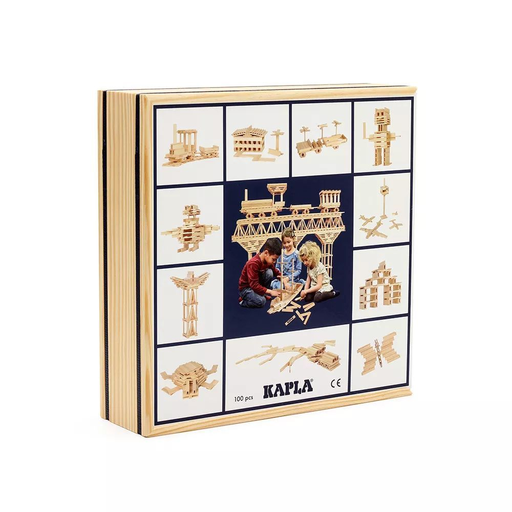
Why this product fits the profile: The 100 rectangular building blocks are, according to the product description, made from untreated pine wood and come in a wooden box with a sliding lid.
Instead of a thematically limited construction, this set uses uniform, loose blocks for towers, bridges and abstract shapes.
Precise rectangular wooden blocks, 100 pieces and compact storage.
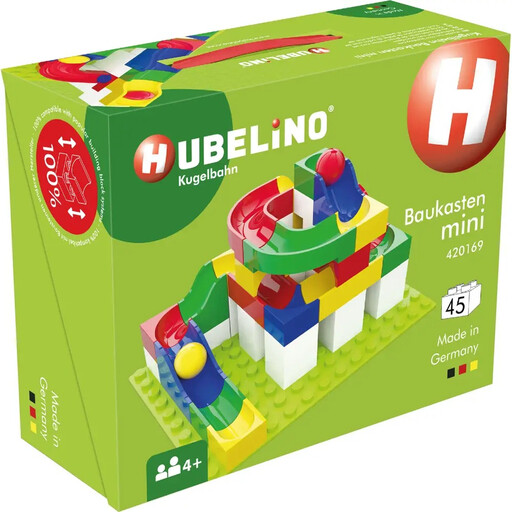
Why this product fits the profile: The 45-piece marble run includes a baseplate, building blocks, track elements, marbles and instructions. It is recommended for children aged 4+ and can be expanded with other Hubelino products.
The included starter set prevents individual track parts from being bought without a compatible base. The marbles come with small parts warnings.
Complete starter set, carry case and expandability with compatible products.
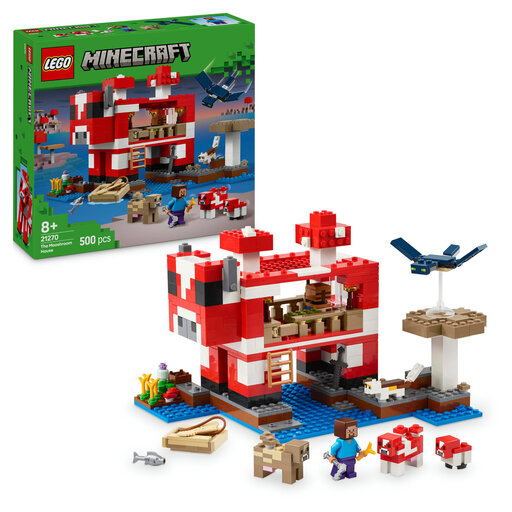
Why this product fits the profile: According to product details, this set is aimed at Minecraft fans aged 8+ and combines a specific model with figures, a farm area and accessories for role play.
The clear age recommendation and model size make it obvious that this is not a toddler set, but a more detailed building kit for older children.
500 pieces, multiple figures and a finished model approximately 16 cm tall.
We have compiled a complete, regularly updated list of products that fully meet these strict selection criteria and the safety regulations in force in the EU.
For this age group, sets with larger building blocks that are easy to grip and contain no small, swallowable elements are suitable. The specific age rating, warnings and material information from the respective manufacturer must be observed. The UNICO Plus 8525 is, according to the product description, intended for use from 18 months.
The lifespan depends on the material, connection type, storage and intensity of play. Plastic building blocks should be stored dry or cleaned according to the manufacturer's instructions, and regularly checked for damaged parts. Wooden blocks should be stored in a dry place. A sorting box helps prevent missing pieces and keeps the set complete over the long term.
A classic marble run normally does not require batteries. However, costs can arise if additional baseplates, expansions or replacement parts are purchased. Before buying, you should check whether the starter set can be used on its own and which building blocks are compatible with future expansions.