
Lieferung heute & morgen

Qualitätsgarantie

Willkommens-Angebote freischalten: KOSTENLOSE Lieferung | Bis zu 80 % RABATT | Kostenlose 30-Tage-JoyPlus-Testphase
App herunterladen
Construction toys for children and adults can offer shared playtime, focused building sessions, or decorative display pieces. However, there are clear differences between a simple building block set, a marble run, and a challenging architecture model. What really matters isn’t the highest piece count or flashy marketing claims, but the age recommendation, materials, functionality, and safety information.
A set with several hundred pieces may include many building stages, but it could also be designed for a single model. For free-form building, a variety of basic shapes, connection options, and a clear instruction manual are more important. An architecture building kit, for example, is often more focused on a finished display model than on repeated rebuilding.
With magnetic building blocks, the product description should clearly state the magnet encapsulation and age rating. Small, strong magnets must not be swallowed. If parts are damaged, magnets come loose, or cracks appear, the set should no longer be used. An age rating of “3 years and up” does not replace adult supervision for younger children or in busy play situations.
Terms like educational STEM toy or “creative building toy” initially describe a product’s positioning. So check specifically what activities are possible: sorting, stacking, spatial planning, mechanical construction, or following a model. This will help you assess whether the set matches the child’s developmental stage and intended use.
The age recommendation should match the child’s actual developmental stage. Small parts are generally problematic for children under three. The WANGE Elizabeth Tower and WANGE Louvre Museum explicitly state that the sets are not suitable for children under three and should be assembled under full supervision from age six. The COBI F-14 model is recommended for children aged eight and above, and the Messerschmitt model for ages nine and up.
For a gift for children, it’s not just about the theme. Pay attention to piece size, the fine motor skills required, and the expected build time.
For plastic building blocks, details like ABS material, smooth edges, and precise connections are relevant indicators. For wooden blocks, the surface should be free of visible cracks and sharp edges. A wooden building blocks set is usually best for stacking and balancing games, while magnetic tiles allow for geometric surfaces and three-dimensional shapes.
For magnetic products, the following points are also important:
A building block set with versatile basic shapes suits children and families who want to try out new constructions again and again. A marble run building blocks selection adds a visible moving function to building: curves, levels, and track elements must be connected so that the ball follows the intended path.
An architecture or aeroplane building kit, on the other hand, usually follows a fixed instruction manual. Such sets are interesting when the finished model is meant to be displayed. For older children, teenagers, and adults, a model kit for adults or a collector’s building kit with scale details may also be suitable.
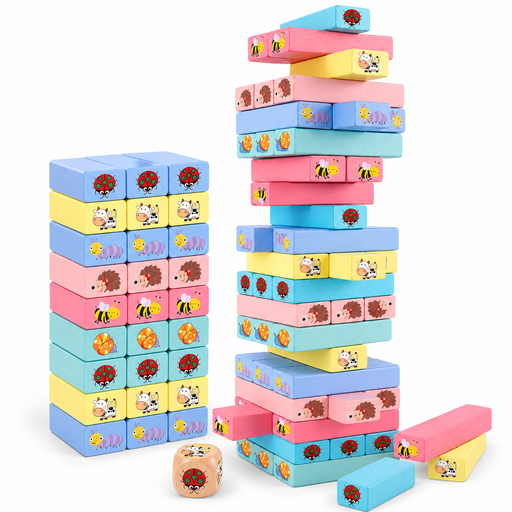
Why this product fits the profile: This 51-piece wooden game is designed for children aged three and up, combining stacking, sorting, and balancing in a manageable set.
The piece count and contents are clearly stated. The set is not limited to a single finished model.
51 pieces, animal motifs, dice, plus use for stacking and balancing; adult supervision is recommended.

Why this product fits the profile: The 76 transparent ABS tiles feature encapsulated magnets and an edge length of 3.75 cm, according to the product description.
Material, individual dimensions, quantity, and warnings about small parts and strong magnets are all clearly stated.
76 tiles, transparent design, compatibility with other standard sets, and no batteries required.
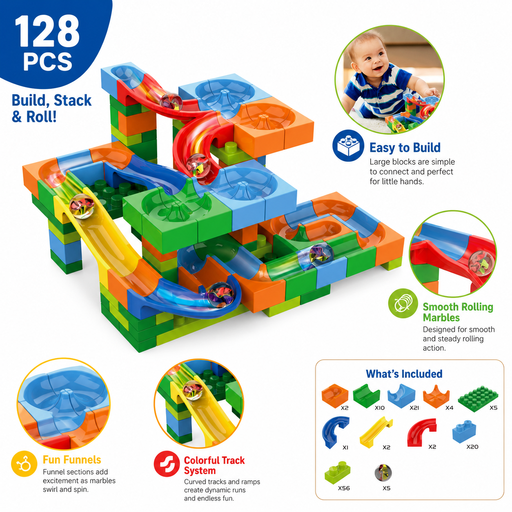
Why this product fits the profile: This set combines construction with rolling movement, making it ideal for family activities and repeated redesign.
The track function is the main focus. Before buying, consider space requirements, piece storage, and supervision.
128 pieces, combines building and rolling, and can be used without batteries.
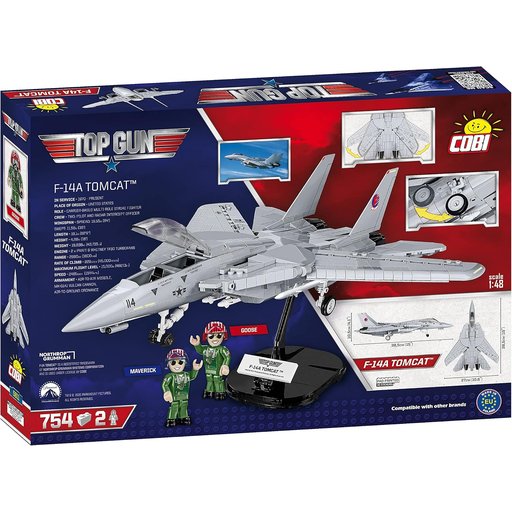
Why this product fits the profile: This aircraft model at 1:48 scale is designed for ages eight and up, and features movable wings, landing gear, and a display stand.
Scale, piece count, functional details, figures, and stand are all clearly described, making it easy to assess what’s included.
754 pieces, printed elements, movable wings, two pilot figures, and a display stand.
We’ve put together a full, regularly updated list of products that meet these strict selection criteria and comply with EU safety regulations.
Sets with a clear age rating, sufficiently large pieces, and manageable building tasks are suitable. Wooden building blocks or simple stacking games can be a good choice. With magnetic building blocks, you must pay particular attention to warnings about small and strong magnets. An adult should supervise the first play sessions.
The lifespan depends on the material, connection system, storage, and handling. Store the pieces in a dry place and keep them complete, avoid excessive heat, and regularly check the blocks for cracks, loose components, or missing pieces. For magnetic sets, a visual inspection before use is especially important.
The price depends on factors such as piece count, scale, level of detail, brand licensing, and display accessories. A smaller building block set may be enough to start with, while an architecture building kit or collector’s building kit with several hundred pieces requires more time and space. So compare not just the price per piece, but also the intended use, the instruction manual, and the actual contents.