
Lieferung heute & morgen

Qualitätsgarantie

Willkommens-Angebote freischalten: KOSTENLOSE Lieferung | Bis zu 80 % RABATT | Kostenlose 30-Tage-JoyPlus-Testphase
App herunterladen
A construction vehicle toy needs to look good, but it also has to work reliably in the playroom, the sandpit or on the balcony. Parents, grandparents and relatives are faced with a huge choice: diggers, wheel loaders, dump trucks, construction cranes and remote-controlled construction lorries all differ significantly in age recommendation, size, material and how they operate.
Typical buying decisions often go wrong for three reasons. A model is bought because it has lots of functions, even though the child cannot yet operate them. A particularly small vehicle looks detailed in product images, but in everyday use it quickly gets lost. Or moving parts are advertised without it being clear whether they are sturdy enough for regular play. The following criteria will help you avoid these kinds of mistakes.
A toy digger with a rotating cab, movable arm and detachable bucket offers plenty of play possibilities. For children aged 3 and over, however, a simple, manually operated model can be more suitable than a complex vehicle with an app, remote control or lots of small parts.
With a remote-controlled construction lorry, you also have to factor in batteries or a rechargeable battery. So before you buy, you should check:
Many Bruder construction vehicles are made to a scale of 1:16. This creates a consistent play system, but it also means the vehicles need quite a lot of space. A large digger around 40 to 60 cm long won't simply fit on every shelf.
Smaller models in 1:32 scale need less storage space, but they often offer less room for figures and smaller moving parts. For a shared construction site scenario, it makes sense to choose vehicles with a compatible scale and accessories.
The age recommendation is not just a marketing detail. With many construction vehicles for children, manufacturers point out small parts that could be swallowed. Models marked for ages 3 or 4 should not be passed on to younger children. Even with age-appropriate vehicles, it is a good idea to check for damaged parts.
When buying, the information on the packaging and product page should be your guide. Moving arms, detachable buckets, figures and accessories can come loose with heavy use. Products with small parts are fundamentally not intended for children under 3.
ABS plastic is used in many realistic models. What matters is not just the material name, but also the construction: are the axles, joints and bucket arms smooth to operate? Can parts be moved without excessive force? Are there any sharp edges or loose components?
For outdoor use, vehicles should be cleaned of sand and dirt after play and stored dry. Electronic models must not be used in water unless the manufacturer states they are suitable for it.
A manual digger toy is great for role play that needs no preparation time. Electronic features like lights and sound add to the fun, but they need batteries and can't always be easily replaced if they break.
A remote-controlled model is really only a good idea if the child can already handle forward, reverse and steering commands confidently. With the 1:24 tipper from Joybuy, the 2.4 GHz remote control raises and lowers the tipping bed, among other things. The built-in rechargeable battery is charged via USB, while the remote control needs two AA batteries.
For daily role play, a single wheel loader or a dump truck toy is often enough. If you want to set up a complete construction site, you can combine vehicles with figures, barriers and accessories. A construction crane toy needs a lot of space because of its extended arm and should be used on a stable, level surface.
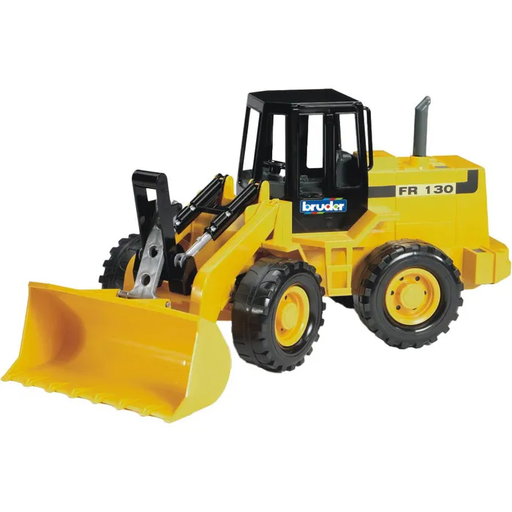
Why this product fits the profile: This manual wheel loader in 1:16 scale needs no batteries and offers a straightforward introduction to construction play with its movable arm, tilting bucket and articulated steering.
No ongoing battery costs and no app or remote control to operate. This cuts out extra technology that often goes unused with younger children.
1:16 scale, manual operation, functional bucket and, according to the product information, suitable for children aged 3 and over.
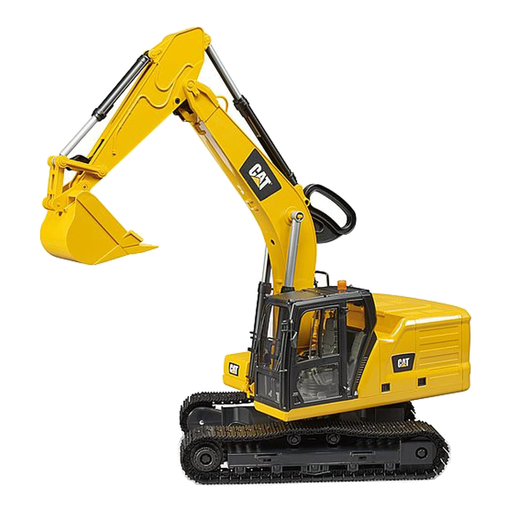
Why this product fits the profile: This large crawler excavator is aimed at children aged 4 and over who want to act out realistic operations with a movable arm and a rotating cab.
The product data gives specific dimensions of approximately 63 × 20 × 28 cm. This makes it much easier to judge the play and storage space you'll need before you buy.
ABS plastic according to the product information, tracked chassis, 360° rotating cab and detachable bucket; no batteries required.
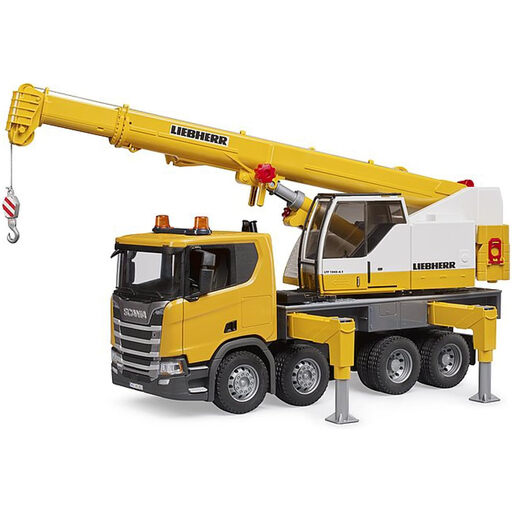
Why this product fits the profile: This crane lorry is ideal for large role-play scenarios that combine lifting, transporting and securing a construction site.
The manufacturer describes stabiliser legs and a counterweight that can be filled with sand or gravel. This takes the stability of the extended crane arm into account.
1:16 scale, 360° rotating crane unit, extendable arm up to 1.30 m according to the product description, plus light and sound module.
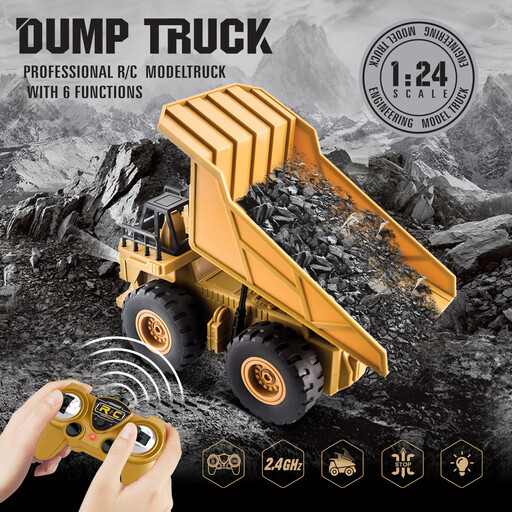
Why this product fits the profile: This RC model is designed for children who want to actively control driving functions and prefer a tipping bed that can be raised and lowered.
The power supply is clearly stated: a built-in 3.7 V rechargeable battery with 500 mAh and two AA batteries for the remote control. This makes it easier to plan for ongoing costs.
2.4 GHz remote control, six control channels, light and sound functions, and a movable tipping bed according to the product description.
We have put together a complete, regularly updated list of products that fully meet these strict selection criteria and the safety regulations in force in the EU.
For toys for children aged 3 and over, manual models with clear movement functions are a good choice, such as a wheel loader, a compact digger or a dump truck. You should always follow the manufacturer's specific age recommendation and the warnings on the packaging.
That depends on the individual model and the recommended age group. A remote control with several channels requires coordination and constant attention. You also need to think about the rechargeable battery, charging time and batteries. For younger children, a manual vehicle is often easier to use.
It's impossible to give a general lifespan. It depends on the material, the joint construction, how intensively the toy is played with and where it is used. After playing in sand, moving parts should be cleaned, electronic models kept dry, and damaged components replaced or taken out of use. This helps to reduce unnecessary wear and tear and safety risks.