Bakers with a cake tin already in mind
If you’re planning to use a springform or loaf tin, compare its dimensions with the oven cavity or with the maximum tin size explicitly stated for the model you’re considering.


For coffee cake in a small kitchen, first check that your cake tin fits the oven cavity and that the appliance will fit in your available space, including any required clearances. Capacity in litres alone won’t tell you whether a tin will fit. A compact convection oven may be suitable if the tin fits and you can position the appliance as instructed. Larger tins may require a roomier model, which will take up more space.
If you’re planning to use a springform or loaf tin, compare its dimensions with the oven cavity or with the maximum tin size explicitly stated for the model you’re considering.
As well as the appliance’s external dimensions, check the set-up instructions so you can allow for the required clearances.
If you want to cook more than just cakes, you can compare heating functions and controls, but keep the fit of your cake tin in mind.
Start by checking your tin will fit, then make sure you have enough space for the appliance and its convection function. Other heating options and ease of cleaning matter most if you’ll use them regularly.
| What to consider | What to check before buying | Why it matters |
|---|---|---|
| Will your cake tin fit? | Measure the tin, including any parts that stick out, and compare it with the model-specific approval or internal dimensions. | If I want my springform or loaf tin to fit safely, I’ll choose an oven based on its actual dimensions. Around 31% of consumers put tin fit first. |
| Available space and positioning | Measure the space available and check the clearances and set-up instructions for the exact model. | If my worktop space is limited, I need an appliance that will fit there with all the required clearances. Around 31% of consumers prioritise available space. |
| Convection and settings | Check that the exact model has a convection function, and compare its heating modes and baking settings with your recipe. | What matters to me is that the specific model has convection and settings suited to my recipe. Around 25% of consumers prioritise heating modes and baking settings. |
| Use and care | Check the cleaning instructions and any available information on energy use. Don’t confuse wattage with the energy used for one baking session. | I want to know how cleaning and everyday use will fit into my routine, without mistaking a power rating for the energy used to bake a cake. Around 13% of consumers prioritise ease of use and care. |
The oven cavity’s volume doesn’t tell you whether your tin’s diameter, height and handles will fit. Rommelsbacher explicitly lists different maximum tin diameters for certain models.
Measure the entire tin and use only dimensions or approvals for the specific model. There’s no general conversion from litres to tin size.
You may need to leave extra space around the appliance. For example, the Steba KB M19 instructions require a 10 cm gap from the kitchen wall and state that it must not be used as a built-in oven.
Before buying, check the set-up instructions for your chosen appliance. Don’t assume the clearances apply to other models.
The term ‘mini oven’ or a baking function doesn’t confirm that a particular model has convection.
Check the list of heating modes for the exact model and distinguish convection from conventional top and bottom heat, as well as from any included accessories.
The rated power in watts isn’t a measurement of the electricity used to bake a cake. According to the European Commission, small and portable ovens aren’t covered by the relevant EU energy labelling rules for ovens.
Compare energy-use figures only when the operating mode and basis of measurement are clearly comparable.
According to the manufacturer, the BG 1055/E and BGE 1580/E differ in oven capacity and maximum tin size.
The KB M19 is a 19 l compact oven with convection, and its internal and external dimensions are published.
According to the manufacturer, the TO 2068 is a 20 l oven and toaster with convection.
According to the manufacturer, the Design Bistro Ofen Bake & Grill 42814 combines a 26-l oven cavity with convection and other heating modes.
These Joybuy appliances list baking as one of their uses. For each model, check whether convection is explicitly specified, how much space it needs and whether the oven cavity will fit your cake tin.
 No image available
The product description lists baking and grilling as uses. Before buying, check whether the specific model has the convection function your recipe requires.
Listed features include a 32 l capacity, 1600 W, a timer, a crumb tray and a temperature range of 100 to 250 °C. The external dimensions are 52.3 × 36 × 32.2 cm.
 No image available
The small oven capacity could suit a limited amount of worktop space. Check your tin’s dimensions and confirm that the exact model has a convection function.
The product description lists a 10 l capacity, external dimensions of 37 × 26.5 × 21 cm, top and bottom heat, and a temperature range of 100 to 230 °C. Baking and cakes are listed as uses.
 No image available
The product title describes this appliance as a convection oven. Check your cake tin and the space available against the details for the specific model.
Listed features include a 28 l capacity, three heating modes, a temperature range of 100 to 230 °C and a timer.
 No image available
The product description lists baking with circulating hot air as one of its uses. Check that the oven cavity and your tin are suitable for your coffee cake.
Listed features include a 6.5 l capacity, 360° hot air circulation, a temperature range of 80 to 200 °C, a viewing window and an interior light.
 No image available
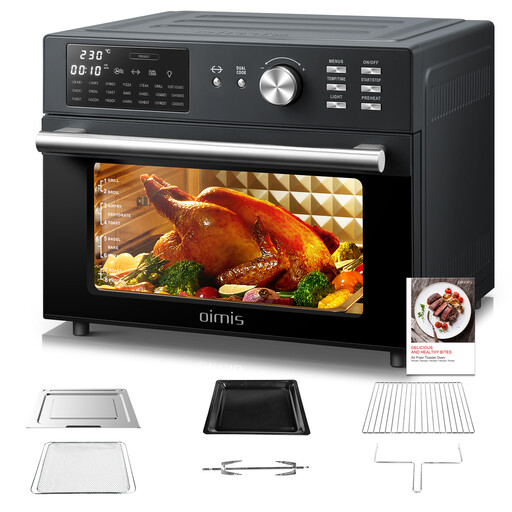
The product description lists baking with circulating hot air. The statement that it can fit a 13-inch pizza doesn’t confirm that a cake tin will fit.
Listed features include a 30 l capacity, 21 presets, a pizza mode and 360° airflow.
No. Rommelsbacher explicitly states that the BG 1055/E accommodates baking tins up to 25 cm in diameter. For other appliances, compare your tin, including any parts that stick out, with the dimensions or approvals for the specific model.
Check the instructions for the model in question. Steba requires a 10 cm gap from the kitchen wall for the KB M19 and states that it isn’t a built-in oven. This requirement doesn’t automatically apply to other models.
Check the heating modes in the technical details for the exact model. A baking function or an accessory such as a pizza stone isn’t a substitute for an explicitly listed convection function.
No. The rated power in watts isn’t a measured figure for the energy used per baking session. Under the European Commission’s definition, small and portable ovens aren’t covered by the relevant oven energy labelling rules. Compare energy-use figures only when they’re based on the same measurement method.
Follow the safety and cleaning instructions for the specific appliance. Rommelsbacher lists a removable crumb tray and a door that can be dismantled for cleaning on the BGE 1580/E. The Steba KB M19 instructions warn that surfaces can be hot and say to unplug the appliance after use.