Which oven is right for you?

Baking tray cake lovers with limited space

If you want to fit a large cake tray and a safely positioned oven on a small worktop, compare the tray and appliance dimensions first. The REWE recipe specifies a deep tray measuring 38 × 32 cm; Rommelsbacher publishes different dimensions for its oven trays.

Bakers making smaller portions

If you can adapt the recipe to a smaller tray or bake in batches, a more compact appliance may also be suitable. The actual tray dimensions and the space needed to position the oven safely are still key considerations.

Bakers who want a choice of heating functions

If you use recipes with different heating functions, check whether your chosen model offers conventional top and bottom heat as well as fan-assisted cooking. The REWE recipe specifies 200 °C using top and bottom heat for its tray; this won’t automatically be the right fan-assisted setting for a different oven.

What should you look for when choosing?

Compact oven, smaller portion

A good fit if: Space for safe positioning is limited and you can adapt the batter to a smaller tray.

The trade-off: Less space per batch may mean adapting the recipe or baking in additional batches.

A larger tray in a countertop oven

A good fit if: Baking more cake in one batch matters and you have enough space to position the oven safely.

The trade-off: The models listed offer more tray space but have larger housings; the published dimensions don’t guarantee that every tin will fit.

Keep using your existing oven

A good fit if: Your planned tray fits in your existing oven and there’s no safe space for an additional appliance.

The trade-off: You won’t gain any extra baking capacity.

Criteria What to check before buying Who should consider it?
Usable tray area Compare the tray dimensions with the dimensions and height of the tin specified in the recipe. REWE lists 38 × 32 cm; Rommelsbacher gives dimensions of 32.5 × 28.5 cm for both the BG 1550 and BGE 1580/E. If I want to bake the recipe’s full quantity in one go, tray area is my top priority. Around 31% of consumers prioritise finding the right tray size.
Safe positioning Check the external dimensions, the space needed to open the door and the positioning requirements in the instructions for the specific model. If my worktop is small, I need to be able to position the oven safely with the required clearance. Around 31% of consumers check the space available first.
Heating functions Check whether the model offers fan-assisted cooking and the top and bottom heat specified in your recipe. Don’t use the same temperature and cooking time without checking first. If I want to follow recipes with different instructions, I want to be able to choose the right heating function. Around 23% of consumers prioritise heating functions.
Cleaning and accessories Check what’s included, whether there’s a removable crumb tray and whether suitable replacement trays are available. Compare electricity costs based on consumption for each baking session. If I use the oven regularly, I look for easy cleaning and consider the effort involved in buying extra accessories. Around 15% of consumers prioritise cleaning and ongoing costs.

Common mistakes when choosing

  • Assuming capacity in litres tells you whether a tray will fit

    The REWE recipe uses a deep tray measuring 38 × 32 cm, while Rommelsbacher lists trays measuring 32.5 × 28.5 cm for both the BG 1550 and BGE 1580/E. So the oven’s capacity alone won’t tell you whether the tray you want to use will fit.

    Measure the tin, including its rim, and compare its dimensions with the tray for the specific model before choosing based on capacity in litres.

  • Checking only the oven’s external dimensions on the worktop

    An oven may fit on the worktop, but the available space might not meet the positioning requirements for that specific model.

    Check the instructions, the space needed to open the door and whether the surrounding surfaces can withstand the heat. The instructions for the Steba KB 28 ECO state that it is not designed for built-in use and specify a 10 cm gap from the kitchen wall; this requirement applies to this model.

  • Switching from top and bottom heat to fan-assisted cooking without checking

    The temperature specified in the REWE recipe applies to the tray and top-and-bottom-heat setting described there. It won’t automatically be right for every countertop oven with fan-assisted cooking.

    Where possible, use the heating function specified in the recipe. If you use a different tin or heating function, keep an eye on the baking and follow the oven’s instructions.

A guide to suitable brands

Rommelsbacher

When choosing a countertop oven, the published tray dimensions for the models listed are particularly useful.

  • Rommelsbacher lists tray dimensions of 32.5 × 28.5 cm for both the BG 1550 and BGE 1580/E, and 38.5 × 31.5 cm for the BG 1805/E.
  • These tray dimensions are provided by the manufacturer and don’t confirm the fully usable area or whether a particular cake tin will fit.

Severin

The specifications for the TO 2068 and TO 2058 provide useful points of comparison for smaller and larger countertop ovens.

  • According to Severin, the TO 2068 has a capacity of 20 l and measures 29.5 × 44 × 39 cm externally (H × W × D); the TO 2058 has a capacity of 42 l and measures 36.5 × 51.5 × 42 cm.
  • Capacity in litres and external dimensions alone don’t confirm that your planned cake tray will fit either model.

Steba

The KB 27 U.2 is a useful point of comparison for smaller batches and a compact appliance with continuous fan-assisted cooking.

  • Steba lists a capacity of 20 l and internal dimensions of 22 × 30 × 31 cm (H × W × D).
  • Internal dimensions don’t replace the need to check the tray, the rim of the tin and the clearance from the heating elements.

Joybuy products for compact baking

This Joybuy selection includes mini and convection ovens for baking. Before buying, check whether your tray and cake tin will fit the specific model; capacity in litres is no substitute for comparing dimensions.

Woltu BF12sz mini oven, 32 l

Woltu BF12sz mini oven, 32 l

For baking and grilling; check the tray dimensions against your cake tin.

32 l; 1.600 W; temperature control from 100–250 °C; 60-minute timer; crumb tray.

View at Joybuy
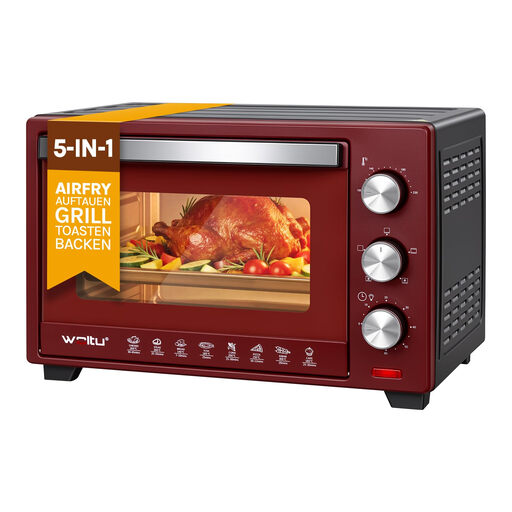
Woltu mini convection oven, 28 l

Woltu mini convection oven, 28 l

The description lists fan-assisted cooking and several heating functions; check that the tray will fit your cake tin.

28 l; top heat, bottom heat and combined top and bottom heat; temperature control from 100–230 °C; 60-minute timer.

View at Joybuy

Frequently asked questions

Is the capacity in litres enough to choose an oven for plum cake?

No. Compare the tray dimensions with the dimensions and height of the tin, including its rim, and check the specifications for the specific oven. The REWE recipe uses a 38 × 32 cm tray; Rommelsbacher lists dimensions of 32.5 × 28.5 cm for both its 30-litre BG 1550 and BGE 1580/E models.

Can I bake two cake trays at once using fan-assisted cooking?

Don’t assume you can just because the oven has more than one shelf position. Rommelsbacher lists conditions for the BGE 1580/E: preheat thoroughly, use a fan-assisted programme, don’t overfill the oven and leave space around the heating elements. A fuller oven may take longer to cook; for other models, follow their own instructions.

How should I position a countertop oven?

Follow the instructions for the specific model and allow for the required clearance and enough space to open the door. The instructions for the Steba KB 28 ECO prohibit using it as a built-in oven and specify a 10 cm gap from the rear kitchen wall for this model; don’t apply this measurement to other appliances.

How can I compare electricity costs when baking?

Compare the electricity used for each baking session and your electricity tariff, rather than looking at the rated power alone. The Verbraucherzentrale recommends checking an appliance’s actual electricity consumption.

What should I check when buying an electrical appliance for the German market?

Check the specific appliance for the CE marking, product and manufacturer identification details, and German-language instructions with any necessary safety warnings. The Bundesnetzagentur lists these points as part of its market surveillance; the CE marking alone doesn’t show that an appliance will fit your tray.