For cooks with very limited worktop space
You need a freestanding oven whose casing and required ventilation clearances will fit in your kitchen. The clearances specified by the manufacturer apply to the particular model.


First, measure your filled ovenproof dish, including its handles, and compare it with the usable interior, shelf height and door opening. Then check the ventilation clearances required for the specific model at your chosen spot. A small countertop convection oven may suit smaller dishes, while a larger countertop oven or your existing oven may be a better fit for a larger dish, provided you have enough safe space.
You need a freestanding oven whose casing and required ventilation clearances will fit in your kitchen. The clearances specified by the manufacturer apply to the particular model.
You want to keep using your usual dish and make the same portion size. In that case, the usable internal dimensions and shelf height matter more than the stated capacity in litres alone.
You want to prepare more than just baked rice pudding, so you’re looking for convection cooking and a choice of heating functions.
First decide whether you need an additional countertop appliance. Then check the dish, available space and heating functions for the specific model.
A good fit if: you use a smaller dish and there’s enough room for it inside the oven, along with the model-specific ventilation clearances at your chosen spot.
Consider: A smaller casing doesn’t guarantee that your existing dish will fit inside.
A good fit if: you need a larger dish and have enough space for the oven and its required clearances.
Consider: The Caso TO 26 SilverStyle casing measures 48 × 40 cm (W × D); these external dimensions alone don’t confirm that there’s a safe place to put it. (CASO Design)
A good fit if: your dish already fits and another appliance would permanently take up worktop space. Swissmilk recommends a 20 × 30 cm dish for a recipe serving four.
Consider: You avoid adding another appliance, but you won’t gain any extra baking capacity.
| What matters | What to check before buying | Who is it important to? |
|---|---|---|
| A safe place to put it | Check the casing dimensions and the side, rear and upper ventilation clearances in the instructions for the exact model. | If my worktop space is limited, I need to be able to fit the oven safely, with enough room around it. Around 36% of consumers prioritise finding a suitable spot. |
| Dish and portion size | Compare the dish, including its handles and height, with the interior, rack area, shelf and door opening. | If I want to keep using my oven dish and making the same portion size, usable cooking space matters more than the stated capacity in litres alone. Around 29% of consumers prioritise a dish that fits. |
| Heating functions and controls | Check whether the exact model has convection and how the top and bottom heating elements operate. | If I make a variety of baked recipes, I want to be able to choose the heating function I need. Around 21% of consumers focus mainly on heating functions and controls. |
| Cleaning and day-to-day use | Look for an easy-to-reach interior and a removable crumb tray. To compare running costs, only compare energy use for similar cooking methods. | If I use the oven regularly, cleaning and running costs matter to me. Around 14% of consumers put these factors first. |
For the Rommelsbacher BG 1055/E, the manufacturer also specifies 4 cm of clearance at the sides and 1 m above the oven for ventilation. These requirements are specific to this model.
Before deciding, compare your chosen location with the instructions for the exact model variant.
Swissmilk recommends a 20 × 30 cm dish for a recipe serving four, while Rommelsbacher lists round baking tins up to 25 cm in diameter for the BG 1055/E. These dimensions refer to different types of dish.
Measure your dish, including its handles and height, and compare it with the usable interior, shelf and door opening.
The product description for the Severin TO 9020 mentions convection, while its technical table says it does not have a fan-assisted function.
Check the function of the exact model variant before buying, rather than relying on a single product description.
According to Steba, the KB M19 is a 19-litre countertop oven with switchable convection. Its internal dimensions are 31 × 25.5 × 23.5 cm (W × D × H).
According to the manufacturer, the BG 1055/E is an 18-litre compact oven with convection and a choice of heating functions. Rommelsbacher says it fits round baking tins up to 25 cm in diameter.
According to CASO Design, the TO 26 SilverStyle has a capacity of 26 litres, convection and internal dimensions of 35 × 30 × 20 cm (W × D × H).
According to Severin, the TO 2068 is a 20-litre oven and toaster with a fan-assisted function. The casing measures 44 × 39 cm (W × D).
These Joybuy mini ovens vary in size and features. For the exact model variant, check that your dish will fit, which heating functions it has and what ventilation clearances are needed at your chosen spot.
 Image unavailable
A larger mini oven option, provided your dish fits and you have enough space for it.
32 litres; 1.600 W; 100–250 °C; timer up to 60 minutes; crumb tray. Compare the stated external dimensions of 52.3 × 36 × 32.2 cm with your available space and the clearances required.
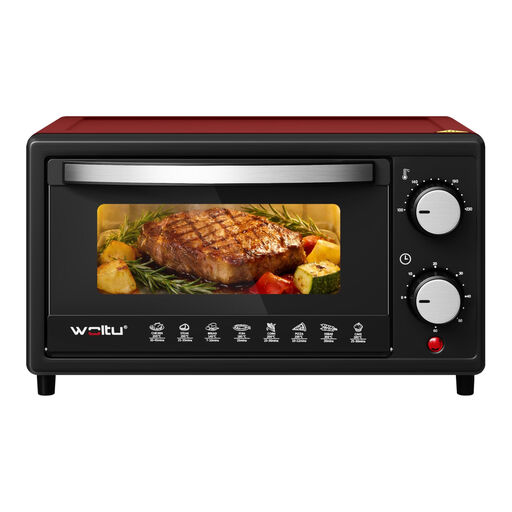 Image unavailable
The smaller capacity may suit a correspondingly small dish. Measure the available cooking space and your dish first.
10 litres; red finish.
 Image unavailable
An option if you’re looking for a mini oven described as a convection oven and your dish and chosen location are suitable.
28 litres; described as a mini convection oven for pizza; temperature control and timer, according to the product name.
Follow the recipe you’re using and check that the pudding is cooked through. For a recipe in a 20 × 30 cm dish, Swissmilk recommends 180 °C fan-assisted without preheating, for around 50 minutes on the lowest shelf. Stir after about 40 minutes. These instructions haven’t been confirmed for every smaller dish or countertop oven.
Only if the instructions for the specific model allow for enough clearance and airflow in that location. For the Rommelsbacher BG 1055/E, the manufacturer specifies 1 m of clearance above and 4 cm at the sides. The instructions for the Steba KB M19 specify a 10 cm gap between the back of the appliance and the wall; this isn’t a general requirement for other ovens.
Not simply because it’s an electric oven: the European Commission lists small and portable ovens as being outside the scope of this energy labelling scheme. The absence of an energy label doesn’t indicate either low or high energy use.
Where relevant EU rules require CE marking, the manufacturer uses it to declare that the product meets the applicable requirements. The marking doesn’t confirm that your oven dish or chosen location is suitable for the appliance.
The German Federal Institute for Risk Assessment recommends allowing cooked, heated food to cool, then storing it in the fridge until just before reheating it to eat.