Who is a convector heater at a desk suitable for?

People who get chilly at their desk from time to time

If you only need extra warmth while sitting for limited periods, check that you have a suitable spot for the heater and can adjust its settings at your workstation, rather than automatically trying to heat the whole living room. STIEBEL ELTRON describes convector heaters as appliances that warm the air and circulate it upwards through natural convection.

Living room users who need a quiet workspace

If you want to keep fan noise to a minimum while working or talking, compare natural convection models with those that have an additional fan. De’Longhi lists a fan and a noise level for the HSX2320F, but the measurement basis is not suitable for direct comparison.

Households with limited space around the desk

If furniture, cables or walkways limit where you can place the heater, check that it can be positioned safely and connected correctly before choosing a model. STIEBEL ELTRON lists a tip-over switch for its CNS 2000 Plus LCD Move; for wall-mounted convectors such as the AEG WKL 2005, you should also check the exact connection type.

What should you consider when choosing one?

Freestanding convector without a fan

A good fit if: you can place the heater in a suitable spot near your desk when you need it.

The trade-off: Natural convection warms circulating air in the room; it does not guarantee a targeted warm zone at your seat.

Wall-mounted convector

A good fit if: a fixed position near your workspace works for you and you have checked the installation requirements for the specific model.

The trade-off: It keeps the floor clear, but you cannot move it around at a moment’s notice; some versions are not supplied with a plug.

Convector with a fan

A good fit if: more active distribution of warm air matters more to you than keeping fan noise to a minimum.

The trade-off: De’Longhi describes the HSX2320F as suitable for well-insulated rooms or occasional use; check whether the fan on the model you choose can be switched off.

Check your existing heating first

A good fit if: the whole living room is consistently too cold or you expect to run supplementary heating for long periods every day.

The trade-off: Checking your heating, room temperature and electricity tariff may not provide an immediate solution if you suddenly feel cold at your desk.

Purchase priority What to check Who it matters most to
Warmth at your workspace Room or workspace requirements; design, placement and adjustability. If I only get chilly at my desk from time to time, I want to check that the heater will provide the warmth I need in a safe position, rather than heating the whole living room. Around 27% of consumers put warmth at their workspace first.
A quiet working environment Whether there is a fan and if it can be switched off; only compare noise levels when the measurements are based on the same method. When concentrating on work or talking, I want to avoid distracting fan noise and understand the noise rating for the specific model. Around 20% of consumers put a quiet working environment first.
Safe positioning and connection The model’s instructions on clearances and positioning; cable, socket and connection type. If furniture, fabrics or walkways limit the space, I need to find a safe position or suitable mounting option before choosing a heater. Around 27% of consumers prioritise safe positioning.
Ongoing electricity costs Power in kW, actual hours of use and your own unit rate; don’t assume a timer guarantees savings. If I use supplementary heating often or for long periods, I want to estimate consumption for my tariff before relying on an electric heater for ongoing room heating. Around 26% of consumers put ongoing electricity costs first.

Common selection mistakes

  • Assuming a higher wattage means cheaper heating

    The rated power alone does not tell you whether a heater will warm a large living room sufficiently or how much it will cost to run. The ADAC considers electric heaters more suitable as a supplement; running time and your unit rate determine the consumption-based part of the cost.

    Before planning to run a heater for long periods every day, work out the cost using the expected hours of use, its power rating and your tariff.

    Longer running times increase electricity consumption. The actual cost depends on how long the heater is switched on and how its thermostat regulates the temperature.

  • Assuming freestanding, wall-mounted and model variants are interchangeable

    Similar model names can refer to different designs and connections. For example, STIEBEL ELTRON lists the CON 20 Premium and CON 20 Premium U as different versions; a wall-mounted model that is not supplied with a plug may need to be installed by a qualified professional.

    Check the full model number, connection type and instructions for the specific version before deciding where and how to install it.

    You will also need to factor in professional installation for versions that are not supplied with a plug.

  • Assuming the space under your desk is suitable

    Furniture, fabrics, obstructed air vents or insufficient clearance can affect safe operation. STIEBEL ELTRON’s instructions for the EG-50-TR2-PM prohibit covering it or placing it directly below a wall socket; these instructions are not a complete guide to other models.

    Check the positioning requirements for the specific heater and do not use appliances with damaged cables or visible scorch marks. The German Fire Brigade Association warns against using appliances with this kind of damage.

Key brands to consider

STIEBEL ELTRON

The brand offers freestanding and wall-mounted convectors for supplementary or transitional heating. STIEBEL ELTRON lists a power rating of 2,000 W for the CNS 2000 Plus LCD Move.

  • For this freestanding model, the manufacturer lists a weekly programme, a tip-over switch and overheat protection.
  • These features apply to this specific model; its power rating alone does not show that it will be enough for every large living room.

AEG Haustechnik

The brand’s wall-mounted convectors are designed for a fixed heating position. AEG Haustechnik lists a power rating of 2.0 kW for the WKL 2005.

  • For the range, the manufacturer lists electronic controls, a weekly programme and overheat protection.
  • For versions not supplied with a plug, check the requirements for professional installation and the details of the exact model.

De’Longhi

The manufacturer describes the portable HSX2320F convector as suitable for occasional supplementary heating or well-insulated rooms.

  • The model comes with a room thermostat and an additional fan.
  • The manufacturer describes it as suitable for small and medium-sized rooms; this does not establish that it is suitable for a large living room.

Klarstein

Klarstein offers Bornholm Curve convectors as freestanding or wall-mounted models. The black version reviewed, 10031979, is rated at 2,000 W.

  • Klarstein lists an electronic thermostat and a weekly programme for this version.
  • The brand specifies a room size of 20 m² for this version; this figure should not be taken to apply to larger living rooms.

Rowenta

The manufacturer’s website describes the Vectissimo CO3030F1 as suitable for medium-sized rooms.

  • Rowenta lists a coverage area of 20–25 m² for this model.
  • This figure from the manufacturer does not establish that the model is suitable for a larger living room.

Joybuy products for occasional supplementary heating

The electric convectors below are described as suitable for occasional supplementary heating in living areas. Check the stated coverage area for each model and make sure its design and connection suit your desk space.
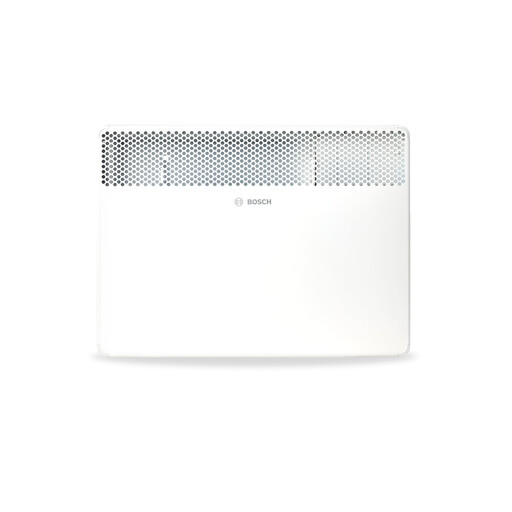
Bosch HC 4000-15 electric convector heater, 1,500 W, up to 15 m²

Bosch HC 4000-15 convector heater, 1,500 W, up to 15 m²

Could be suitable for occasional supplementary heating at your desk if the stated coverage of up to 15 m² is right for your room.

Temperature control, seven pre-set settings, a weekly programme, Eco mode and an LED display are listed. The model can be wall-mounted or placed on the floor; floor-standing feet are available separately.

The stated room size does not guarantee that it will be suitable for a larger living room. Overheat protection, a child lock, open-window detection and IP24 are also listed.

Joybuy
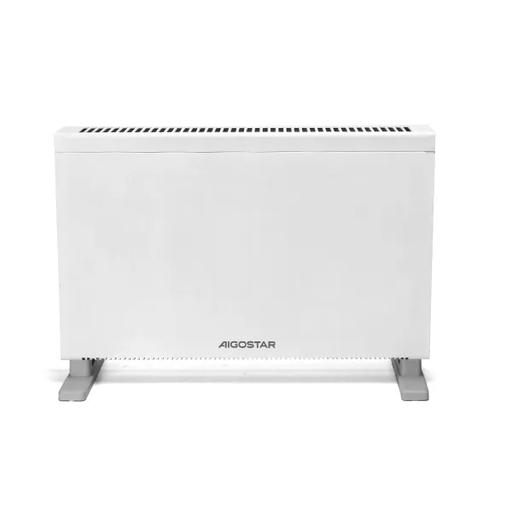
Aigostar convector heater, 2,000 W, with remote control

Aigostar convector heater, 2,000 W, with remote control

Natural convection and the stated coverage of 20–25 m² may make this model worth considering for occasional supplementary heating in a living area; the coverage figure does not guarantee that it will heat larger rooms.

A remote control, LED touch controls, a thermostat and a 24-hour timer are listed. Tip-over and overheat protection are also included.

According to the product description, the heater needs at least 1 m of clearance from furniture, curtains and other objects, as well as a suitable 16 A/250 V socket.

Joybuy

Frequently asked questions

Can a 2,000 W convector heater heat a whole large living room?

You cannot tell from the 2,000 W rating alone. Klarstein lists a room size of 20 m² for one 2,000 W model; De’Longhi describes the HSX2320F as suitable for well-insulated rooms or occasional use. These manufacturer claims do not guarantee that a model will heat a living room of any size. Consider whether you only need occasional warmth at your desk or want to heat the whole room continuously.

What should I bear in mind when positioning and cleaning the heater?

Follow the clearance and positioning instructions in the manual for your chosen model. STIEBEL ELTRON’s manual for the EG-50-TR2-PM prohibits covering it or positioning it directly below a wall socket; these instructions do not automatically apply to other models. Follow the relevant manufacturer’s instructions for cleaning and maintenance too.

How can I estimate electricity consumption?

Multiply the power rating in kW by the number of hours the heater is used to calculate consumption in kWh. Then multiply that figure by your unit rate to estimate the consumption-based part of the cost. For example, running a 2 kW heater continuously for three hours uses 6 kWh; the actual cost depends on your tariff. If the thermostat turns the heater down during this time, its actual power consumption will be lower than if it ran continuously at its rated power.

Who is responsible if there is a fault: the retailer or the manufacturer?

Your statutory rights for faulty goods are against the seller. A manufacturer’s guarantee is separate and is subject to its own terms and conditions. The Federation of German Consumer Organisations advises against treating the two as the same. Check the guarantee terms for the specific offer.

Do I need permission to install an electric convector heater?

There is no blanket answer for every installation: a freestanding heater with a plug and a wall-mounted convector without a plug have different connection requirements. According to the European Commission, electric local space heaters sold in the EU must meet ecodesign requirements; an EU energy label graded A to G is not required for this electric product group. Check the connection type and documentation for the specific heater, and arrange professional installation if your version is not supplied with a plug.