What should you look for when buying?
First, check that the location and intended use are suitable. Then you can weigh up noise, running time and controls.
The following proportions relate to consumers looking for extra warmth at a desk in a shared lounge.
| Priority |
What to check when buying |
Who is it most relevant to? |
| Safe placement |
Check the instructions, intended use, placement and clearances for the specific model. |
If the heater is accessible in a shared space, I want to know whether the location is suitable according to the instructions and intended use. Around 33% of consumers are likely to prioritise safe placement and using the heater as intended. |
| Quiet operation |
Check whether the model has a fan and whether it can be switched off. Only compare noise figures taken under similar test conditions. |
In a shared lounge, I want to avoid a fan disturbing others at their desks or in the seating area. Quiet operation is likely to be the main priority for around 27% of consumers. |
| Electricity use |
Consider the rated power and actual running time. Don’t assume thermostat cycles will deliver a set saving without measuring consumption. |
If I’m only heating the space for limited periods, I want to consider the power consumption alongside the planned running time. Around 20% of consumers are likely to prioritise electricity use while the heater is running. |
| Space and controls |
Check whether it’s a freestanding or wall-mounted model, its dimensions and installation requirements, and whether the specific version has the timer controls you want. |
Next to my desk, what matters is whether the heater fits in the available space and whether I can schedule heating times. Around 20% of consumers are likely to consider the footprint and controls their top priority. |
Joybuy products for extra warmth
The following Joybuy products include convector heaters for extra warmth in a room, with different placement options and controls. Check the instructions for the specific model to make sure it’s suitable for use in a shared space.
 No image available
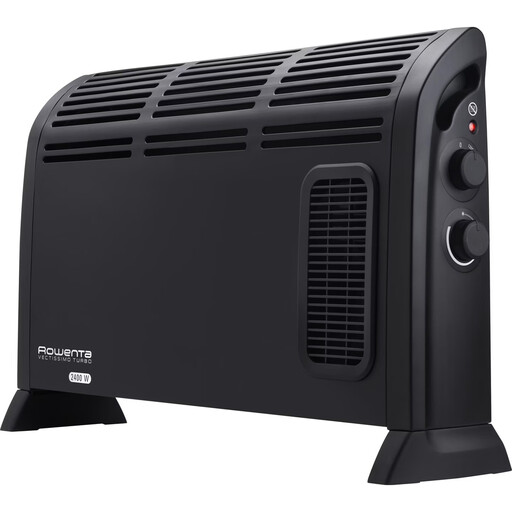
Rowenta Vectissimo II CO3035
May be suitable for adding warmth indoors if you have a suitable freestanding space for it.
Described as an indoor convector heater with two heat settings, a thermostat and a turbo fan function. The product description says to keep it at least 1 m from objects. It isn’t intended for bathrooms or outdoor use.
Joybuy
 No image available
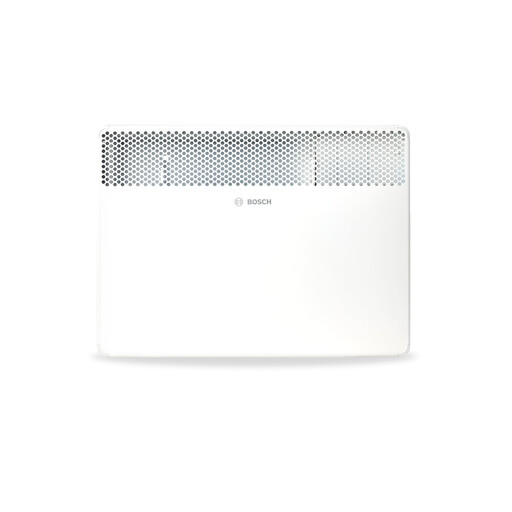
Bosch HC 4000-15
May be suitable if you’re looking for an adjustable supplementary heater with heating times you can schedule.
Described as having 1,500 W, a weekly programme and electronic temperature control from 12 to 28 °C. Wall mounting or floor-standing placement is listed; feet for floor-standing use are sold separately.
Joybuy
 No image available
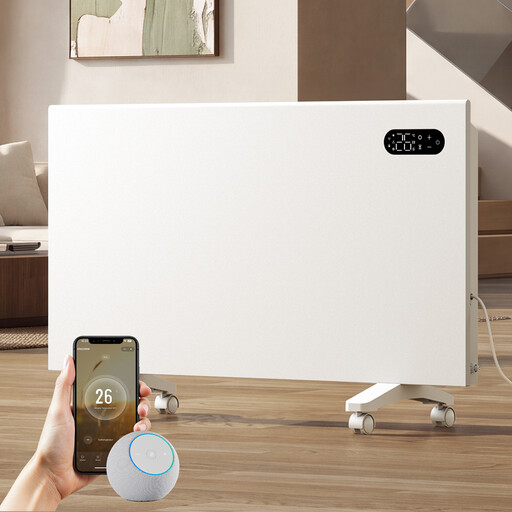
EMKE Smart Electric Heater 2,000 W
May be suitable if you’re looking for a supplementary heater with programmable controls and app or voice control is important to you.
Described as having a thermostat, timer, app and voice control, with a stated power rating of 2,000 W. Freestanding use with castors or wall mounting is listed, along with suitability for rooms up to 20 m².
Joybuy
 No image available
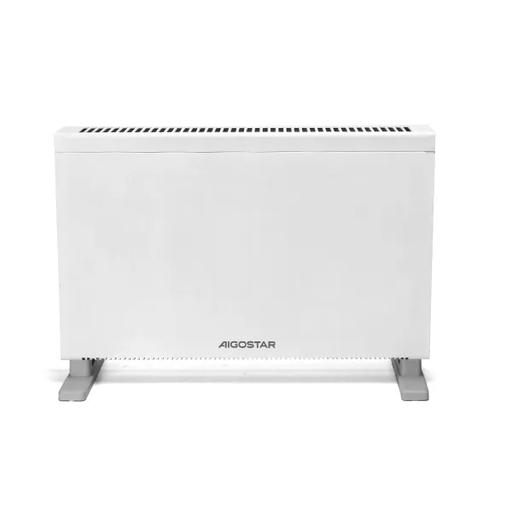
Aigostar 2,000 W convector heater with remote control
May be suitable for adding adjustable heat if a remote control and timer would be useful where you plan to place it.
Described as using natural convection and having two heat settings, a remote control and a timer. The product description says to place it on a flat, stable and dry surface, at least 1 m from objects. Don’t use it in damp areas such as bathrooms.
Joybuy
Frequently asked questions
Can I put a convector heater directly under my desk?
Not without checking the instructions for the specific heater. Follow the placement guidance, keep airways clear and observe the stated clearances. Trotec’s instructions specify floor-standing placement for the TCH 20 E; this doesn’t mean it’s approved for a confined space beneath a desk.
How much electricity does a 2,000 W convector heater use?
At full power without interruption, 2,000 W is equivalent to 2 kWh per hour. Stiebel Eltron lists 2,000 W for the CNS 2000 Plus LCD Move. Actual consumption depends on factors including running time and thermostat cycles.
Does a new 230 V convector heater in Germany need CE marking?
Yes, if the ready-to-use electrical product falls within the scope of Germany’s implementation of the Low Voltage Directive. The Federal Institute for Occupational Safety and Health explains the requirements for electrical equipment. A CE mark alone doesn’t prove that a particular product listing is compliant.
Does every electric convector heater need an EU energy label?
No. The European Commission excludes electric local space heaters from the scope of its energy labelling rules. However, electric local space heaters that fall within the scope of the rules and have been placed on the EU market since 1 July 2025 are subject to ecodesign requirements under Regulation (EU) 2024/1103.
How should I maintain an electric heater?
Follow the instructions for the specific model and regularly check that it’s in good working order. The Federal Institute for Occupational Safety and Health describes the manufacturer’s instructions as an important source of information for private users on use, maintenance and unsuitable environmental conditions.


