What should you look for when buying?
First check where you can safely place or mount the heater. Then decide whether you prioritise quiet operation, a fan function or timer-controlled use.
| Buying consideration |
What to check before buying |
Who is this most relevant to? |
| Ongoing electricity costs |
Check the rated power and controls of the specific model. Calculate the cost using the power in kW, actual heating hours and your own price in €/kWh. |
If I heat the room regularly, I want to calculate the power consumption and running time using my tariff, rather than rely on a timer. Around 24% of consumers put ongoing electricity costs first. |
| Quiet operation |
Check whether the heater has a fan and whether it can be switched off. Compare noise figures only for the operating mode specified. |
If I work or sleep in the room, I don’t want to be disturbed by fan noise. Around 23% of consumers prioritise quiet operation. |
| Safe placement |
Check the required clearances and installation instructions against your intended location. Check the socket and cable, too. |
I need a location where I can maintain the required clearances and keep the airflow unobstructed. Around 23% of consumers focus primarily on safe placement. |
| Floor space and installation |
Check the heater’s dimensions and feet, and whether wall fixings are included for the specific variant. |
If there’s little free space in the room, I want to know whether a wall-mounted model can be installed safely or if a freestanding heater would be a better fit. Around 18% of consumers pay particular attention to floor space and installation. |
| Fast air circulation |
Compare the fan function and heat settings of the specific model. Don’t infer a particular heat-up time from the wattage. |
If I only use the room for a short time, I care about how quickly the warmth is distributed. A fan can circulate the air faster, but it will be audible. Around 12% of consumers prioritise fast air circulation. |
Joybuy products for small rooms
This selection includes a portable convector heater with optional air circulation and a programmable model described as suitable for wall or floor installation.
 No image available
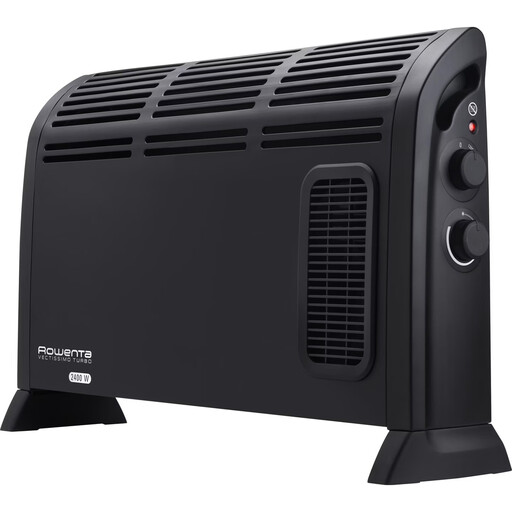
Rowenta Vectissimo II CO3035 convector fan heater
A good choice if you’re looking for a freestanding heater with optional air circulation and a carry handle.
Heat settings: 1,200 and 2,400 W; thermostat; turbo function; IP20 rating. Dimensions: 145 × 745 × 430 mm. The freestanding design requires floor space.
View at Joybuy
 No image available
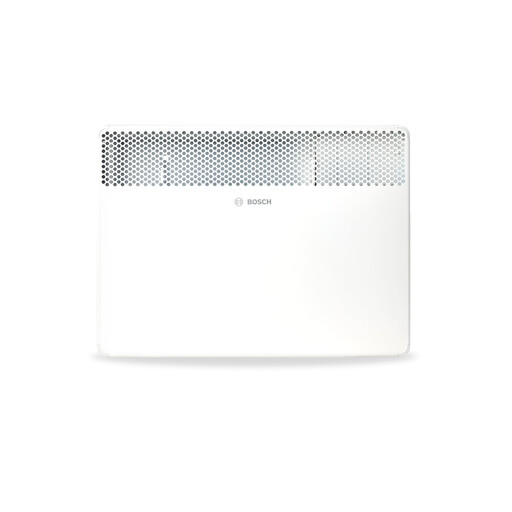
Bosch HC 4000-15 convector heater
A good choice if you’re looking for a programmable model for a room of up to around 15 m², with the option of wall or floor installation.
Heat output: 1,500 W; weekly programme; seven presets; Eco mode; open-window detection; overheat protection and child lock. Feet for freestanding use are sold separately.
View at Joybuy
Frequently asked questions
How can I estimate the electricity costs of a convector heater?
For each heating period, calculate power in kW × actual hours of use × your price in €/kWh. 1,000 W is equivalent to 1 kW and uses 1 kWh for every hour of continuous heating. How long the heater actually runs depends, among other things, on the thermostat settings. So use your tariff and pattern of use rather than a general cost estimate in euros.
Is a convector heater without a fan quieter?
A model without a fan won’t make any fan noise. An optional fan can circulate the air more quickly, but you’ll hear it running. Check whether it can be switched off and which operating mode any noise figure applies to.
What should I bear in mind when positioning the heater?
Keep clear the spaces and airflow paths required in the instructions for the specific heater. Don’t dry laundry on the heater or overload the socket. Check the model-specific instructions before cleaning.
Does an electric convector heater need an EU energy label?
EU ecodesign requirements apply to local space heaters, but the EU energy labelling rules exclude electric local space heaters. As the European Commission explains, the absence of an A-to-G label is therefore not, by itself, evidence of a breach of the rules, and it says nothing about electricity costs.
What are my rights if a convector heater is faulty?
If you buy from a business seller, you generally have statutory rights against the seller; the Verbraucherzentrale states that the minimum period is two years. For purchases made from 31 July 2026, the period increases from two to three years, according to the Verbraucherzentrale, if the fault is remedied by repair within the first two years. A voluntary manufacturer’s warranty is separate from these rights.


