
Lieferung heute & morgen

Qualitätsgarantie

Willkommens-Angebote freischalten: KOSTENLOSE Lieferung | Bis zu 80 % RABATT | Kostenlose 30-Tage-JoyPlus-Testphase
App herunterladen
Purchasing the first set of essentials for a baby is a major decision. The choice of the right sleeping space, in particular, is a key concern for many expectant parents. A convertible baby crib offers a long-term, flexible solution that adapts to your child's needs over several years. Instead of having to buy a new bed after a short time, this type of model simply grows with them—from a bedside sleeper for the first few months to a junior bed for the toddler years.
This article serves as your guide. It outlines objective criteria for selection and presents various models with their specific features to provide you with a solid basis for making an informed decision.
To find the perfect model for your family, several functional and safety-related aspects should be considered.
A convertible crib offers various configurations for different developmental stages. Typical conversion options include:
Safety is the highest priority. Ensure compliance with current European safety standards. Relevant standards include EN 1130:2019 for bassinets and bedside sleepers, and EN 716 for children's beds. These standards regulate aspects such as stability, the spacing of the bars, and the safety of the materials used. Paints and woods should be non-toxic, saliva-resistant, and completely safe for children.
A height-adjustable baby crib is an essential feature, especially if it will be used as a bedside sleeper for a box spring bed. Stepless or multi-level adjustment of the sleeping surface ensures that the crib mattress aligns seamlessly with the parents' mattress.
An all-in-one crib set can be a practical and cost-effective solution. Such bundles often include a matching mattress, a crib bumper, bedding, and sometimes even a crib with a mattress and canopy, saving you from purchasing these items separately.
Here we present three models that stand out for their different concepts and functionalities.
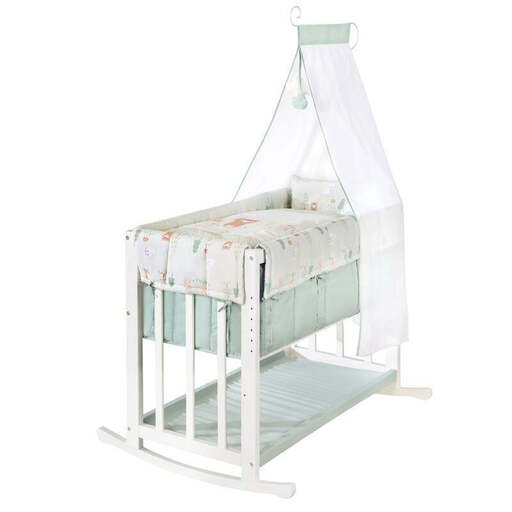
Why it stands out: This model is a true all-rounder for the early stages of your baby's life. It combines four functions in one product and comes as a complete set. Its flexible height adjustment and the included safety strap make it particularly suitable for attaching to various parent beds, including box spring beds.
Advantages:
Who is it for? For parents seeking a flexible, all-in-one solution for the first few months. It's ideal if the baby will be sleeping in different rooms and a secure connection to the parents' bed is desired.
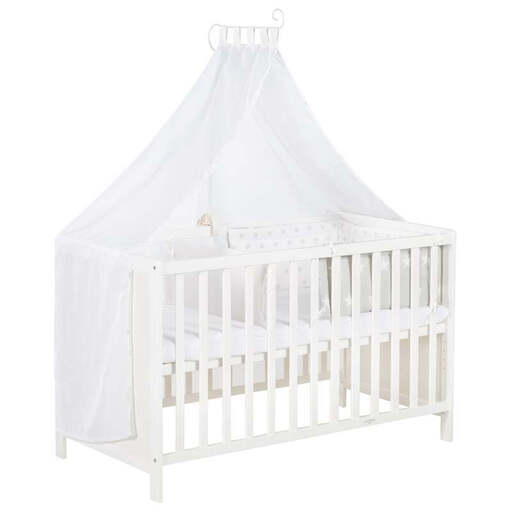
Why it stands out: This 60x120 slatted crib is designed for long-term use, accompanying your child from infancy to their preschool years. Its ability to convert from a bedside sleeper to an enclosed crib and finally to a junior bed makes it a sustainable investment.
Advantages:
Who is it for? For families looking for a single, durable sleeping solution that adapts to their child's development over many years while meeting high safety standards.

Why it stands out: This bed combines the stability of a wooden crib with the flexibility of a travel cot. Being a foldable wooden travel crib is a unique feature that makes it ideal for visits to grandparents or for holidays, without sacrificing the sturdiness of solid wood.
Advantages:
Who is it for? For grandparents who need a sturdy yet easily storable guest bed for their grandchildren, as well as for families who travel frequently and are looking for a more durable alternative to conventional fabric travel cots.
Every family's needs are unique. Perhaps you're looking for a different size, a different design, or additional accessories. A wider selection of beds and equipment can help you find the perfect product for your home.
Discover more models and accessories in our Kids' Furniture category.
A convertible baby crib is a modular sleeping system that can be adapted to a child's size and motor skills through various conversions. Typically, it can be transformed from a bedside sleeper or slatted crib into an open junior bed by removing or replacing the side panels. This significantly extends its lifespan compared to a standard infant-only crib.
The lifespan depends heavily on the specific model. Simple bedside sleepers or bassinets are often designed for the first 6 to 12 months. Fully convertible combination cribs that transform into a junior bed can often be used until the child is 5 to 7 years old, or up to a maximum weight specified by the manufacturer (e.g., 50 kg).
Box spring beds have a significantly higher sleeping surface than conventional beds. Therefore, it is crucial that the bedside sleeper has a sufficiently wide height-adjustable range to allow the crib mattress to align flush and without gaps against the parents' mattress. Additionally, the included safety strap must be long enough and suitable for securing to the frame of a box spring bed to ensure a safe and stable connection.