
Lieferung heute & morgen

Qualitätsgarantie

Willkommens-Angebote freischalten: KOSTENLOSE Lieferung | Bis zu 80 % RABATT | Kostenlose 30-Tage-JoyPlus-Testphase
App herunterladen
By Joybuy Product Recommendation Officer, August 28, 2026
Purchasing a car seat is one of the most critical decisions you'll make for your child's safety in the car. A convertible car seat promises a long-term solution, designed to grow with your child from birth until they no longer need one. However, the market is crowded and filled with marketing claims that don't always deliver. This guide will help you identify the crucial features and avoid common purchasing mistakes.
The appeal of investing in a single seat for up to 12 years is strong, but it comes with risks. Pay close attention to these points to make an informed decision.
To separate the best from the rest, you should closely examine three technical features. These define the safety and practicality of a convertible car seat.
The i-Size standard (UN R129) is the gold standard for child safety. Unlike the older ECE R44 standard, which is based on weight, i-Size uses the child's height. This makes selecting the right seat simpler and more precise.
ISOFIX is an internationally standardised attachment system that connects the car seat directly to the vehicle's chassis. Two connectors on the car seat lock into anchor points located between the car's backrest and seat cushion.
A 360-degree rotating car seat is more than just a luxury feature. It makes daily life significantly easier:
Based on the criteria above, we've curated a selection of models suited to different family profiles and needs.
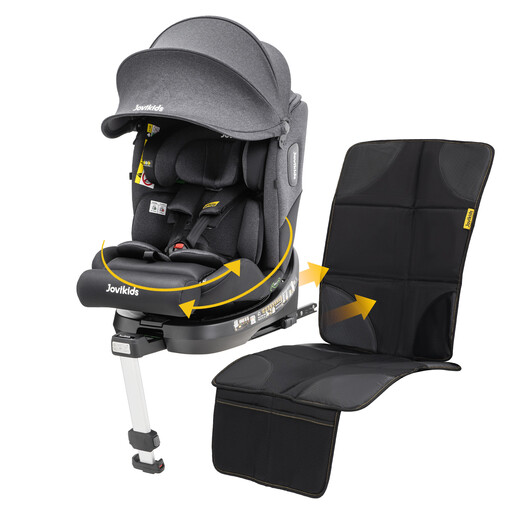
Why this model fits: This model is designed for families seeking a single, well-engineered solution from birth until their child no longer needs a car seat. It covers the entire 40 to 150 cm height range.
It bypasses the "one-size-fits-all" trap with removable newborn inserts and a 12-position adjustable headrest, allowing it to adapt to every growth stage without compromising on safety.
It meets the strict i-Size (ECE R129) standard and combines all modern safety and convenience features in one package, including a 360° rotation, ISOFIX, and a support leg.

Why this model fits: Perfect for parents who want zero compromises on safety and comfort for the first four years of life (61-105 cm). With an optional newborn inlay, it can also be used from birth.
This seat focuses on the critical age group up to 4 years, thus avoiding the compromises of a 12-year seat. It offers an optimised fit and protective features for babies and toddlers.
Combines the 360° rotation with an integrated Linear Side-impact Protection (L.S.P. System) and an air ventilation system for superior travel comfort.

Why this model fits: A 2-in-1 seat that serves as the next stage after an infant carrier, accompanying the child from approx. 15 months to 12 years (76-150 cm). It uses an impact shield system.
It focuses on the age group after the infant carrier and uses an impact shield that distributes frontal collision forces over a large area. Later, it converts into a high-back booster seat.
Long-term usability of over 10 years and simple handling thanks to ISOFIX installation. According to the manufacturer Cybex, the impact shield reduces the risk of neck injuries.
We have compiled a complete, up-to-date list of products that fully meet these strict selection criteria and safety regulations.
According to the current i-Size standard (UN R129), rear-facing travel is legally required until at least 15 months of age. However, safety experts recommend keeping children in a rear-facing car seat for as long as possible, ideally up to the age of four. This position offers significantly better protection for the not-yet-fully-developed neck muscles in a frontal collision.
Technically, it is possible, and models like the Jovikids RANGER 2 are designed for this purpose. It's crucial that the seat has high-quality, adjustable inserts for newborns and that the headrest and harness system can be precisely adapted to the growing child. For some parents, a combination of a specialised infant carrier for the first few months followed by a convertible seat (e.g., from 76 cm) may be the more comfortable solution.
Both systems aim to keep the child securely in the seat in the event of a collision.