
Lieferung heute & morgen

Qualitätsgarantie

Willkommens-Angebote freischalten: KOSTENLOSE Lieferung | Bis zu 80 % RABATT | Kostenlose 30-Tage-JoyPlus-Testphase
App herunterladen
A convertible high chair is an investment that will accompany your family for many years. The concept is compelling: a single chair that adapts from an infant high chair all the way to the teenage years. However, the market is flooded with models whose promises don't always hold up in practice. Before you make a decision, it's crucial to understand the common pitfalls that can quickly turn a long-term investment into a source of frustration.
As your Joybuy Product Recommendation Officer, I'm here to help you distinguish essential features from superfluous ones and make an informed choice.
Many products advertise durability and flexibility. In reality, however, they often fail to meet the fundamental demands of daily family life.
To avoid these pitfalls, you should focus your attention on three objective criteria. These define the quality, safety, and longevity of a high chair.
A reliable indicator of safety is compliance with the European standard EN 14988. This standard sets specific requirements for children's high chairs, including:
Look for this standard in the product details. It is a fundamental, non-negotiable quality feature.
A true convertible wooden high chair is characterised by finely-stepped or stepless adjustment of the seat and foot plates. This is the only way to precisely adapt the chair to the child's current height.
Also, check the maximum weight capacity. Figures of 50 kg, 70 kg, or more indicate the robustness of the construction and its true lifespan into adolescence or even adulthood.
A wooden high chair is popular with many families for its stability and aesthetic appeal. But not all woods are created equal.
Look for sealed surfaces and a design that avoids unnecessary crevices. Removable trays and harnesses further facilitate thorough cleaning.
Based on these objective criteria, we have identified several models that are well-suited for different needs and lifestyles.
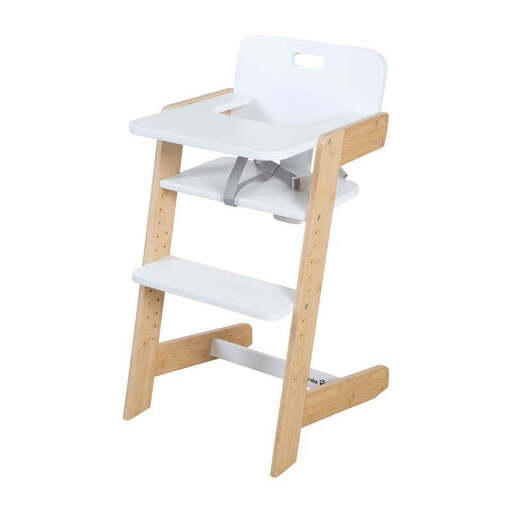
Why it's a good fit: The combination of solid bamboo and lacquered MDF elements creates a modern aesthetic that blends seamlessly into stylish eat-in kitchens. The use of bamboo appeals to eco-conscious buyers.
It bypasses the limited-use pitfall with a high weight capacity of up to 70 kg and avoids the cleaning-difficulty pitfall with its smooth, wipeable surfaces.
Complies with safety standard EN 14988:2017+A1:2020. The removable tray offers flexibility for use at the family table or as a standalone chair.
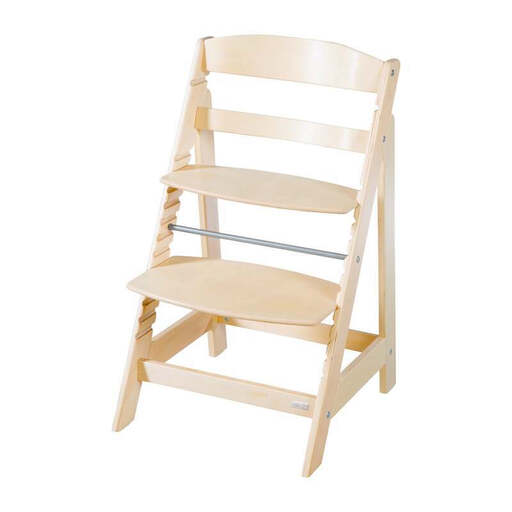
Why it's a good fit: As a classic convertible wooden high chair, this model is the epitome of adaptability. It can be adjusted to any table height, allowing the child to participate directly in family meals. A matching high chair tray is available as an optional accessory.
Its design, with a height-adjustable seat and footrest, is the proven solution to the limited "grow-with-me" functionality. Adjustments can be made precisely to the child's height.
Maximum flexibility thanks to separately adjustable boards and a removable safety bar. The high weight capacity (up to 50 or 70 kg, depending on the model) ensures a long service life.

Why it's a good fit: This folding high chair is the perfect solution for smaller apartments, kitchens, or for use at the grandparents' house. When not in use, it can be folded flat and stored away in just a few simple steps.
Despite its folding mechanism, it avoids the stability pitfall. According to the manufacturer, the chair offers excellent stability and tip-over resistance, complying with standard EN 14988-1:2006+A1:2012.
It arrives pre-assembled and is ready to use out of the box. The combination of functionality (folding) and safety (3-point harness, stability) is the key selling point here.
We have compiled a complete, up-to-date list of products that fully meet these strict selection criteria and German safety regulations.
A high chair from 6 months is generally suitable once your child can sit independently with minimal support. This is a crucial milestone, as their back muscles must be strong enough. Most convertible models are equipped with a safety bar and harness system for this stage to ensure a secure fit.
That depends on how you plan to use it. A high chair with a tray offers the advantage of being a freestanding unit, giving your child their own space for eating and playing. A model without a tray can be pushed directly up to the family table, which encourages the child's integration into shared meals. Many systems, like the roba high chair from the "Sit Up Flex" series, offer a high chair tray as an optional accessory, allowing for maximum flexibility.
Look for a wide, stable base and a solid overall construction, preferably made of solid wood or robust bamboo. A key feature is long floor gliders that prevent the chair from tipping backwards when the child pushes off the table. However, the most reliable criterion is certification according to the EN 14988 safety standard, as this includes testing for tip-over resistance under standardised conditions.