
Lieferung heute & morgen

Qualitätsgarantie

Willkommens-Angebote freischalten: KOSTENLOSE Lieferung | Bis zu 80 % RABATT | Kostenlose 30-Tage-JoyPlus-Testphase
App herunterladen
A convertible tricycle promises to be a faithful companion for several years, from the first parent-pushed outings to a child's first independent riding attempts. However, the market is saturated with models whose promises don't always hold up in practice. Before you make a decision, it's crucial to understand the common pitfalls that can quickly turn a promising purchase into a source of frustration.
Many parents invest in a multifunctional vehicle only to find it sitting unused in a corner after just a few months. The reasons are often the same:
A well-considered choice based on objective criteria will protect you from such disappointments.
To find a suitable and long-lasting model, don't be swayed by marketing buzzwords; instead, focus on concrete technical specifications. These three parameters are decisive for the quality and utility of a convertible tricycle.
The foundation of any good children's vehicle is a solid frame. Models with a frame made of steel or carbon steel offer significantly higher stability and load capacity than all-plastic versions. This is especially important when using a tricycle with a push bar. The forces generated during pushing and steering are safely absorbed without the structure giving way. A sturdy frame is the fundamental prerequisite for the tricycle to safely accompany your child for several years.
A convertible tricycle should be more than just a puzzle. Check how easily it can be switched between its different stages of use. Ideally, pedals can be removed, wheels adjusted, or the push bar attached and detached without needing a toolbox. Models designed as a balance bike and tricycle in one should allow for conversion in just a few minutes. Look for quick-release fasteners or plug-in systems that permit hassle-free adjustment as your child develops.
For a tricycle for children aged 1 and up, safety features are non-negotiable. A harness system (at least a 2-point harness) is essential to keep the child securely in the seat during the initial phase. The push bar should not only be height-adjustable to ensure a comfortable posture for parents but should ideally also have a steering function. Another important detail is a steering limiter. It prevents the child from turning the handlebar too sharply, which could lead to abrupt stops or falls.
Based on these objective criteria, we have compiled a selection of models for various needs and requirement profiles.
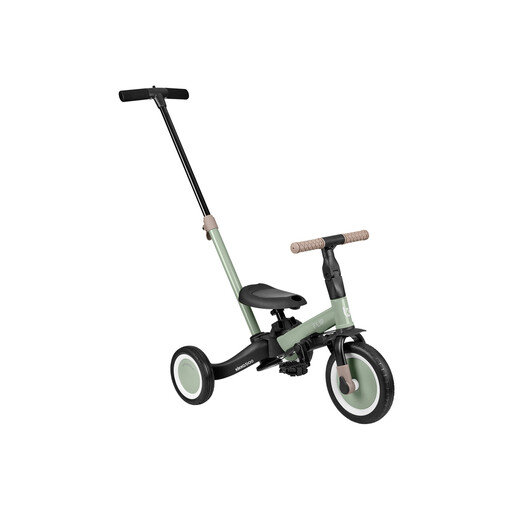
Why It's a Match: Ideal for parents looking for a single purchase to cover the entire developmental span from 1 to 5 years. It covers all phases, from a parent-pushed trike to an independent bicycle.
The carbon steel frame counters the stability problem. The clearly defined 5-in-1 functions offer true modularity and avoid the "false promise" pitfall.
True 5-in-1 functionality (push mode, tricycle, tricycle without pedals, balance bike, bicycle mode). The Kikka Boo tricycle is designed for a long service life.
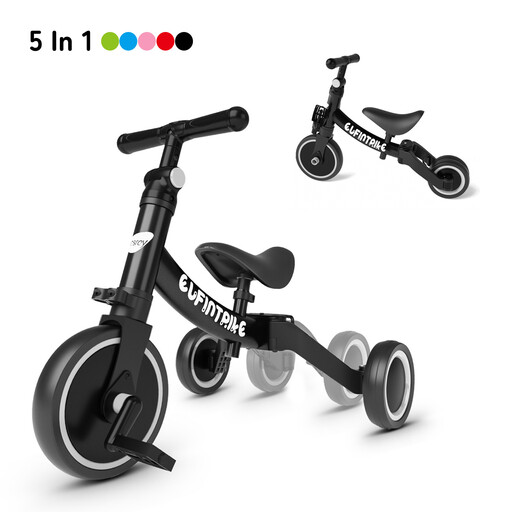
Why It's a Match: Perfect for parents whose primary focus is on safety and control during the first few years. The emphasis is on its function as a walking aid and a securely guided tricycle.
This model addresses the safety pitfall with a sturdy push bar for parental control and a design focused on stability for the youngest riders.
Focus on the early developmental phase as a safe walking aid and tricycle with parental control. Ease of use is a top priority.
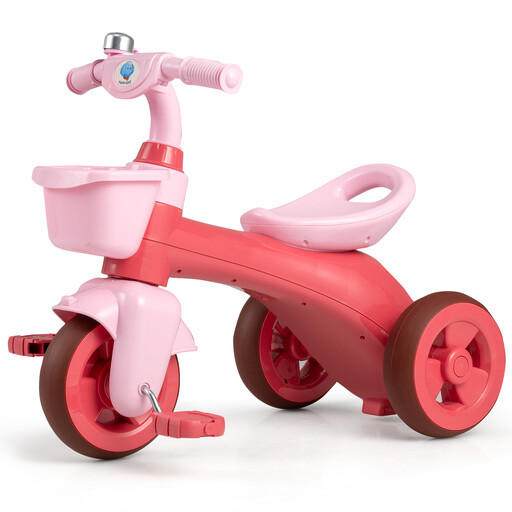
Why It's a Match: A great choice for anyone who wants a simple, durable, and classic first tricycle experience without the complexity of multiple conversions.
It bypasses the pitfall of complicated conversions by being a dedicated, high-quality tricycle. The integrated steering limiter directly addresses a key safety concern.
Classic, robust design with useful safety features and practical accessories like a basket and bell for an authentic riding experience.
We have compiled a complete, up-to-date list of products that meet these strict selection criteria and applicable safety requirements.
Most models are designed for use from around 12 to 18 months. The crucial first stage involves the push bar and safety harness, where the child can sit securely before they can pedal on their own. The "convertible" aspect becomes particularly valuable when the child develops motor skills around the age of 2 to 3 and can use the other modes, such as a balance bike or an independent tricycle.
This varies significantly between models. Look for features like quick-release mechanisms or tool-free adjustments. Models like the Kikka Boo tricycle are designed for a relatively simple conversion. However, it is always advisable to check the manufacturer's instructions. The goal should be for the conversion to be completed in a few minutes without frustration.
The wheel material is the deciding factor here. Rubber wheels or PU (polyurethane) wheels offer a good balance. They are quiet and won't leave marks on floors, making them suitable for indoor use. At the same time, they are robust enough for rides on asphalt and smooth paths outdoors. Hard plastic wheels can be louder and offer less grip.