
Lieferung heute & morgen

Qualitätsgarantie

Willkommens-Angebote freischalten: KOSTENLOSE Lieferung | Bis zu 80 % RABATT | Kostenlose 30-Tage-JoyPlus-Testphase
App herunterladen
A convertible tricycle promises to be a faithful companion for several years—from a child's first birthday to their preschool years. The idea of buying a single product that adapts to a child's growing skills is attractive to many families. However, the market is flooded with models whose promises often don't hold up in practice. Before you make a decision, it's crucial to understand the typical weaknesses that can quickly turn a smart investment into a regrettable purchase.
As your Joybuy Product Recommendation Officer, I'll help you separate the essential features from the empty marketing claims.
Many products look convincing at first glance but reveal their flaws only in daily use. Pay special attention to these three points:
To avoid these pitfalls, you should focus your attention on a few crucial technical features. These determine the tricycle's durability, safety, and true value.
A true balance bike and tricycle combo isn't defined by the number of modes, but by how easily you can switch between them. Check if the conversion is tool-free or can be done in a few simple steps. A good system allows you to remove pedals, adjust wheels, or attach the push handle with snap-in or click mechanisms. Only then does the tricycle truly become a flexible companion for your child from 1-5 years old.
The stability of a toddler tricycle depends heavily on its frame. Models made of steel or high-quality aluminium offer significantly more strength and durability than all-plastic frames. For the wheels, versions made of PU (polyurethane) or rubber are the better choice. They are quieter, more durable, and absorb shocks, which greatly improves ride comfort.
For children aged 1 and up, safety features are non-negotiable. A harness system (at least a 2-point harness) is essential in the initial phase when the child is being pushed. The push handle should not only be sturdy but also ideally height-adjustable to ensure an ergonomic posture for the person pushing. A wide wheelbase also provides high stability against tipping.
Instead of presenting an overwhelming list, we have selected products for specific user profiles.
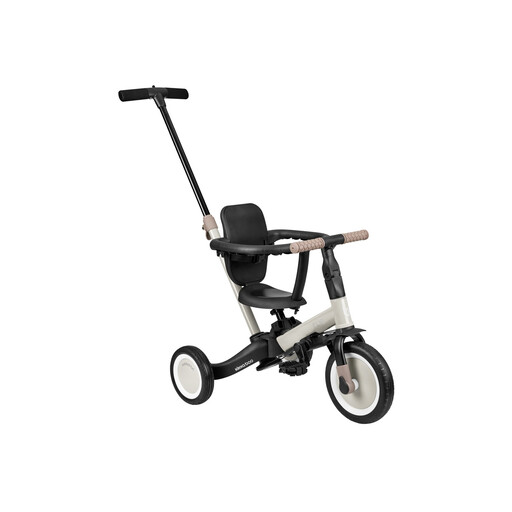
Why it's a good fit: Ideal for families looking for a single, durable solution to accompany their child from the push-along mode at 1 year old to independent riding at 5. It covers all developmental stages.
The robust carbon steel frame counteracts the problem of instability. The rubber front tyre and PU rear wheels prevent the noise and wear associated with hard plastic wheels.
The genuine 5-in-1 functionality (stroller, tricycle, pedal-less trike, balance bike, bicycle) maximises its lifespan and offers excellent value for the investment.
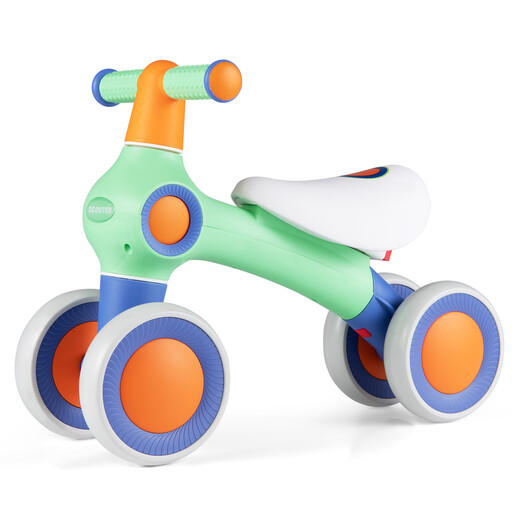
Why it's a good fit: Perfect for parents who want to specifically encourage a sense of balance from an early age. It's a straightforward, focused tool for motor skill development.
This balance bike completely sidesteps the "complicated conversion" pitfall, as it's designed for a single purpose. Its strength lies in its simplicity and light weight.
The four wheels provide high stability for a child's first attempts. The quiet wheels and adjustable seat make it a practical indoor companion that grows with your child.
A convertible tricycle is an excellent choice, but there are many other toys that promote your child's motor development. Discover our full range.
A convertible tricycle can be used in push mode with a harness system from as early as 12 months. In this phase, the child sits securely and is pushed by the parents. Most children don't learn to pedal independently until they are between two and three years old. The long period of use justifies an early purchase.
This varies from model to model. High-quality products increasingly rely on tool-free click-and-lock systems that significantly simplify conversion. It's advisable to check the product description carefully before buying to ensure the conversion process is practical for your daily life.
Yes, in most cases, they are. Rubber or PU wheels offer better grip on various surfaces, higher resistance to wear, and, most importantly, significantly better shock absorption. This results in a quieter and more comfortable ride for the child, especially on uneven paths.