What should you look for when buying?
Electric blade chopper
A good choice if: You want to chop cooked meat for fillings or sauces and check the texture as you go.
Things to consider: Chopping for too long can leave the meat too fine for a chunky dish. Rommelsbacher limits continuous operation of the MZ 500 to a maximum of 20 seconds.
Food processor with a universal blade
A good choice if: You regularly want to slice or grate vegetables as well as chop, and will use the additional attachments.
Things to consider: Extra attachments mean more accessories to store and clean. The Bosch MCM3501M comes with a universal blade and slicing and grating discs; this doesn’t confirm that it can process a particular quantity of meat.
Stand mixer with a suitable beater
A good choice if: You’d rather shred tender, cooked chicken into strands than chop it into small pieces, and you own a suitable stand mixer.
Things to consider: KitchenAid describes using cooked, skinless, boneless chicken with a flat beater or pastry beater on a low speed. This isn’t a general recommendation for other appliances or types of meat.
Before you buy, first consider the texture you want, then check the batch size and how easy the appliance is to clean. For food that will be served later, the German Federal Institute for Risk Assessment recommends rapidly cooling hot food to below 7 °C for longer-term storage.
| Priority |
What to check before buying |
Who it matters most to |
| Desired texture |
Suitable blade or beater; instructions for the intended use |
If I need fine pieces for fillings or strands of meat for another dish, I want to be able to choose the result. Around 27% of consumers say texture is their top priority. |
| Hygiene when serving portions later |
Removable parts that can be cleaned as described in the instructions; suitable containers for chilling |
If I serve meat at different times, I need easy-to-clean parts and a clear routine for storing it. Around 33% of consumers say hygiene and eating later are their main concerns. |
| Portion and batch size |
Manufacturer guidance on quantities and running time; don’t assume bowl capacity equals the amount of meat you can process |
If I’m preparing several portions, I want to work out how many batches I’ll need. Around 27% of consumers say getting the right batch size is their top priority. |
| Additional functions |
What’s included with the exact model; the tasks you actually need it to do |
If I also want to slice or grate regularly, the extra attachments need to serve a purpose. Around 13% of consumers say versatility is their main priority. |
Joybuy products
This selection includes electric choppers and meat-processing appliances. Before buying, check the instructions for the specific model to see whether it’s intended for cooked meat and what quantities it can handle.
 No image available
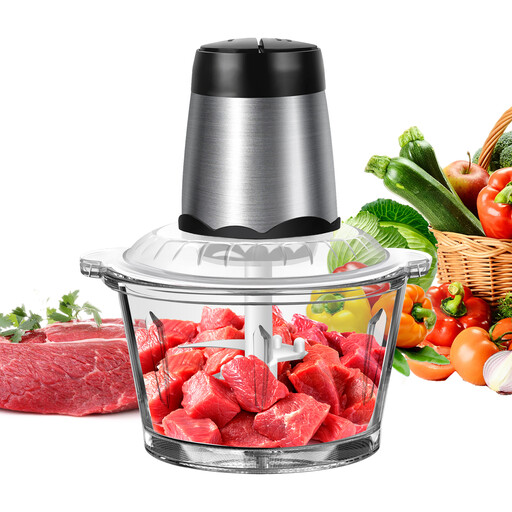
Electric meat chopper with 2-litre glass bowl
For anyone who wants to chop meat in portions; check the instructions to confirm it’s suitable for cooked meat and to find out the permitted batch size.
2-litre glass bowl; stainless steel blades.
View at Joybuy
 No image available
IAGREEA MS-25JM08 350W Food Chopper
For anyone who wants to process several ingredients; before using it with cooked meat, check the instructions and permitted quantities.
Three stackable stainless steel bowls measuring 2.5 l, 2.2 l and 1.8 l; two speeds.
View at Joybuy
 No image available
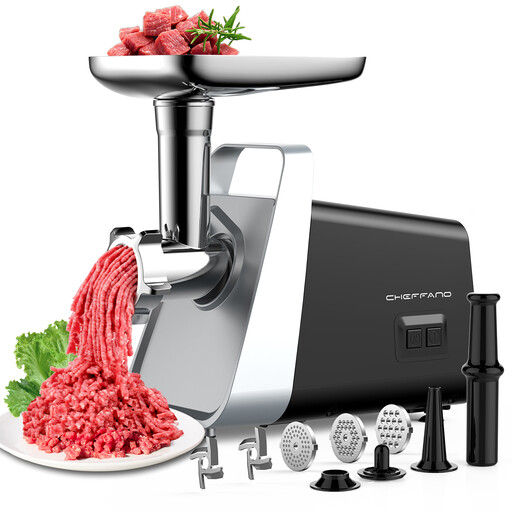
CHEFFANO MG097 Electric Meat Grinder
For anyone who wants to process meat using a meat grinder; check whether the instructions say it’s suitable for cooked meat too.
Two blades and three grinding plates; sausage-stuffing accessories and a kubbe kit.
View at Joybuy
 No image available
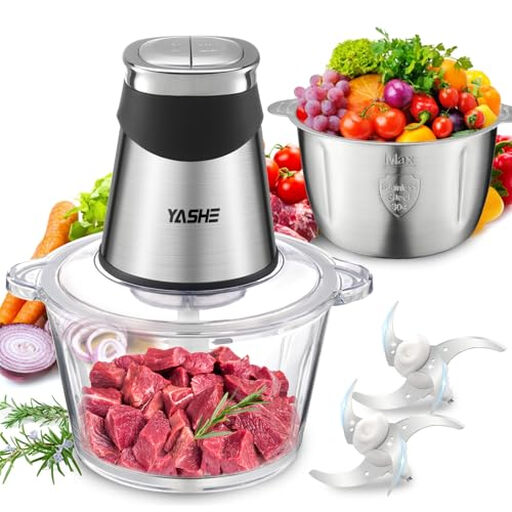
YASHE BM-217A Electric Meat Chopper
For anyone who wants to process meat and other ingredients separately; check the instructions for use with cooked meat and the appropriate quantity.
1.8 l and 2 l glass and stainless steel bowls; 500 W, two speeds and two blades.
View at Joybuy
Frequently asked questions
Can I use a food processor to prepare cooked meat for fillings?
A food processor with a suitable universal blade may be an option, particularly if you’ll use its other functions too. Check that the specific model is suitable for cooked meat and review its quantity guidance; bowl capacity alone doesn’t confirm how much meat it can process in one go.
How can I get strands of meat rather than chopped pieces?
For a suitable stand mixer, KitchenAid describes using cooked, skinless, boneless chicken with a flat beater or pastry beater on a low speed. This manufacturer-specific method isn’t an instruction for every appliance.
How should I store portions that will be eaten later?
The German Federal Institute for Risk Assessment recommends rapidly cooling hot food to below 7 °C for longer-term storage, and keeping perishable food in the fridge at 2 °C to a maximum of 7 °C. For reheating, it specifies at least 70 °C for two minutes throughout; if food is to be kept hot ready to serve, it should be at least 60 °C throughout. These are food hygiene recommendations, not appliance features.
What should I bear in mind when cleaning after handling meat?
The German Federal Institute for Risk Assessment recommends using separate utensils for raw and cooked food. Which appliance parts are dishwasher-safe depends on the specific model and its instructions.
Does a large bowl mean I can process more meat at once?
No. Bowl capacity doesn’t automatically tell you the permitted or suitable amount of meat to process in one go. Check the quantity and running-time guidance in the instructions for the specific model.


