
Lieferung heute & morgen

Qualitätsgarantie

Willkommens-Angebote freischalten: KOSTENLOSE Lieferung | Bis zu 80 % RABATT | Kostenlose 30-Tage-JoyPlus-Testphase
App herunterladen
Choosing the right cooker hood is crucial for a pleasant kitchen environment. Cooking vapours, grease particles, and odours can quickly spread throughout your home. A suitable hood not only ensures clean air but can also be a central design feature of your kitchen. However, with the vast array of designs, technical specifications, and features available, making a choice can be complex.
This guide is here to help. It explains the most important criteria to consider when making your selection and presents a range of models for different needs. Our goal is to provide you with an informed basis for your decision, so you can find a cooker hood that perfectly suits your kitchen and cooking habits.
Before you decide on a model, three fundamental aspects should be considered: the operating mode, the design, and the technical performance data.
The operating mode is one of the most fundamental decisions.
The design determines how the hood integrates into your kitchen's aesthetic.
The width of the hood should be at least the same as the width of your hob. Standard sizes are 60 cm and 90 cm.
Two key metrics are crucial here:
Here is a selection of models that cover different requirements for design, size, and function.
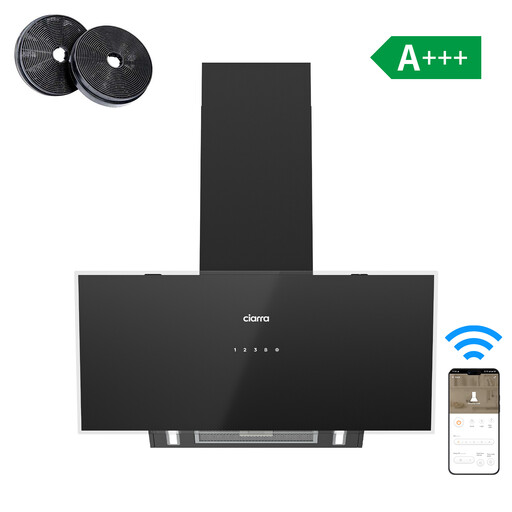
Why it stands out: This 90cm wide angled hood combines an elegant black glass design with high functionality. According to the manufacturer, its "Dual Intake" system allows for more efficient capture of cooking vapours from multiple directions. With an energy efficiency class of A+++ and a maximum airflow rate of 650 m?/h, it is designed for medium to large kitchens. It can be operated via a modern sensor touch control panel or conveniently through a Wi-Fi app.
Advantages:
Who is it for? Ideal for users looking for a powerful and energy-efficient 90cm angled hood for a modern, open-plan kitchen, who also value smart control options.
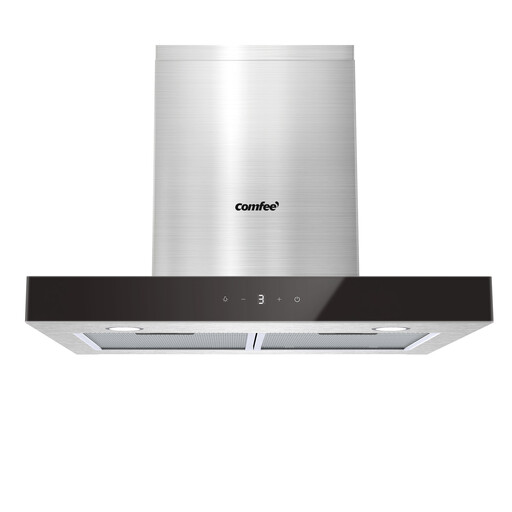
Why it stands out: This T-shaped stainless steel model offers an innovative control method with gesture control—a simple wave of the hand is all it takes to adjust the fan speed. According to the manufacturer, the brushless DC (BLDC) motor provides a powerful extraction rate of 650 m?/h while maintaining high energy efficiency (A+++). The five-layer aluminium grease filter is dishwasher-safe, making cleaning easy.
Advantages:
Who is it for? A great choice for tech-savvy users seeking a 60cm wide stainless steel wall-mounted hood with high performance and innovative features for their kitchen.
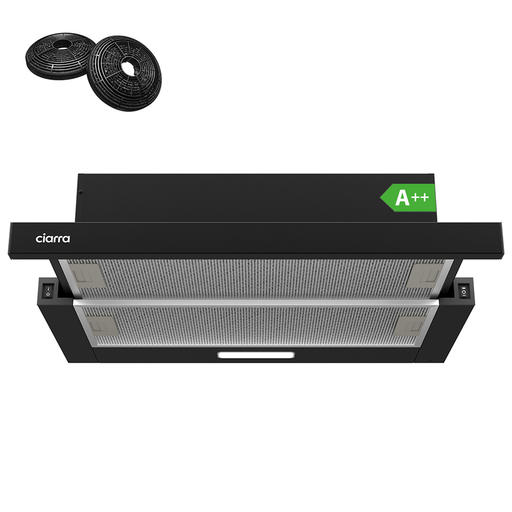
Why it stands out: This canopy hood in black is an extremely space-saving solution. Thanks to its telescopic design, it can be simply pushed in when not in use, fitting discreetly under a wall unit. A practical memory function saves the last used fan speed and light setting. With an airflow rate of up to 370 m?/h and an energy efficiency class of A++, it is designed for small to medium-sized kitchens.
Advantages:
Who is it for? Perfect for anyone needing a discreet and functional telescopic under-cabinet hood for a compact kitchen or apartment, without compromising on efficiency.
Haven't found the right model for your needs yet, or are you specifically looking for appliances with a particular control type? Many modern cooker hoods feature intuitive fingertip control.
Discover our wide selection of Touch Control Cooker Hoods for more models and designs.
1. What m?/h rating should a cooker hood have? The required airflow rate depends on the size of your kitchen. As a rule of thumb: multiply your kitchen's volume (length × width × height) by a factor of 10. The result is a good guideline for the required performance in cubic metres per hour (m?/h) for extraction mode. For open-plan kitchens, a higher value should be considered.
2. What is the difference between extraction and recirculation on a cooker hood? An extraction hood vents cooking vapours and moisture completely outside. This requires an opening in an external wall. A recirculation hood filters the air through a grease and an activated carbon filter, then returns the cleaned air to the room. Recirculation is easier to install but does not remove moisture from the air.
3. How often do you need to change a cooker hood filter? The metal grease filter should be cleaned every 2 to 4 weeks, depending on your cooking intensity. Most grease filters are dishwasher-safe. For a recirculation hood, the activated carbon filter must also be replaced every 3 to 6 months, as its capacity to absorb odour molecules is limited.